Question 3
FNatural gas is mainly methane. Methane burns in a Bunsen burner. This reaction is exothermic.
a.[3]
Complete the sentences about the reaction profile for burning methane.
Use words from the list: activation, bond, given out to, less, more, taken in from
In the reaction profile, the products have ...... energy than the reactants. The energy needed to start the reaction is called the ...... energy. The difference in energy between the reactants and the products is the energy ...... the surroundings.
b.[2]
Methane does not start to burn until a lit match or a spark is used.
Explain why.
c.[2]
Which two statements describe the reaction profile for an endothermic reaction?
Statement 1: The products are at a higher energy than the reactants.
Statement 2: The products are at a lower energy than the reactants.
Statement 3: The activation energy is shown from the reactants up to the highest point of the curve.
Statement 4: The activation energy is shown from the products up to the highest point of the curve.
Statement 5: The overall energy change is shown by an arrow pointing down from the reactants to the products.
Write the numbers of the two correct statements.
d.i.[1]
The diagram shows the reaction profile for a different reaction.
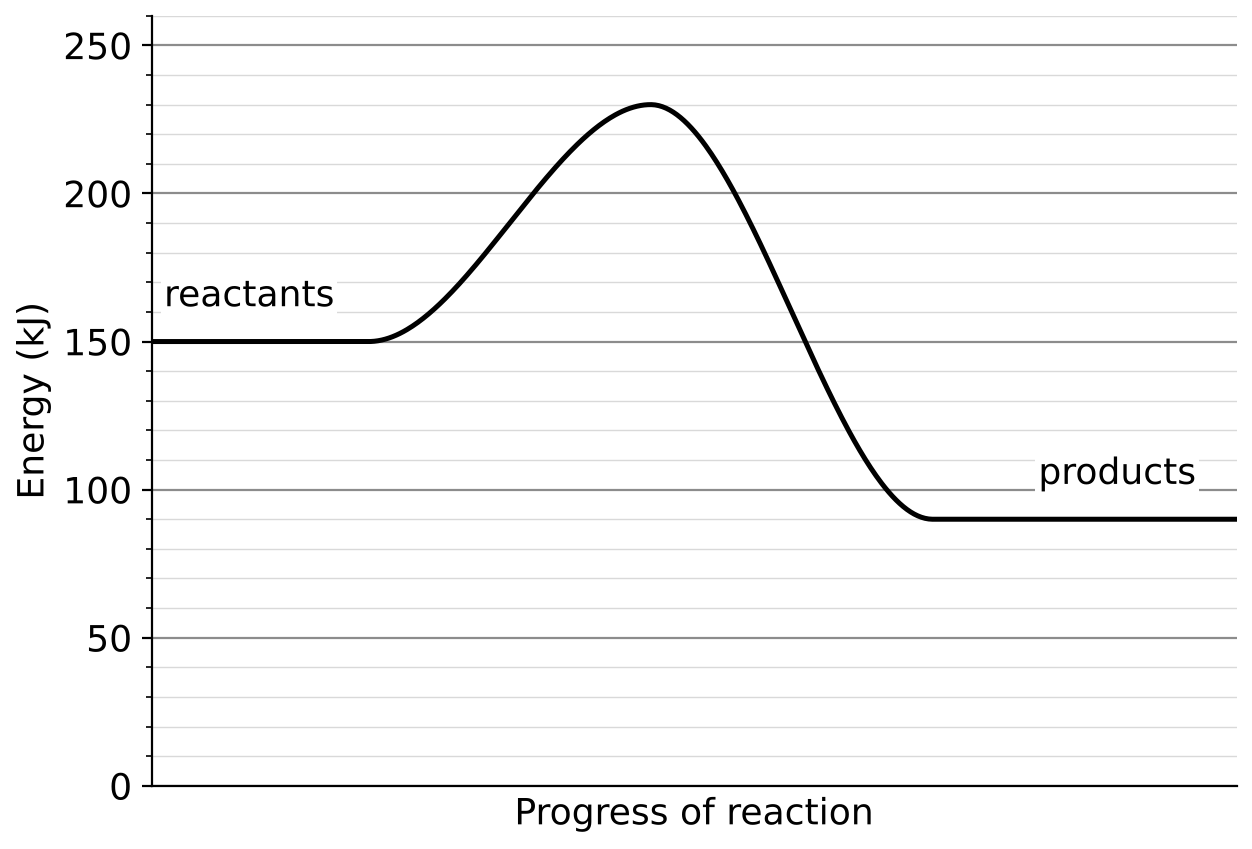
Use the diagram to calculate the activation energy for this reaction.
Activation energy = ...... kJ
d.ii.[2]
Is this reaction exothermic or endothermic?
Give a reason for your answer.
3.2 Energetics Questions
51 exam-style questions on OCR GCSE Chemistry 3.2 Energetics, covering 3.2.1 Exothermic and endothermic reactions and reaction profiles and 3.2.2 Calculating energy change from bond energies. Each one has a worked solution and a mark scheme showing where the marks go.