The properties of a polymer decide its uses
- A polymer is chosen for a job because of what it does, not what it is made from.
- Flexibility, strength, rigidity and resistance to chemicals all matter.
- Whether it is a good electrical insulator decides some uses on its own.
- Behaviour when heated matters wherever the object gets warm.
- Explaining a use means naming the property and the demand it meets.
Key Idea
The reasoning runs both ways: a property explains a use, and a use implies the property needed.
Poly(ethene) and poly(propene)
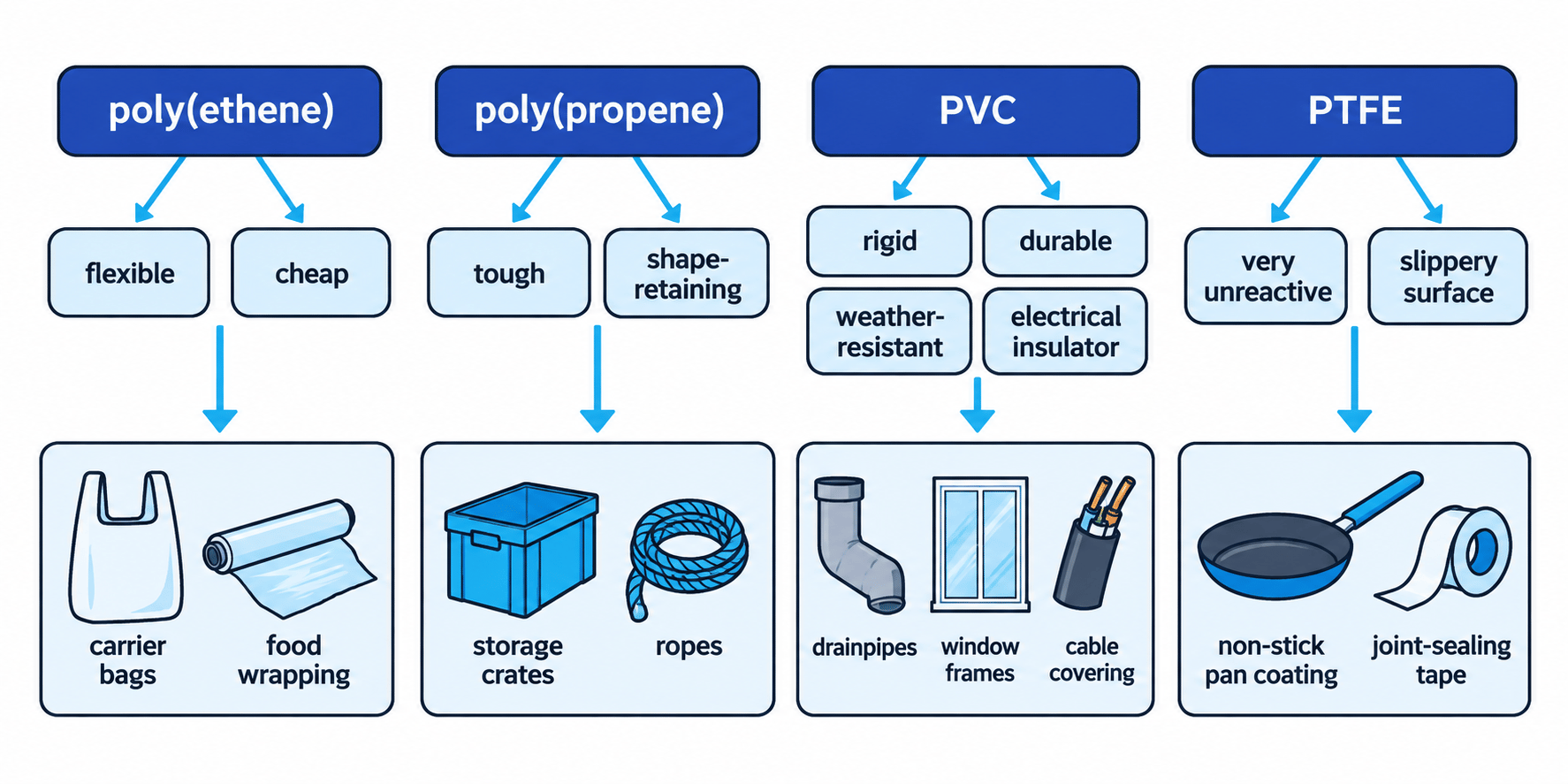
- Poly(ethene) is flexible, cheap and easily moulded.
- It is used for plastic bags, bottles and food wrapping.
- Poly(propene) is tougher and keeps its shape better.
- It is used for crates, ropes and containers that must take a knock.
- Both are unreactive, so neither contaminates the food it holds.
Example
- Carrier bag: poly(ethene), because it is flexible and cheap.
- Storage crate: poly(propene), because it is rigid and hard-wearing.
PVC and PTFE
- PVC is rigid and durable, and it resists weather well.
- It is used for drainpipes and window frames.
- PVC is also a good electrical insulator, so it covers electrical cable.
- PTFE is very unreactive and has a very slippery surface.
- It is used as a non-stick coating on pans and as a tape for sealing joints.
Note
PVC can be made flexible by adding other substances to it, which is why cable covering bends.
Matching a polymer to a new job
- Start from the demands the job makes on the material.
- A job needing flexibility and low cost points to poly(ethene).
- A job needing rigidity outdoors points to PVC.
- A job needing a surface nothing sticks to points to PTFE.
- A sound answer names the polymer and the property that makes it suitable.
Self review
- Give a use of poly(ethene) and the property that suits it.
- Why is poly(propene) used for crates rather than poly(ethene)?
- Give two uses of PVC and the property behind each.
- What property makes PTFE suitable as a non-stick coating?
- Which polymer would you choose for a window frame, and why?