A condensation polymer releases a small molecule
Definition
Condensation polymer
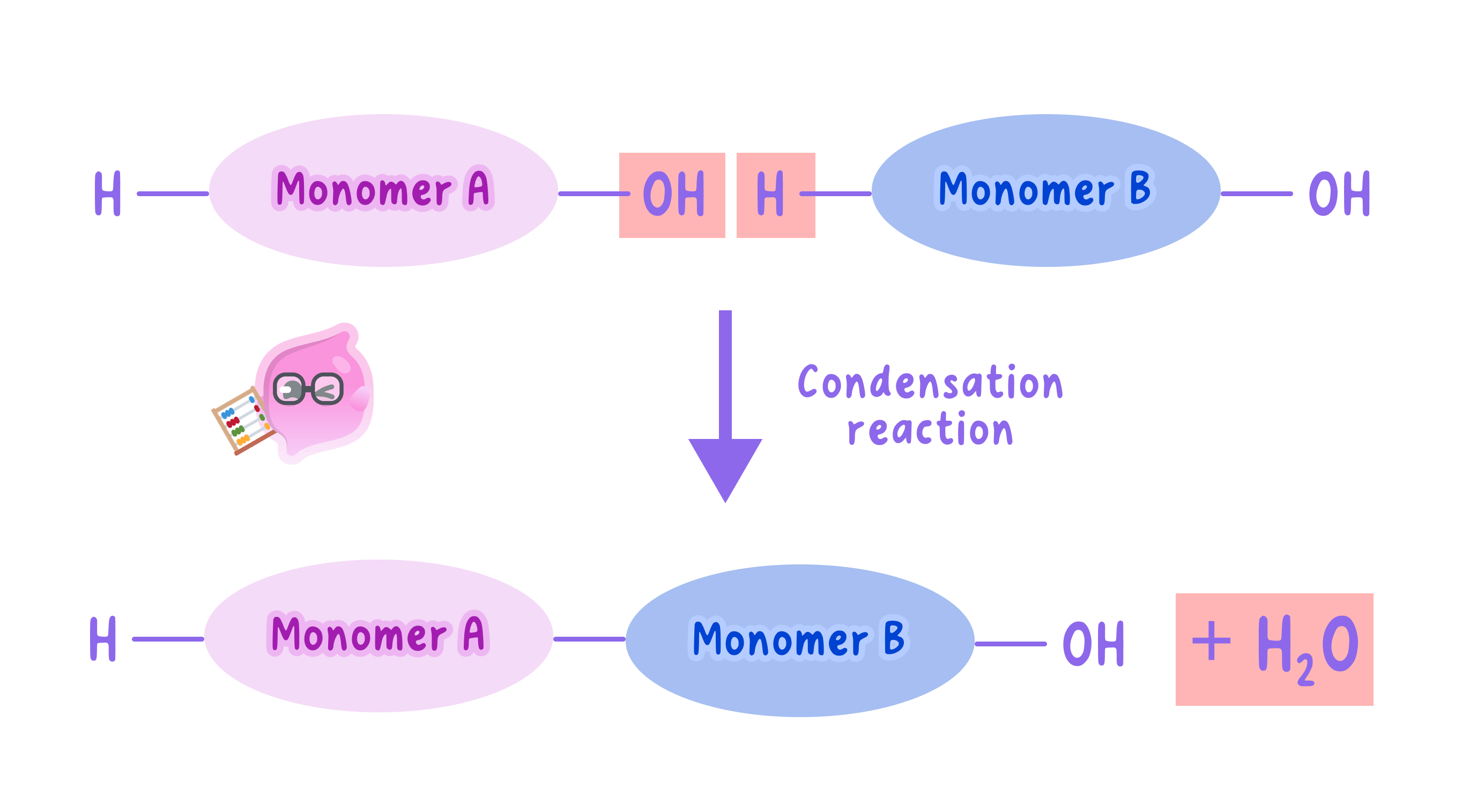
A polymer formed when monomers join and a small molecule, usually water, is released each time a link forms.
- The monomers join together to form a long chain, as in any polymerisation.
- Each time two monomers join, a small molecule is released.
- That small molecule is usually water.
- This is what distinguishes condensation from addition polymerisation.
- An addition polymerisation releases nothing, so all the atoms end up in the polymer.
Key Idea
One product or two: addition gives only the polymer, condensation gives the polymer and water.
Each monomer needs two functional groups
Definition
Functional group
The group of atoms in a molecule that gives a homologous series its characteristic reactions.
- A monomer must be able to join at both ends to build a chain.
- It therefore carries a functional group at each end.
- One monomer has two carboxylic acid groups, −COOH-\text{COOH}−COOH.
- The other has two alcohol groups, −OH-\text{OH}−OH.
- A monomer with only one group would stop the chain after one join.
Note
Two groups per monomer is what makes a chain possible rather than a single pair.
An ester link forms and water is lost
Definition
Ester link
The group of atoms joining two monomers in a polyester, formed when a carboxylic acid group reacts with an alcohol group.
- A carboxylic acid group on one monomer meets an alcohol group on the other.
- The two react and join the monomers together.
- The join formed is called an ester link.
- A molecule of water is released each time a link forms: −COOH+HO−→−COO−+H2O-\text{COOH} + \text{HO}- \rightarrow -\text{COO}- + \text{H}_2\text{O}−COOH+HO−→−COO−+H2O
- The water comes from the −OH-\text{OH}−OH of the acid and a hydrogen from the alcohol.
Example
- One link: one molecule of water released.
- A hundred links: a hundred molecules of water released.
The polymer formed is a polyester
Definition
Polyester
A condensation polymer whose monomers are joined by ester links.
- A chain held together by ester links is a polyester.
- The two monomers alternate along the chain, acid then alcohol.
- Each monomer's second group is free to react with the next monomer along.
- The chain grows as long as monomers remain to be added.
- Polyesters are used as fibres for clothing and as plastic bottles.
Exam technique
- An explanation names the two groups, the link formed, and the water released.
- Saying that water is lost each time a link forms is what shows the process is condensation.
- A monomer is drawn with its group at both ends, or the chain cannot grow.
Self review
- What makes a polymerisation a condensation rather than an addition?
- Why must each monomer carry two functional groups?
- Which two functional groups react to form a polyester?
- What is the name of the link formed?
- How many molecules of water are released when fifty links form?
