A polymer is built from many small repeating units
Definition
Polymer
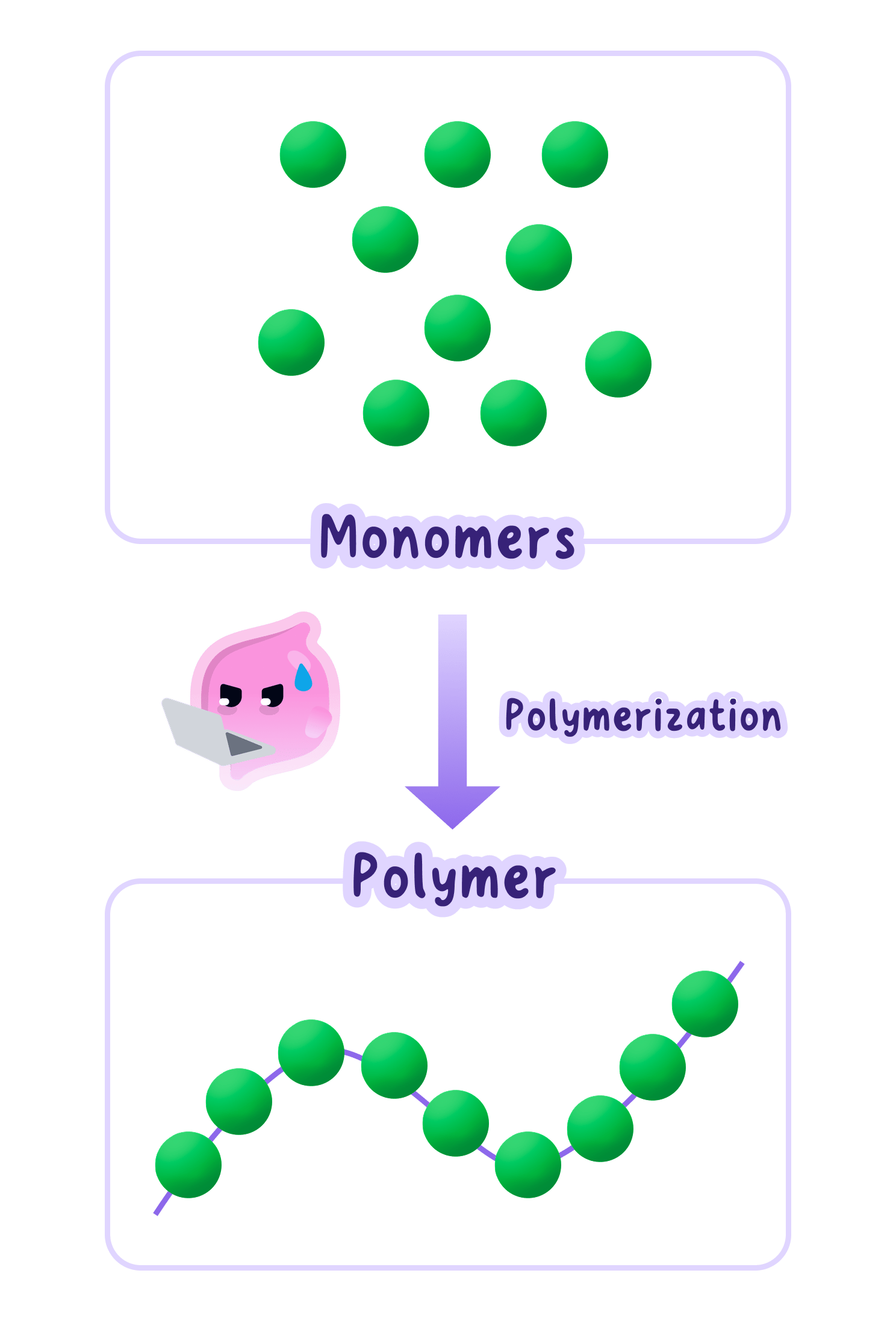
A very large molecule formed when many small molecules join together in a repeating pattern.
Definition
Monomer
A small molecule that joins to others of its kind to form a polymer.
Definition
Repeating unit
The small group of atoms that repeats along the chain of a polymer.
- A polymer has a very high average relative molecular mass.
- It is built from many small units joined into a long chain.
- The small molecules that join together are the monomers.
- The section that repeats along the chain is the repeating unit.
- The chains in a sample are not all the same length, which is why the mass is an average.
Key Idea
Monomer and repeating unit contain the same atoms, differing only in the bonds at each end.
Ethene molecules join to form poly(ethene)
Definition
Addition polymer
A polymer formed when many monomers containing a carbon to carbon double bond join together, with no other product formed.
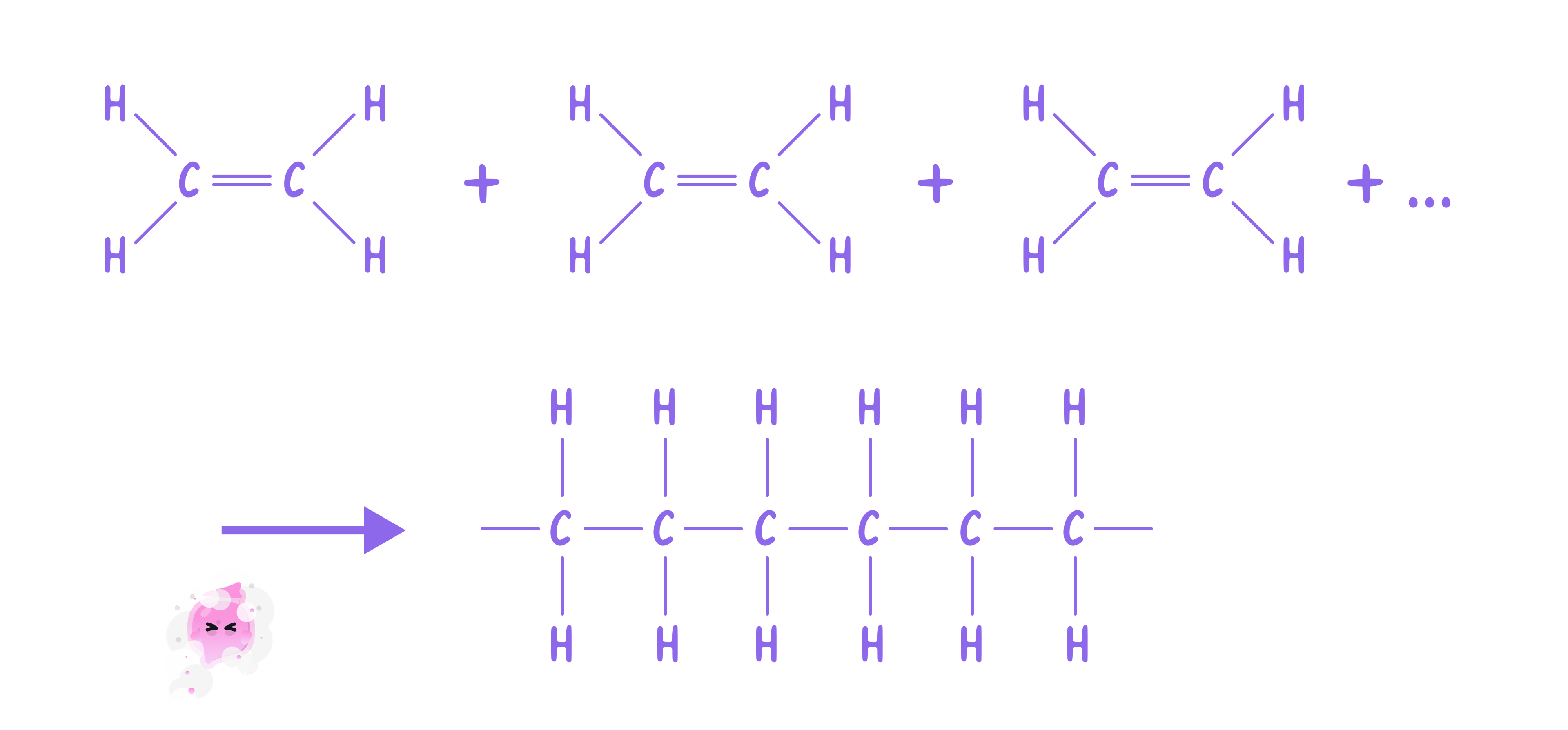
- Many ethene molecules are brought together under pressure.
- The double bond in each molecule opens.
- The opened molecules join to one another end to end, forming a long chain.
- The polymer formed is poly(ethene).
- Nothing else is produced, which is what makes this an addition polymerisation.
Note
The conditions and the mechanism of the reaction are not part of this course.
Other monomers give other addition polymers
- Any monomer containing a carbon to carbon double bond can polymerise this way.
- Propene gives poly(propene).
- Chloroethene gives poly(chloroethene), known as PVC.
- Tetrafluoroethene gives poly(tetrafluoroethene), known as PTFE.
- The polymer is named by putting the monomer's name in brackets after poly.
Example
- Ethene to poly(ethene). Propene to poly(propene).
- Chloroethene to PVC. Tetrafluoroethene to PTFE.
Deducing a monomer from a polymer
- Take one repeating unit from the chain shown.
- Remove the bonds that extend out of each end of that unit.
- Join the two end carbons with a double bond instead.
- The molecule that results is the monomer.
- Working the other way, open the monomer's double bond and draw bonds extending from each end.
Exam technique
- A repeating unit is drawn with a bond extending from each end, showing the chain continues.
- The monomer has a double bond where the repeating unit has a single one.
- Counting the atoms is a check: monomer and repeating unit must match.
Self review
- What is a monomer?
- Explain what happens to ethene molecules during polymerisation.
- Why is this called addition polymerisation?
- Name the polymers formed from propene and from chloroethene.
- How do you deduce the monomer from the structure of an addition polymer?
