Question 6
FThree identical clean iron discs are placed in the conditions shown. The strings do not react. Tube B is kept dry throughout the experiment. In C, the water is boiled to remove dissolved air and an oil layer is added immediately. All tubes are kept at the same temperature for the same time.
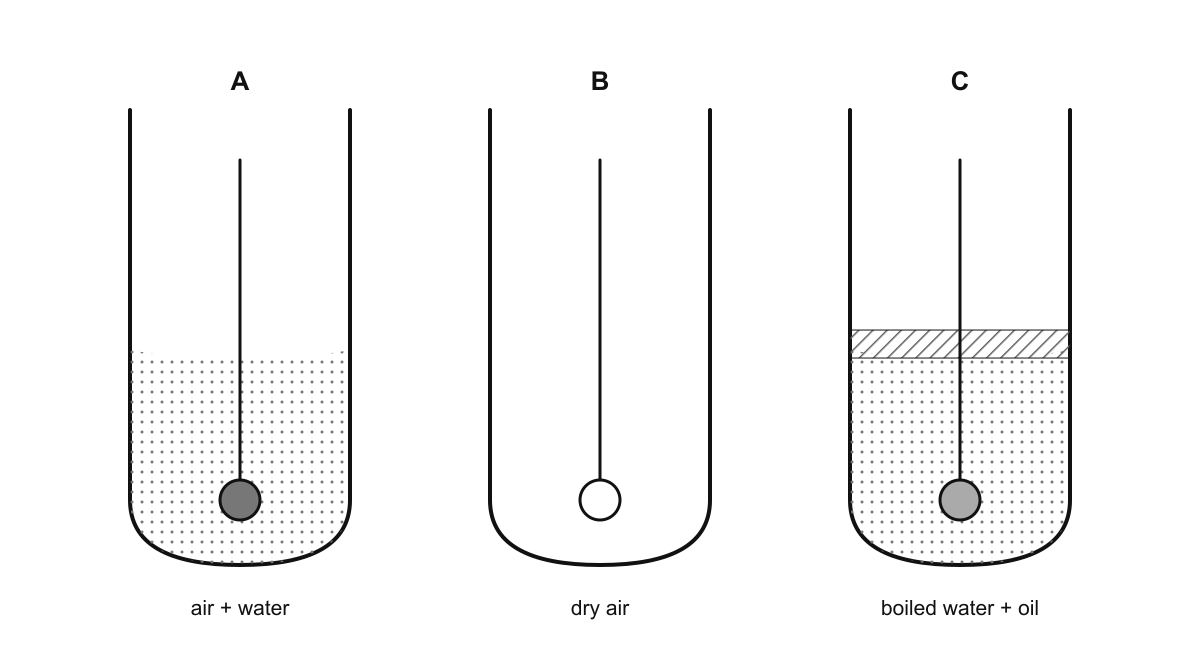
After five days, rust is observed on the disc in A but not on the discs in B or C.
a.[3]
A student says, "Tube A proves that water alone causes iron to rust." Explain why this conclusion is incorrect. Use the comparisons with both B and C.
b.[3]
Another student removes the oil layer from C and leaves the tube open. Predict how the result could change after several more days and explain the change.
c.[4]
Two new iron discs are coated, one with paint and one with zinc. A scratch through each coating exposes the iron. Both discs are then placed in conditions like A.
Explain why the scratched zinc-coated disc is likely to remain protected for longer than the scratched painted disc.
6.1 Transition metals, alloys and corrosion Questions
42 exam-style questions on Edexcel GCSE Chemistry 6.1 Transition metals, alloys and corrosion, covering 6.1.1 Properties of transition metals, 6.1.2 Corrosion and its prevention, and 6.1.3 Alloys and the uses of metals. Each one has a worked solution and a mark scheme showing where the marks go.