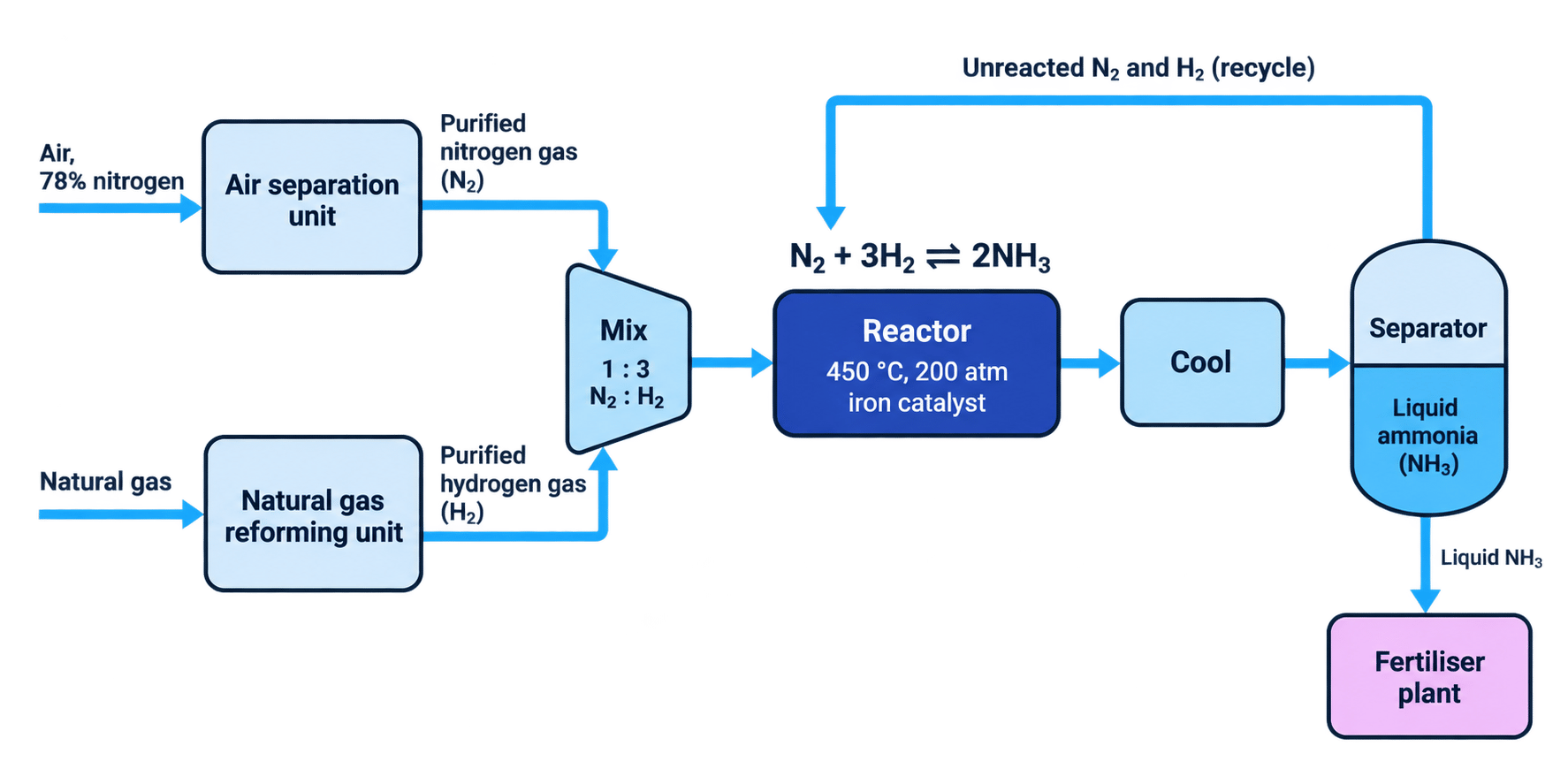
Ammonia is made from nitrogen and hydrogen
- The Haber process combines nitrogen and hydrogen to make ammonia.
- The equation for the reaction is: N2(g)+3H2(g)⇌2NH3(g)\text{N}_2(\text{g}) + 3\text{H}_2(\text{g}) \rightleftharpoons 2\text{NH}_3(\text{g})N2(g)+3H2(g)⇌2NH3(g)
- The ratio is one nitrogen to three hydrogen, and the gases are supplied in that proportion.
- The forward reaction is exothermic, so it releases energy as ammonia forms.
- Ammonia is the raw material for fertilisers, which is why the process is run on such a scale.
Key Idea
Every molecule of ammonia is built from atmospheric nitrogen, which plants cannot use directly.
Where the two raw materials come from
- Nitrogen is extracted from the air, which is about 78%78\%78% nitrogen by volume.
- The air is cooled until it liquefies and is then separated by fractional distillation.
- Hydrogen is obtained from natural gas, which is mainly methane.
- Both raw materials are purified before they enter the reactor, because impurities spoil the catalyst.
- The nitrogen is effectively unlimited, while the hydrogen depends on a supply of natural gas.
Note
Natural gas is a finite resource, so the hydrogen is the part of the process that cannot go on forever.
The reaction is reversible and reaches a dynamic equilibrium
Definition
Reversible reaction
A reaction in which the products can react together to re-form the reactants, shown by the symbol ⇌.
Definition
Dynamic equilibrium
The state of a reversible reaction in a closed system in which the forward and backward reactions happen at the same rate, so the amounts of reactants and products stay constant.
- Ammonia breaks back down into nitrogen and hydrogen under the same conditions that form it.
- The gases are held in the reactor long enough for the mixture to approach equilibrium.
- Where the forward and backward rates become equal, the mixture has reached a dynamic equilibrium.
- At that point the mixture holds ammonia together with unreacted nitrogen and hydrogen.
- The reaction can therefore never convert all of the nitrogen and hydrogen in a single pass.
Common Mistake
Gas flows through the reactor continuously, so the mixture approaches equilibrium rather than sitting at it as a sealed flask would.
The conditions used in the Haber process
Definition
Catalyst
A substance that speeds up a reaction without being used up in the reaction.
- The temperature used is 450 ∘C450\ ^{\circ}\text{C}450 ∘C.
- The pressure used is 200200200 atmospheres.
- An iron catalyst is used.
- The catalyst brings the mixture to equilibrium sooner without being used up.
- These three conditions are the ones recalled for this process.
Example
- Temperature: 450 ∘C450\ ^{\circ}\text{C}450 ∘C.
- Pressure: 200200200 atmospheres.
- Catalyst: iron.
The mixture is cooled and recycled
- The gases leaving the reactor are cooled until the ammonia condenses to a liquid.
- Nitrogen and hydrogen stay as gases at that temperature, so the ammonia separates out.
- Removing the ammonia means the liquid product is run off on its own.
- The unreacted nitrogen and hydrogen are pumped back into the reactor.
- Recycling means that very little of either raw material is wasted, even though each pass converts only some.
Self review
- Write the equation for the formation of ammonia from its elements.
- Where does the nitrogen used in the Haber process come from, and how is it obtained?
- Why does the reactor never convert all of the nitrogen and hydrogen?
- State the temperature, pressure and catalyst used.
- How is the ammonia separated from the unreacted gases?