The position of equilibrium describes what the mixture holds
Definition
Position of equilibrium
Whether a dynamic equilibrium holds more products or more reactants, described as lying to the right or to the left.
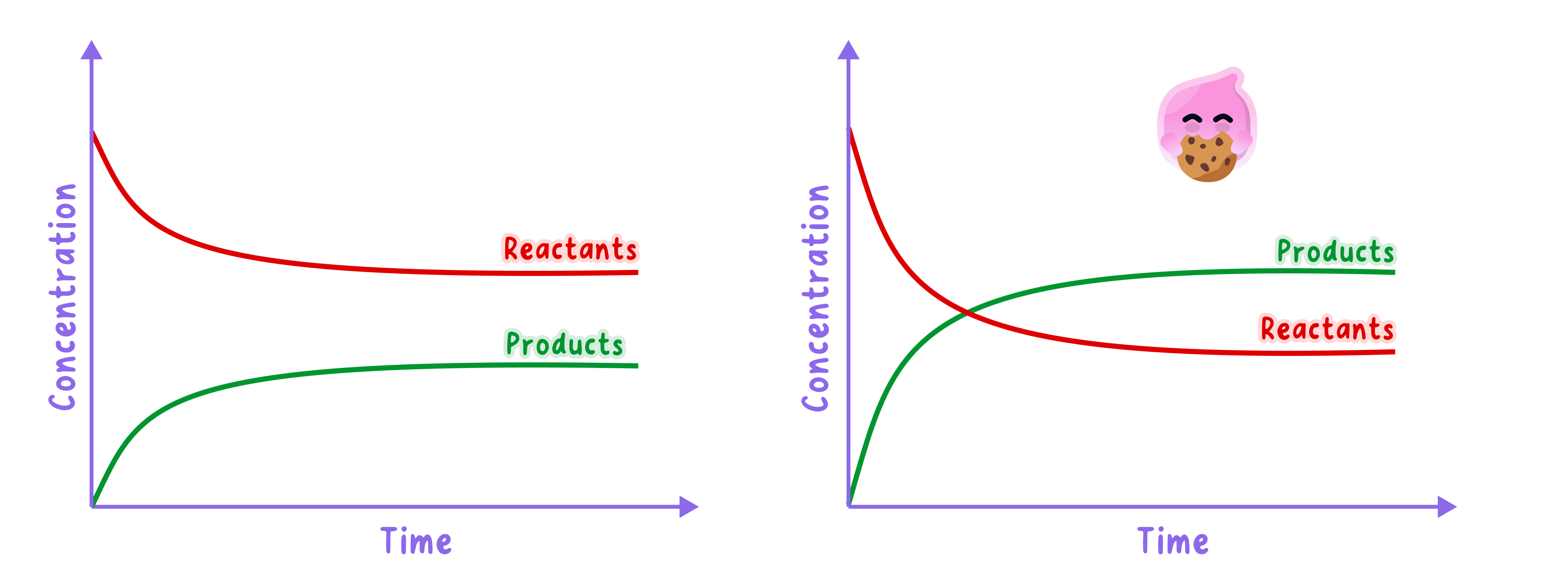
- A mixture at equilibrium holds both reactants and products, in unchanging amounts.
- An equilibrium lying to the right holds mostly products.
- An equilibrium lying to the left holds mostly reactants.
- Changing a condition upsets the balance of the two rates, and the mixture settles at a new position.
- The general rule is that the system responds so as to oppose the change that was made.
Key Idea
Predicting a shift means asking which direction reduces the effect of the change imposed.
Temperature favours the endothermic or the exothermic direction
- One direction of a reversible reaction is exothermic and the other is endothermic.
- Raising the temperature shifts the position towards the endothermic direction, which takes energy in.
- Lowering the temperature shifts the position towards the exothermic direction, which gives energy out.
- In the Haber process the forward reaction is exothermic, so a lower temperature gives more ammonia at equilibrium.
- Temperature shifts the position of every equilibrium, while pressure does so only where the two sides differ in moles of gas.
Common Mistake
Energy is a condition, not a substance, so it never appears as a species in the equation.
Pressure matters when the two sides hold different amounts of gas
- Only gases respond to a change in pressure, so solids and liquids can be ignored.
- Count the moles of gas shown on each side of the equation.
- Raising the pressure shifts the position towards the side with fewer moles of gas.
- Lowering the pressure shifts it towards the side with more moles of gas.
- Ammonia forms from four moles of gas and makes two, so high pressure favours ammonia.
Note
Where both sides hold the same number of moles of gas, changing the pressure moves the position not at all.
Concentration shifts the equilibrium away from whatever is added
- Adding more of a reactant shifts the position to the right, making more product.
- Adding more of a product shifts the position to the left, making more reactant.
- Removing a product shifts the position to the right, as the system replaces what was taken.
- Removing a reactant shifts the position to the left for the same reason.
- Removing the product as it forms keeps shifting the position right, so the reaction can run close to completion.
Example
- More nitrogen added: the position moves right and the amount of ammonia rises.
- Ammonia removed: the position moves right again, which is why the Haber plant condenses it out.
A catalyst changes the speed but not the position
Definition
Catalyst
A substance that speeds up a reaction without being used up in the reaction.
- A catalyst speeds up the forward and backward reactions by the same factor.
- Because both rates rise together, they still become equal at the same composition.
- Equilibrium is therefore reached sooner, holding exactly the amounts it would have held anyway.
- The yield at equilibrium is unchanged, however much catalyst is present.
- Industry pays for a catalyst because of the time it saves, not for extra product.
Exam technique
- A prediction is worth stating as a direction of shift plus the reason the system opposes the change.
- Counting the moles of gas on each side comes before any answer about pressure.
- An answer that credits a catalyst with a higher yield contradicts the equal factor point above.
Self review
- What does it mean to say an equilibrium lies to the left?
- Which direction does raising the temperature favour, and why?
- When does a change of pressure leave the position of equilibrium unchanged?
- What happens to the position when a product is removed?
- Why does a catalyst not change the yield at equilibrium?
