Some reactions run in both directions
Definition
Reversible reaction
A reaction in which the products can react together to re-form the reactants, shown by the symbol ⇌.
- In many reactions the products can react together to re-form the reactants.
- Heating blue hydrated copper sulfate drives off water and leaves white anhydrous copper sulfate.
- Adding water to the white solid turns it blue again, which reverses the change.
- Heating white ammonium chloride breaks it into ammonia and hydrogen chloride, which recombine on cooling.
- The conditions decide which direction dominates, so changing them can reverse the change.
Example
- Hydrated copper sulfate: blue solid, heated, gives a white solid and water vapour.
- Anhydrous copper sulfate: white solid, water added, turns blue and warms up.
The double arrow marks a reversible reaction
- A reversible reaction is written with the symbol ⇌\rightleftharpoons⇌ in place of a single arrow.
- The copper sulfate change is written this way: CuSO4⋅5H2O⇌CuSO4+5H2O\text{CuSO}_4{\cdot}5\text{H}_2\text{O} \rightleftharpoons \text{CuSO}_4 + 5\text{H}_2\text{O}CuSO4⋅5H2O⇌CuSO4+5H2O
- The left to right change is called the forward reaction and the right to left change the backward reaction.
- The two reactions are opposites, so one is exothermic by exactly as much as the other is endothermic.
- Both reactions are taking place at the same time whenever reactants and products are mixed together.
Note
A single arrow is the convention for a reaction that goes essentially to completion, which a reversible one does not.
A closed system reaches dynamic equilibrium
Definition
Closed system
A system in which no reactants or products can enter or leave.
Definition
Dynamic equilibrium
The state of a reversible reaction in a closed system in which the forward and backward reactions happen at the same rate, so the amounts of reactants and products stay constant.
- Nothing can enter or leave a closed system, so every product stays in contact with the mixture.
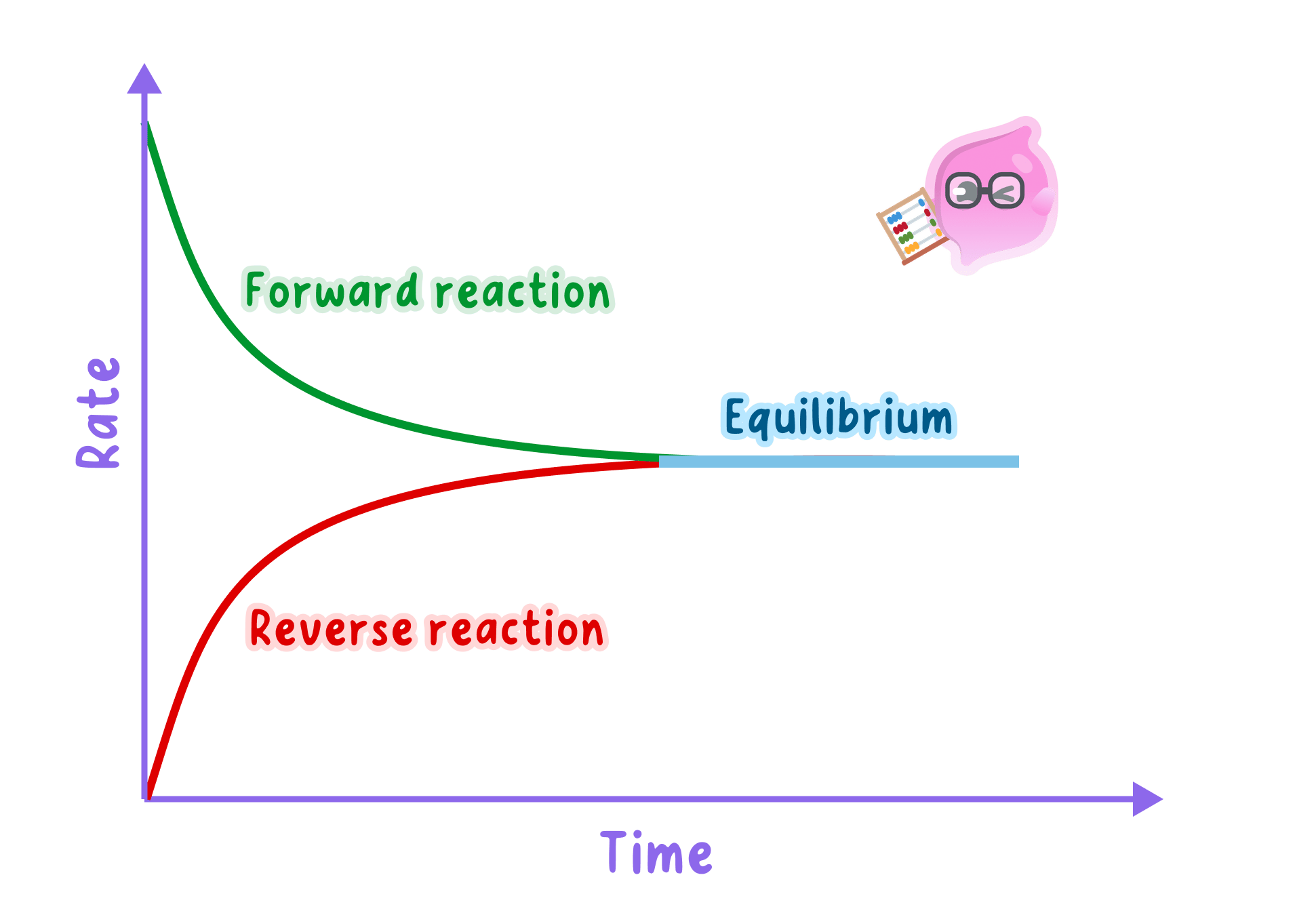
- As the reactants are used up the forward reaction slows down.
- As the products build up the backward reaction speeds up.
- The two rates eventually become equal, and at that moment the amounts stop changing.
- The mixture has then reached equilibrium, and it stays there unless something is changed.
Common Mistake
- Equilibrium is only possible in a closed system, because a product that escapes can never react back.
- Letting a gaseous product escape keeps shifting the reaction forwards, so it can run close to completion instead.
Equilibrium is dynamic, not still
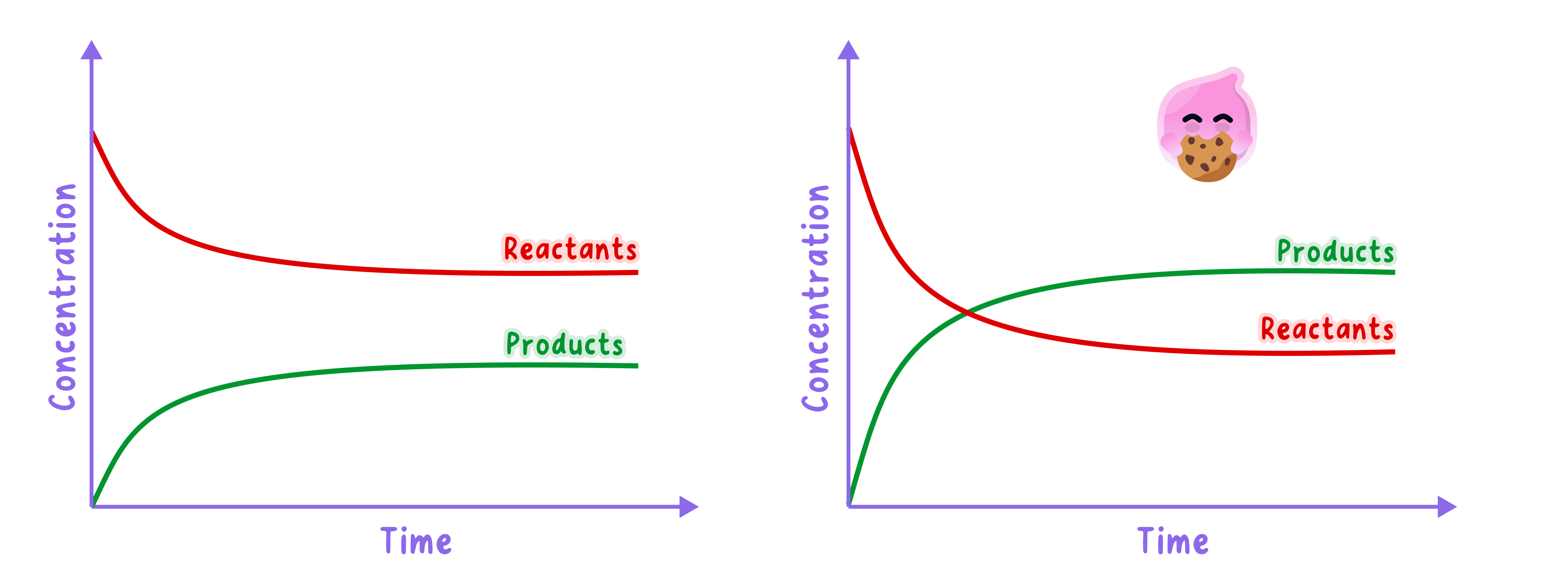
- At equilibrium both reactions are still running, and running at the same rate.
- Particles are still being converted in both directions, which is what dynamic means.
- What stays constant is the amount of each substance present, not the activity in the mixture.
- The reactants and products are not present in equal amounts, only in unchanging ones.
- A mixture that has simply stopped reacting is not at equilibrium, because nothing is happening at all.
Key Idea
Equal rates, not equal amounts, is what defines a dynamic equilibrium.
Changing the conditions changes what the mixture holds
- Once a mixture is at equilibrium, its composition stays fixed until a condition is altered.
- Changing the temperature, the pressure or a concentration disturbs the balance of the two rates.
- The mixture then settles at a new equilibrium holding different amounts of reactants and products.
- This is why the direction of a reversible reaction can be controlled by choosing the conditions.
- Industry uses that control to push a reversible reaction towards the product that is wanted.
Self review
- What does the symbol ⇌\rightleftharpoons⇌ tell you about a reaction?
- Why can equilibrium only be reached in a closed system?
- What is happening to the forward and backward rates at equilibrium?
- Why is equilibrium described as dynamic?
- What happens to a mixture at equilibrium when a condition is changed?
