The fractions differ in the size of their molecules
Definition
Viscosity
How easily a liquid flows, with a more viscous liquid flowing less easily.
- A hydrocarbon in a light fraction has few carbon and hydrogen atoms in its molecule.
- A hydrocarbon in a heavy fraction has many more of both.
- Every other difference between the fractions follows from that difference in size.
- Boiling point rises as the molecules get larger.
- Viscosity rises too, so the heavier fractions flow less easily.
Key Idea
One variable, the length of the chain, drives every trend across the fractions.
Ease of ignition falls as the molecules get larger
- A short-chain hydrocarbon vaporises readily and catches light easily.
- A long-chain hydrocarbon is harder to vaporise, so it is harder to ignite.
- Petrol ignites far more readily than fuel oil for this reason.
- Ease of ignition therefore runs opposite to boiling point and viscosity.
- A fuel is chosen partly on how easily it needs to ignite in the engine that burns it.
Example
- Petrol: low boiling point, runny, ignites easily.
- Bitumen: very high boiling point, barely flows, very hard to ignite.
Most of these hydrocarbons are alkanes
Definition
Alkane
A saturated hydrocarbon with the general formula CnH2n+2.
Definition
Saturated hydrocarbon
A hydrocarbon whose carbon atoms are joined only by single bonds.
- The hydrocarbons in the fractions are mostly members of the alkane family.
- An alkane has its carbon atoms joined by single bonds only.
- A molecule with only single bonds between carbons is saturated.
- The general formula for an alkane is CnH2n+2\text{C}_n\text{H}_{2n+2}CnH2n+2.
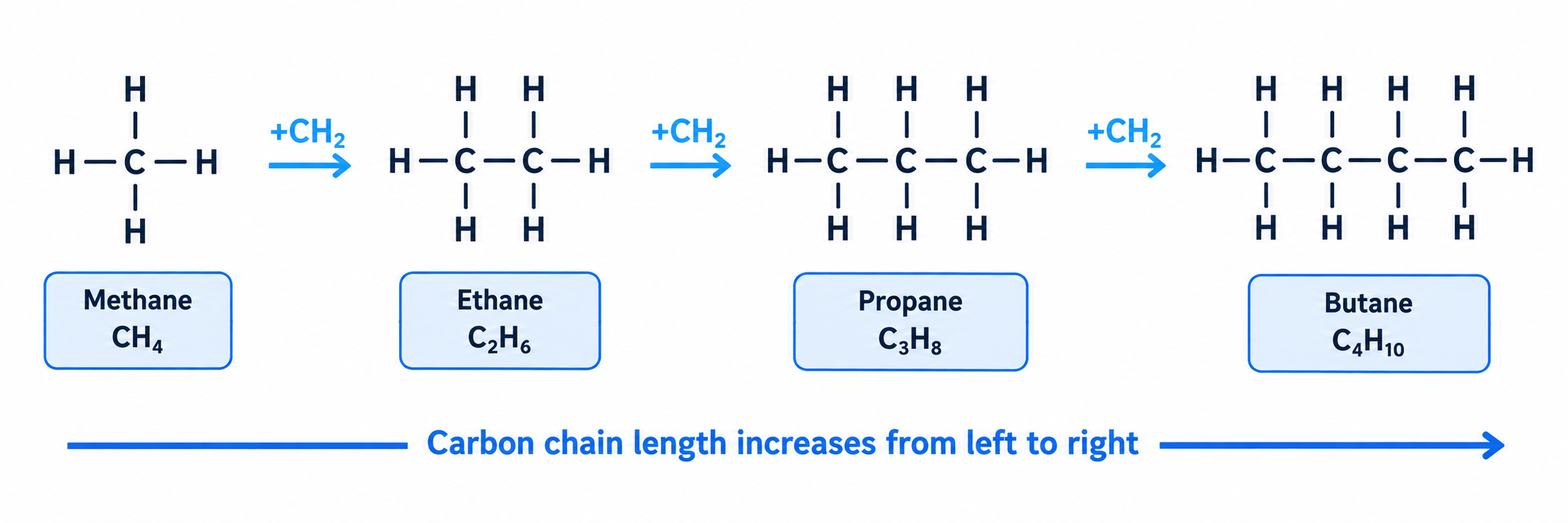
- Methane, ethane, propane and butane are the first four members.
Note
Substituting n=3n = 3n=3 into the general formula gives C3H8\text{C}_3\text{H}_8C3H8, which is propane.
A homologous series shares a general formula
Definition
Homologous series
A family of compounds with the same general formula, differing by CH2 from one member to the next, with similar chemical properties and a gradual change in physical properties.
- Members of a homologous series all fit the same general formula.
- Each member differs from the next by CH2\text{CH}_2CH2 in its molecular formula.
- Their physical properties change gradually along the series, as boiling point does.
- Their chemical properties are similar, because the molecules are built the same way.
- The alkanes are one such series, and there are others built round different groups.
Example
- Methane CH4\text{CH}_4CH4, ethane C2H6\text{C}_2\text{H}_6C2H6, propane C3H8\text{C}_3\text{H}_8C3H8, butane C4H10\text{C}_4\text{H}_{10}C4H10.
- The step each time is CH2\text{CH}_2CH2, one carbon and two hydrogens.
Using the pattern to predict a member
- The next alkane after butane is C5H12\text{C}_5\text{H}_{12}C5H12, found by adding CH2\text{CH}_2CH2.
- The general formula gives the same answer, since n=5n = 5n=5 gives 2n+2=122n + 2 = 122n+2=12.
- Its boiling point lies above butane's, because its chain is longer.
- It reacts in the same way as the others, since its chemistry is that of an alkane.
- A prediction of this kind uses the series rather than a recalled fact.
Self review
- What happens to boiling point as the hydrocarbon molecules get larger?
- Why is petrol easier to ignite than fuel oil?
- What does saturated mean?
- Give the general formula of the alkanes.
- Name three features shared by members of a homologous series.