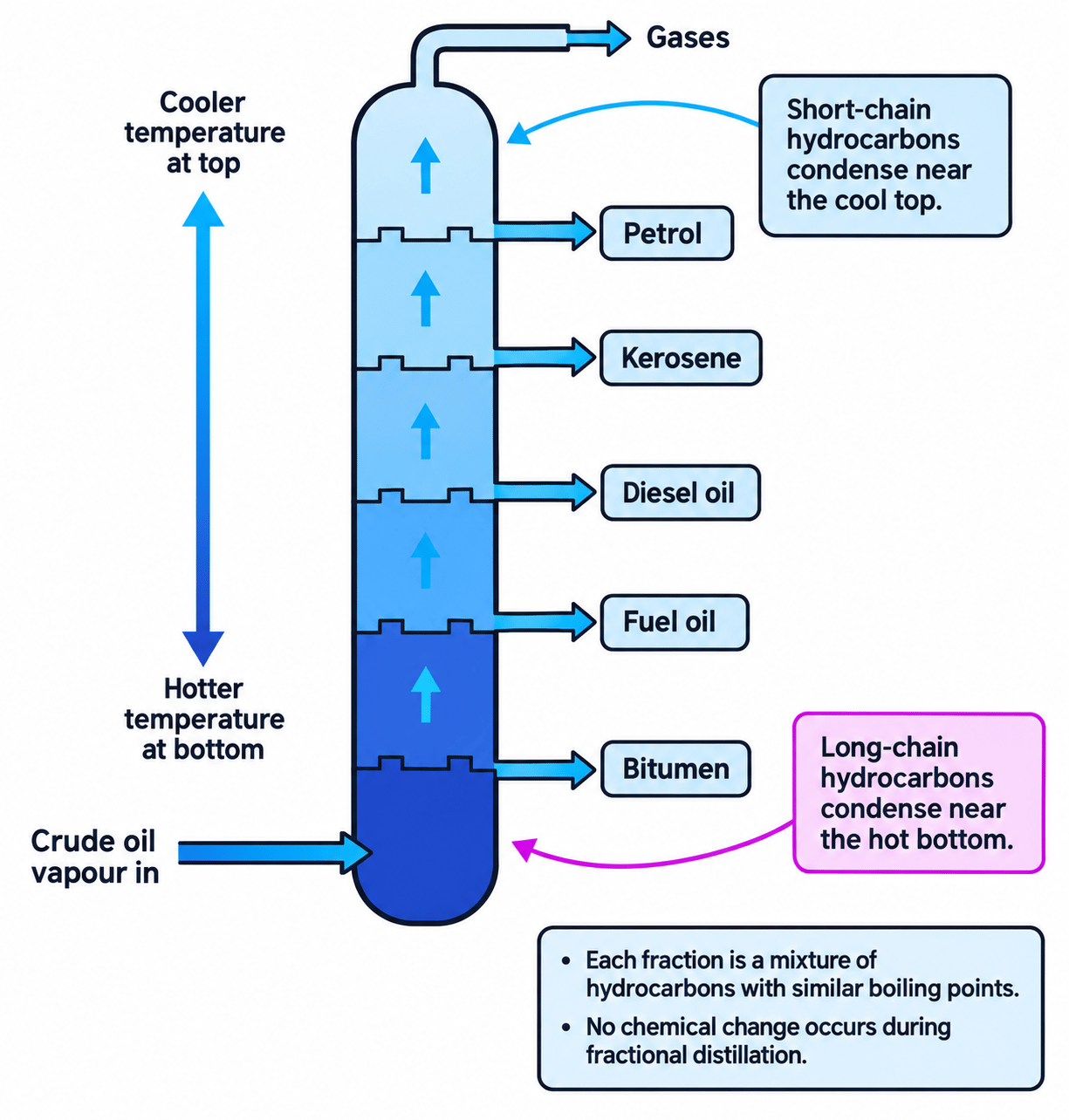
Fractional distillation separates crude oil by boiling point
Definition
Fractional distillation
A method that separates miscible liquids with close boiling points, using a fractionating column in which vapours repeatedly condense and evaporate.
Definition
Fraction
A group of hydrocarbons with similar boiling points, separated from crude oil together.
- Crude oil is heated until most of it has turned into a vapour.
- The vapour passes into a tall fractionating column that is hot at the bottom and cool at the top.
- A vapour rises until it reaches a level cool enough for it to condense.
- The liquid that collects at each level is drawn off as a fraction.
- Each fraction is still a mixture, but of hydrocarbons with similar boiling points.
Key Idea
The separation works on boiling point, so it sorts the molecules by the length of their chains.
Chain length decides where a fraction condenses
- A longer carbon chain gives a molecule with stronger attractions to its neighbours.
- Stronger attractions mean a higher boiling point.
- Long-chain hydrocarbons therefore condense low down, where the column is hottest.
- Short-chain hydrocarbons stay as vapour longer and condense near the top.
- Molecules that never condense leave the column at the top as gases.
Note
Nothing is chemically changed in the column: the same molecules simply end up in different places.
The fractions and what each is used for
- Gases are drawn off at the top and used for domestic heating and cooking.
- Petrol is used as fuel for cars.
- Kerosene is used as fuel for aircraft.
- Diesel oil is used as fuel for some cars and for trains.
- Fuel oil is used for large ships and in some power stations, and bitumen surfaces roads and roofs.
Example
- Top of the column: gases, then petrol, then kerosene.
- Bottom of the column: diesel oil, then fuel oil, then bitumen.
Matching a fraction to its job
- A fuel for a car engine must vaporise easily, which suits the short chains in petrol.
- A fuel for a ship's engine can be thicker and harder to ignite, so fuel oil serves.
- Bitumen barely flows at all, which is exactly what a road surface needs.
- The property that matters is set by the chain length in that fraction.
- Demand for the fractions does not match the amounts the column produces, which is why some are in short supply.
Self review
- Why is crude oil heated before it enters the fractionating column?
- Why do long-chain hydrocarbons condense near the bottom?
- Name the fraction used as fuel for aircraft.
- Which fraction is used to surface roads?
- Why is each fraction still a mixture?