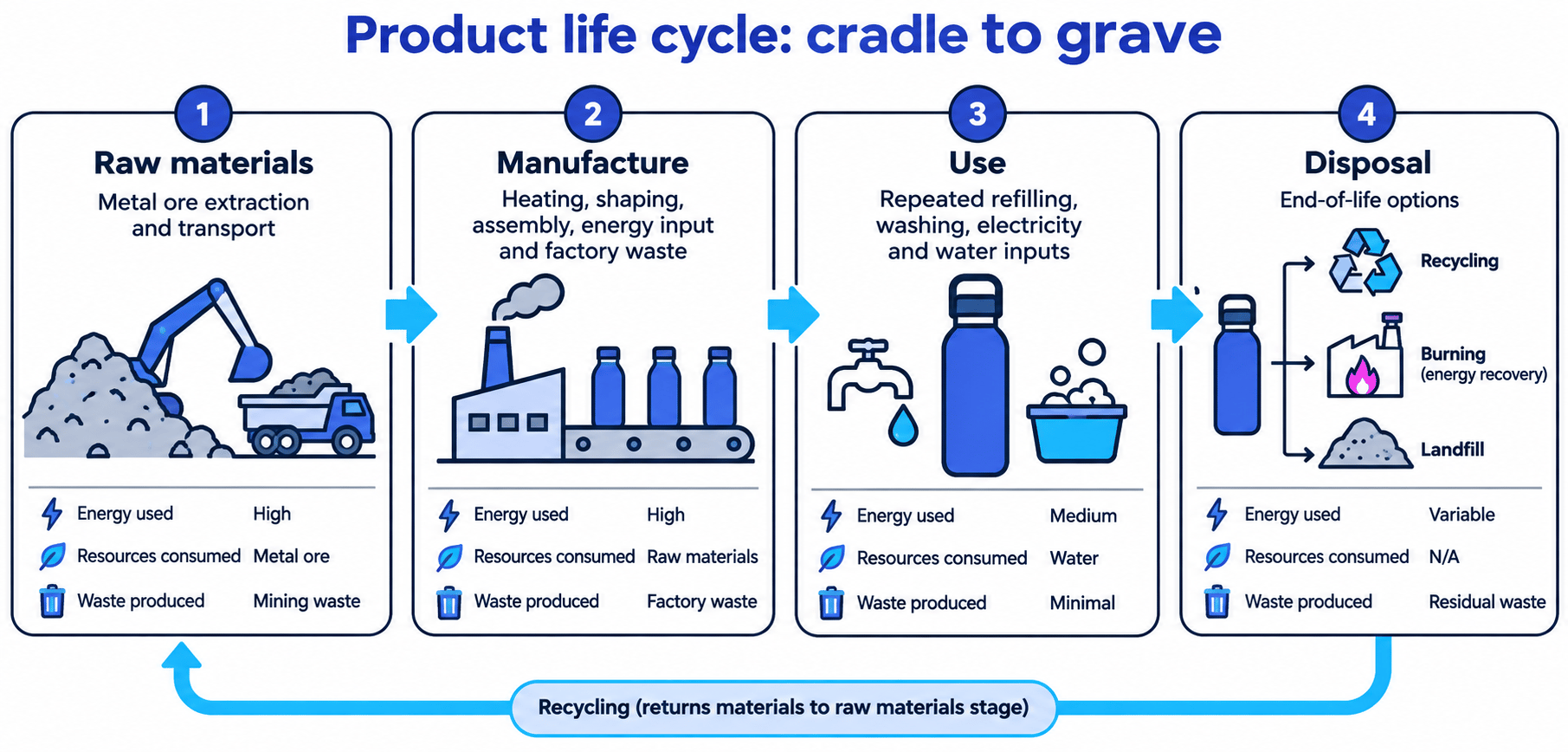
A life cycle assessment follows a product from cradle to grave
Definition
Life cycle assessment
An assessment of the effect a product has on the environment across obtaining its raw materials, manufacturing it, using it and disposing of it.
- The assessment looks at the effect a product has on the environment across its whole life.
- Four stages are considered: obtaining the raw materials, manufacturing, using the product, and disposing of it.
- Each stage is examined for the energy it uses, the resources it consumes and the waste it produces.
- Putting the four together prevents a saving at one stage hiding a cost at another.
- The result is used to compare two products that do the same job.
Key Idea
A product that looks clean in use may carry a large cost at the raw material or disposal stage.
Obtaining the raw materials
- Raw materials are mined, quarried, drilled or grown, and every route disturbs land.
- Extracting a metal from its ore uses energy and leaves waste rock behind.
- A material made from crude oil ties the product to a finite resource.
- Transporting the raw material to the factory burns fuel and releases carbon dioxide.
- A recycled input cuts this stage sharply, because the extraction has already been paid for.
Note
A material grown as a crop uses land and water, which is a cost even though the material renews.
Manufacture, use and disposal
- Manufacturing uses energy for heating, shaping and assembly, and can release waste into air or water.
- The use stage covers everything the product consumes while it is doing its job.
- A product that uses electricity in service may dominate its own assessment over many years.
- A long-lived product spreads the cost of making it across more years of use.
- Disposal covers whether the product is recycled, burned or buried, and how long it persists.
Example
- Plastic bag: cheap to make, very light to transport, but persists for a long time once buried.
- Paper bag: made from a renewable crop, yet heavier to transport and more energy-hungry to produce.
- Cotton bag: high cost to make, which is only repaid if it is reused many times.
Reading the data from an assessment
- Data are usually given per stage, so the four figures are compared before they are added.
- The totals decide the comparison, and the largest stage shows where an improvement would count most.
- Figures must be quoted for the same quantity of product, or the comparison means nothing.
- A difference of a few percent is too small to separate two products reliably.
- A conclusion is stated with the stage that drives it, not as a bare preference.
Common Mistake
Comparing only the stage that favours one product is the most common way an assessment is misused.
Where an assessment involves judgement
- Energy use can be measured, but the damage done by habitat loss cannot be put on the same scale.
- Deciding how much weight to give each effect is a judgement, not a measurement.
- Some figures are estimates, particularly for how long a product will be kept and used.
- An assessment paid for by a manufacturer may be selective about which stages it reports.
- For these reasons two honest assessments of the same product can reach different conclusions.
Self review
- What four stages does a life cycle assessment consider?
- Why can a product that is cheap to make still score badly overall?
- Why must figures be compared for the same quantity of product?
- Give one part of an assessment that cannot be measured directly.
- Why might two assessments of the same product disagree?