Transition metals fill the central block of the periodic table
Definition
Transition metal
A metal from the central block of the periodic table, between Group 2 and Group 3.
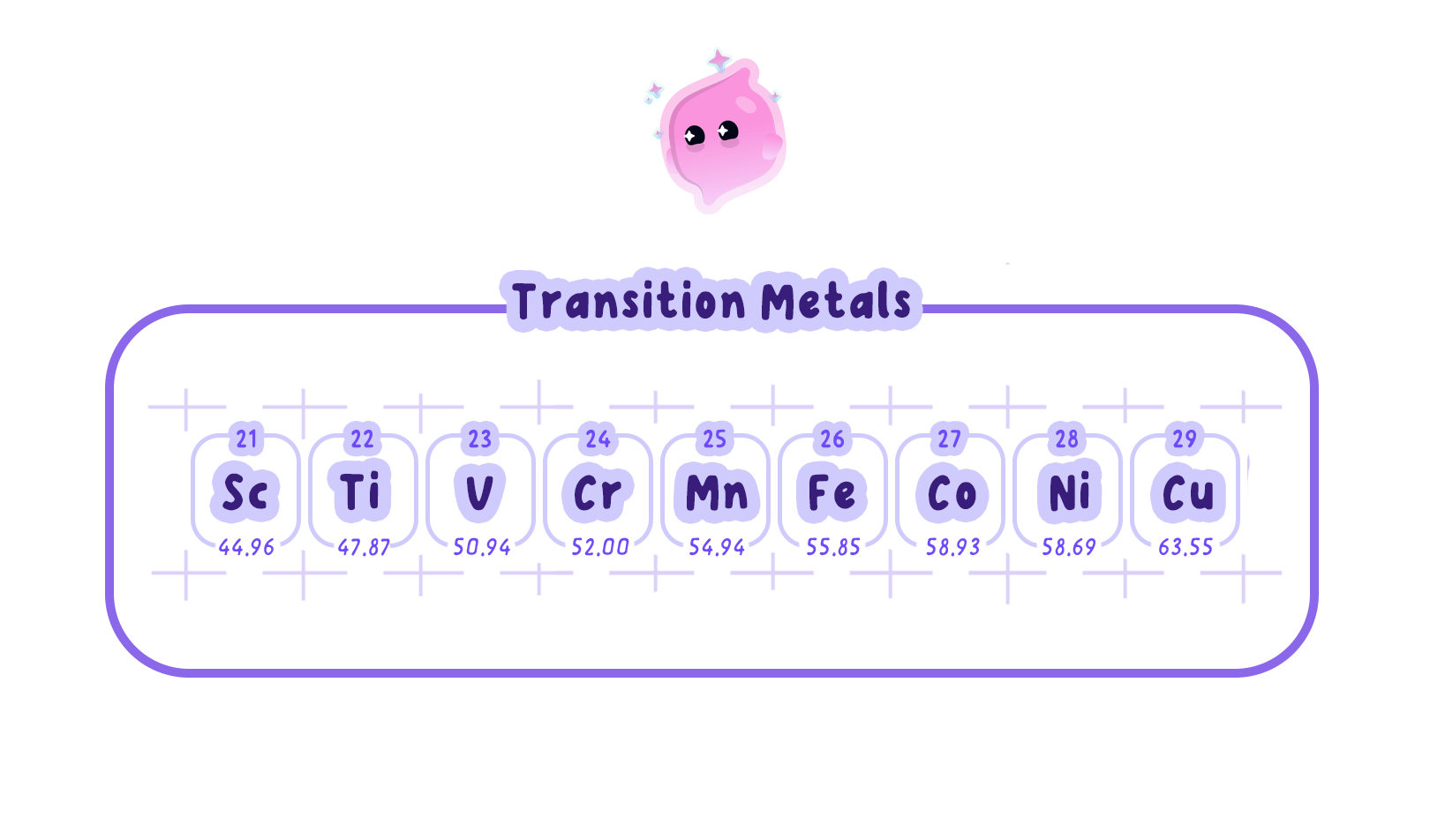
- The block between Group 2 and Group 3 holds the transition metals.
- It includes iron, copper, nickel, chromium, manganese, silver and gold.
- Most of the metals in the periodic table are transition metals, so they set the pattern of what a metal is like.
- Four properties are typical of the block: high melting point, high density, coloured compounds and catalytic activity.
- These are typical properties, so an individual metal may depart from one of them.
Key Idea
Group 1 metals are the untypical ones, which is why they are studied separately.
High melting points and high densities
Definition
Metallic bond
The strong electrostatic attraction between positive metal ions and the delocalised electrons that surround them.
- The metallic bonding in a transition metal is strong, so a large amount of energy is needed to melt it.
- Iron melts at about 1538 ∘C1538\ ^{\circ}\text{C}1538 ∘C and copper at about 1085 ∘C1085\ ^{\circ}\text{C}1085 ∘C.
- A high melting point is what allows these metals to be used in engines and in structures that get hot.
- Their atoms are also packed closely, which gives a high density.
- Iron has a density of about 7.9 g/cm37.9\ \text{g/cm}^37.9 g/cm3, against sodium's 0.97 g/cm30.97\ \text{g/cm}^30.97 g/cm3.
Example
- Mercury is a transition metal that is liquid at room temperature, so the melting point rule has exceptions.
- Sodium floats on water, while every transition metal sinks in it.
Transition metals form coloured compounds
- The compounds of a transition metal are usually coloured, in the solid and in solution.
- Copper(II) compounds are typically blue or green, as in blue copper(II) sulfate solution.
- Iron(II) compounds are pale green, while iron(III) compounds are orange or red-brown.
- The colour depends on which metal is present and on its charge, so iron gives two different colours.
- Group 1 ions are colourless, so their compounds are white unless the negative ion supplies a colour.
Note
- The colour of a solution is a first clue to which ion is present, though a chemical test confirms it.
- Zinc sits in the block but forms white compounds, so it is not counted as a typical transition metal.
Transition metals and their compounds act as catalysts
Definition
Catalyst
A substance that speeds up a reaction without being used up in the reaction.
- Catalytic activity means increasing the rate of a reaction without being used up by it.
- Iron is the catalyst used in the Haber process to make ammonia.
- Iron compounds are also used as catalysts in industry, so the activity is not limited to the metal itself.
- Nickel catalyses the addition of hydrogen to unsaturated oils.
- Recovering the catalyst at the end and using it again is why a small mass serves a large plant.
Common Mistake
A catalyst changes only the rate, so it never alters how much product a reaction can give.
Comparing the block with the Group 1 metals
- Group 1 metals are soft enough to cut with a knife, while transition metals are hard.
- Group 1 metals melt at low temperatures, some below 100 ∘C100\ ^{\circ}\text{C}100 ∘C.
- Group 1 metals react vigorously with water, while iron and copper barely react with it.
- A Group 1 ion adds no colour of its own to a compound.
- Transition metals are therefore the metals chosen for construction and machinery, and Group 1 metals are not.
Self review
- Where in the periodic table are the transition metals found?
- Name four typical properties of a transition metal.
- Give the colour of an iron(II) compound and of an iron(III) compound.
- Which transition metal catalyses the Haber process?
- Give two ways in which sodium differs from a typical transition metal.
