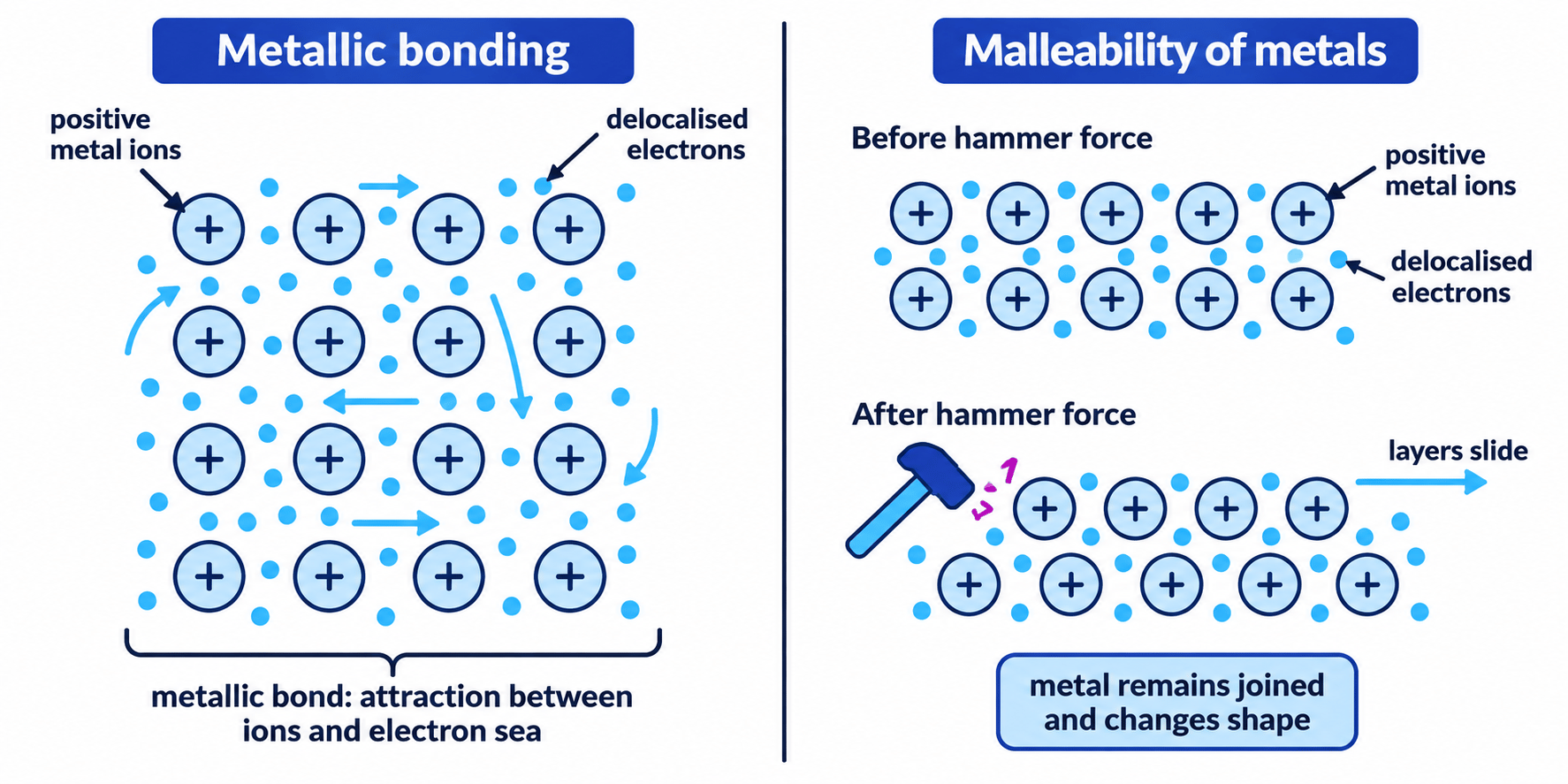
A metal is positive ions in a sea of delocalised electrons
Definition
Metallic bond
The strong electrostatic attraction between positive metal ions and the delocalised electrons that surround them.
Definition
Delocalised electron
An electron that is free to move through a structure instead of being held between two particular atoms.
- A metal is a giant lattice of positive metal ions, with the electrons from their outer shells free to move among them.
- Every ion is attracted to that electron sea, in every direction through the lattice.
- The attraction is strong and there is a great deal of it, so most metals melt and boil at high temperatures.
- The free electrons also make metals good conductors of electricity and of heat.
- They reflect light at the surface as well, which is what gives a metal its shine.
- Mercury is liquid at room temperature, so most metals is the accurate phrasing rather than all metals.
Key Idea
- The electrons are shared by the whole lattice, not by any single pair of ions.
- Almost every metallic property traces back to those mobile electrons, from conduction to shine.
Malleability comes from layers of ions that slide
Definition
Malleability
The ability of a material to be hammered or rolled into a new shape without breaking.
- The metal ions in the lattice are arranged in layers.
- A hammer blow pushes one layer past the next.
- The electron sea moves with them, so the attraction between the ions and the electrons is never lost.
- The metal changes shape instead of cracking, which is what makes it malleable.
- The same sliding lets a metal be drawn out into wire, a property called ductility.
- A brittle solid cannot do this, because its particles cannot move past one another without the structure failing.
Example
- Copper wiring: copper is drawn into thin wire, and its delocalised electrons then carry the current.
- Aluminium drinks cans: aluminium is rolled into thin sheet without cracking, and has a low density for a metal.
Most metals: shiny, dense and high melting
- Most metals are shiny solids at room temperature, because the electrons at the surface reflect light.
- Most metals have high melting points, because the attraction between the ions and the electrons runs throughout the lattice.
- Most metals have high densities, because their ions pack closely together.
- Most metals are good conductors of electricity, as solids and when molten.
- Mercury, which is liquid at room temperature, and the group 111 metals, which are soft and low melting, are the usual exceptions.
Note
- The word most is doing real work, because mercury and the group 111 metals are genuine exceptions.
- Conduction and melting point both trace to the same attraction, between the positive ions and the delocalised electrons.
Most non-metals: low melting and boiling points, poor conduction
- Most non-metals have low melting and boiling points.
- Many of them are simple molecular, so only weak intermolecular forces have to be overcome.
- Most non-metals are poor conductors of electricity, having neither mobile ions nor delocalised electrons.
- Most non-metals are dull rather than shiny, and are gases or brittle solids at room temperature.
- Most non-metals also have low densities compared with metals.
Common Mistake
- Graphite conducts electricity although it is a non-metal, because each carbon atom there leaves one electron delocalised.
- Giant covalent non-metals melt very high, so the low melting point pattern holds for the simple molecular ones.
Writing a comparison
- A comparison reads more clearly when the same property is named on both sides.
- Melting point: most metals high, most simple molecular non-metals low.
- Electrical conductivity: most metals good, most non-metals poor.
- Appearance: most metals shiny, most non-metals dull.
- Density: most metals high, most non-metals low.
- Any of these traces back to the delocalised electrons in the metal and their absence in the non-metal.
Self review
- What holds a metallic lattice together?
- Why can a metal be hammered into a new shape without breaking?
- Which particles carry the current through a metal?
- Why do most non-metals conduct electricity poorly?
- Why is graphite an exception to that pattern?