Buckminsterfullerene: a hollow cage of sixty carbon atoms
Definition
Fullerene
A molecule made only of carbon atoms joined in rings to form a hollow cage or tube.
- Buckminsterfullerene, C60\text{C}_{60}C60, is a ball-shaped molecule built from 606060 carbon atoms.
- The cage is made from 121212 pentagonal rings and 202020 hexagonal rings.
- Each carbon atom is joined to three neighbours by strong covalent bonds within the cage.
- C60\text{C}_{60}C60 is a simple molecular substance, because each cage is a separate molecule.
- Only weak intermolecular forces hold neighbouring cages together.
- Solid C60\text{C}_{60}C60 is therefore soft and melts far below diamond or graphite.
Key Idea
- Strong bonds inside each cage, weak forces between cages, which is the simple molecular pattern.
- A fullerene is a molecule, so it has a fixed formula, unlike a giant structure.
Graphene: a single layer of graphite on its own
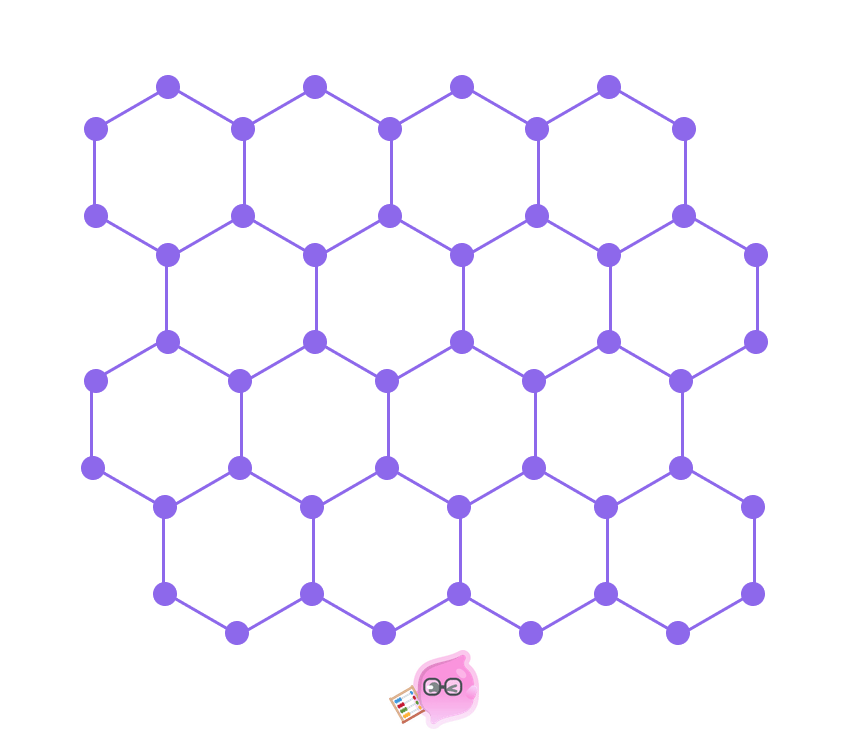
- Graphene is a sheet of carbon atoms one atom thick.
- The atoms are arranged in hexagonal rings, exactly as in one layer of graphite.
- Each carbon atom forms three strong covalent bonds within the sheet.
- The fourth outer electron on each atom is delocalised and moves through the sheet.
- Those delocalised electrons make graphene an excellent conductor of electricity.
- The continuous network of strong covalent bonds makes graphene very strong for its mass.
- A sheet one atom thick is also extremely light and can be bent.
Example
- Conducting: one delocalised electron per carbon atom travels across the sheet and carries charge.
- Strong and light: a continuous sheet of covalent bonds gives high strength with almost no mass for its area.
Poly(ethene): many small molecules joined into long chains
Definition
Polymer
A very large molecule formed when many small molecules join together in a repeating pattern.
- Ethene, CH2=CH2\text{CH}_2\text{=}\text{CH}_2CH2=CH2, is a small molecule with a double bond between its two carbon atoms.
- During polymerisation the double bond in each ethene molecule opens, leaving each molecule able to join to two others.
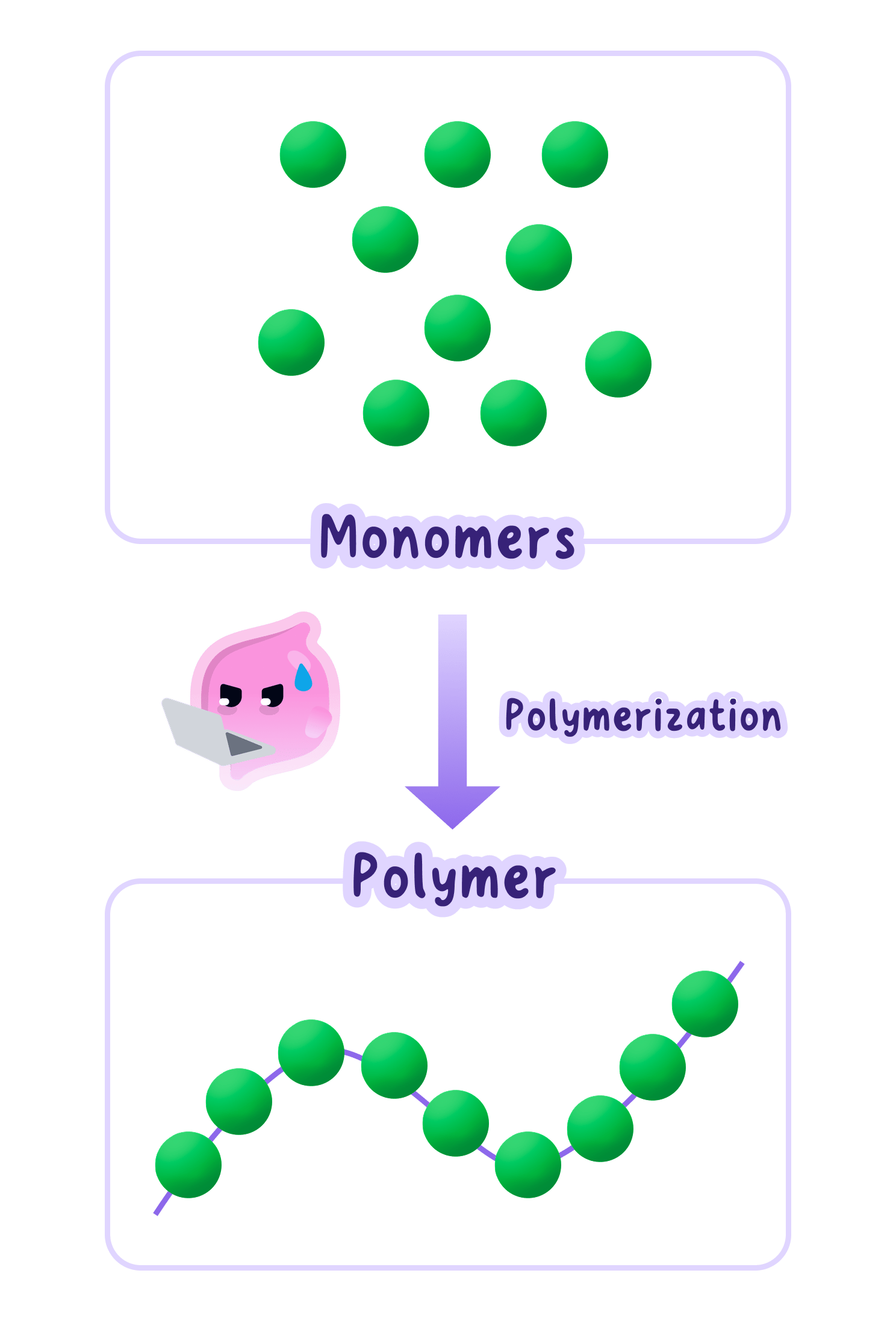
- Thousands of ethene molecules join end to end into one long chain of carbon atoms.
- The product is poly(ethene), whose repeating unit is written [−CH2−CH2−]n\left[-\text{CH}_2-\text{CH}_2-\right]_n[−CH2−CH2−]n.
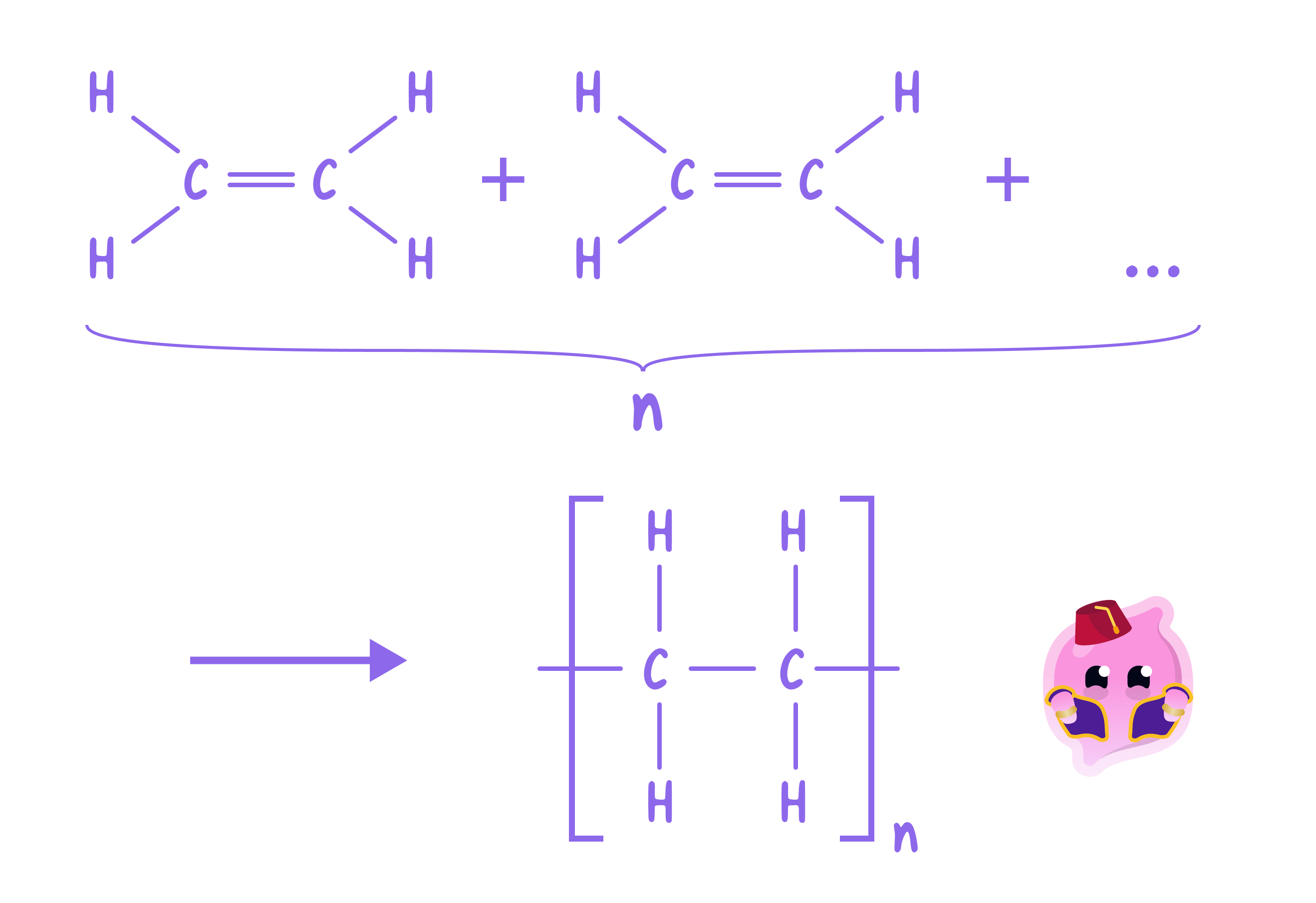
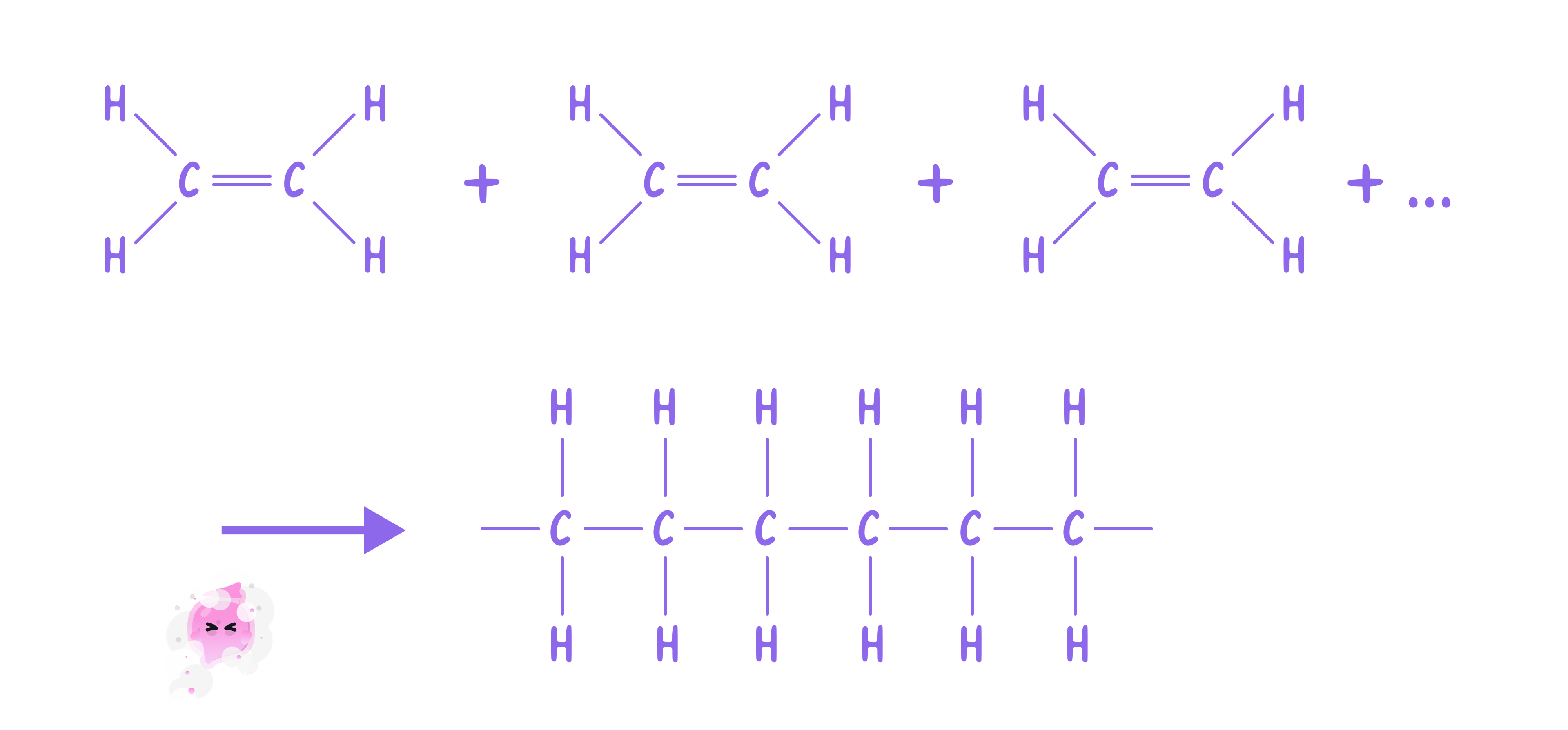
- The subscript nnn stands for a large, unspecified number of repeats, so a polymer has no single fixed formula.
- Strong covalent bonds run the whole length of each chain.
- Each poly(ethene) molecule is very large, which is what makes the material tough and flexible.
Note
- The class comes first, simple molecular for C60\text{C}_{60}C60 and a giant sheet for graphene, and the rest follows from it.
- The brackets and the nnn make it a polymer, because the unit written on its own is one small molecule.
Explaining a carbon structure
- Start by saying whether the substance is made of separate molecules or is one continuous network.
- C60\text{C}_{60}C60 is separate molecules, so the weak forces between them explain its low melting point.
- Graphene is a continuous sheet, so its strong covalent bonds explain its strength.
- Graphene's one spare delocalised electron per carbon atom explains its conductivity.
- Poly(ethene) is separate very large molecules, each a long covalently bonded chain.
- The property always follows from the structure, so the structure is the part worth naming first.
Self review
- How many carbon atoms are in a molecule of C60\text{C}_{60}C60, and how are they arranged?
- Why does solid C60\text{C}_{60}C60 melt at a much lower temperature than graphite?
- Why does graphene conduct electricity?
- What happens to the double bond in ethene during polymerisation?
- What does the subscript nnn represent in the formula of poly(ethene)?
