Atomic number fixes both the element and its place in the table
Definition
Atomic number
The number of protons in the nucleus of an atom, which is unique to each element.
Definition
Periodic table
A chart of all the elements arranged in order of increasing atomic number, so that elements with similar properties fall in the same column.
- Every atom of an element carries the same number of protons, and no two elements share that number.
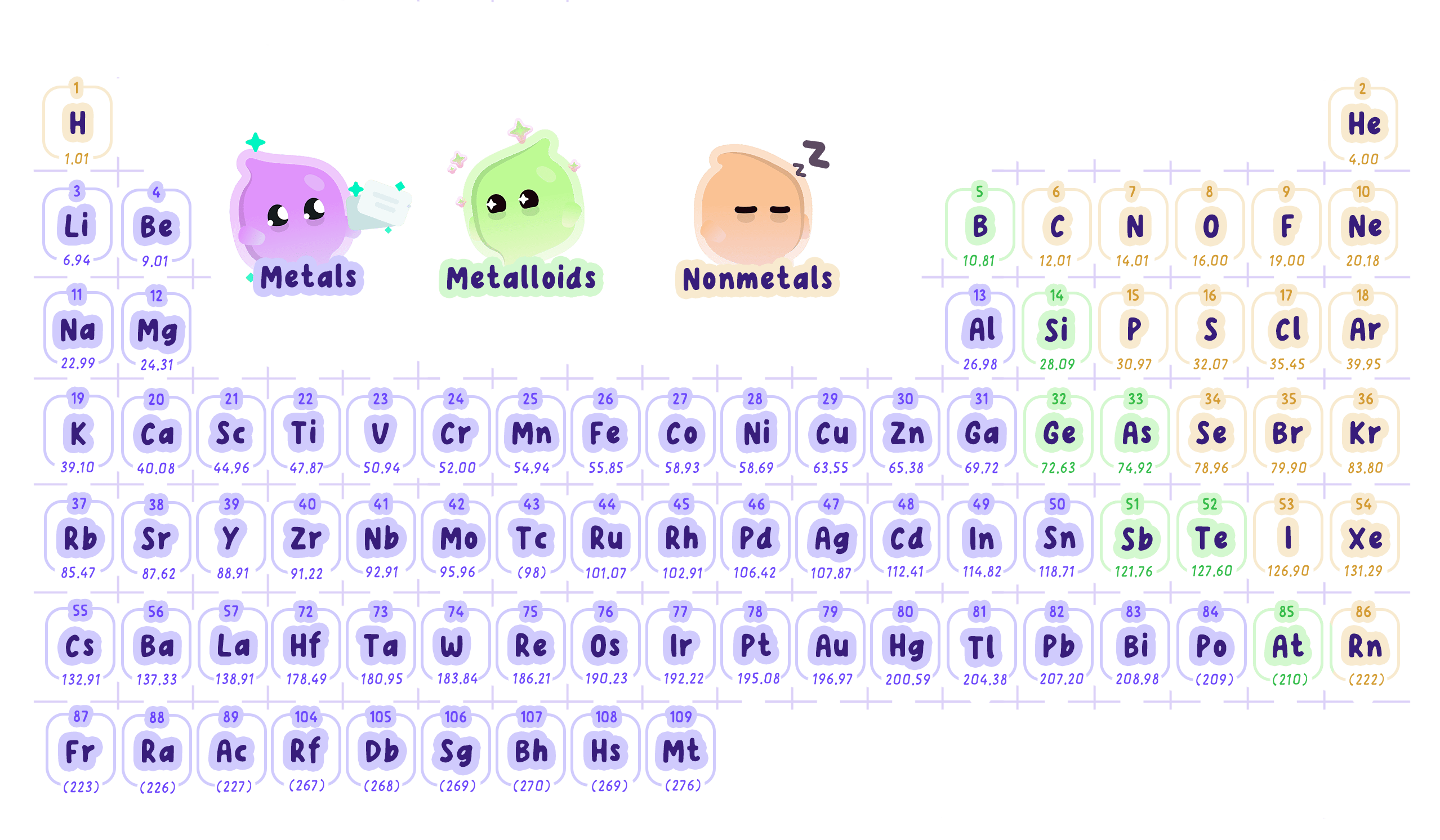
- The elements run left to right and then down, in order of increasing atomic number.
- An element's position therefore follows directly from its proton count.
- Carbon has atomic number 666, so it is the sixth element in that order.
- A neutral atom holds as many electrons as protons, so the same number gives the electron count.
- Reading a position off the table is enough to fix the number of protons in the nucleus of that element.
Key Idea
- Position gives the proton number, because atomic number is the ordering rule.
- Proton number gives the identity, because changing it changes the element.
Periods run across the table and groups run down it
Definition
Period
A horizontal row of the periodic table, along which the atomic number increases by one from each element to the next.
Definition
Group
A vertical column of the periodic table, whose elements have the same number of outer-shell electrons and so have similar chemical properties.
- Each horizontal row fills one more electron shell than the row above it.
- Each main-group column collects elements whose atoms have the same number of outer-shell electrons.
- Shared outer-shell arrangements are why elements in one column react in similar ways.
- Lithium and sodium sit in the same column, and both are reactive metals that form compounds of similar formulae.
- Magnesium and chlorine sit in the same row, and their properties are quite different.
- A position across a row says little on its own, while a position down a column predicts chemical behaviour.
Example
- Lithium and sodium share a column, so both form chlorides of the same pattern, LiCl\text{LiCl}LiCl and NaCl\text{NaCl}NaCl.
- Magnesium and chlorine share a row, yet one is a reactive metal and the other a reactive non-metal.
Metals sit to the left and non-metals to the right
- Most elements on the left and in the centre of the table are metals.
- Most elements on the right are non-metals, separated from the metals by a staircase line running down from near boron.
- Metals are typically shiny solids that conduct electricity, while non-metals are typically dull and conduct poorly.
- Hydrogen is a non-metal despite being drawn above group 111.
- Position is therefore a reliable first sort, with hydrogen the exception worth remembering.
Common Mistake
- Periods are rows and groups are columns, and swapping the two words changes the answer completely.
- Hydrogen is a non-metal, whatever its drawn position above group 111 suggests.
Outer-shell electrons explain the split
Definition
Electron shell
A fixed energy level around the nucleus in which electrons are found.
- Metal atoms usually hold one, two or three electrons in the outer shell.
- Losing those few electrons leaves a full shell beneath, so metal atoms form positive ions.
- Non-metal atoms usually hold four to seven outer-shell electrons.
- Gaining or sharing completes that shell more easily than losing does, and how many electrons are involved depends on the element, from one for chlorine to four for carbon.
- The group 000 elements already hold a full outer shell, which is why they react with almost nothing.
- The difference in outer-shell electrons is what turns a difference in position into a difference in chemistry.
Note
- Position is the clue and atomic structure is the reason, so a classification is explained only once the outer-shell count is given.
- The electronic configuration makes that count explicit, as 2.8.12.8.12.8.1 does for sodium.
Reading an element's identity and type from its position
- Find the element and read its atomic number to get the proton count.
- Count the rows down from the top to name the period.
- Read the group number printed above the column, since the modern table has eighteen columns and the transition block sits between Groups 2 and 3.
- Judge metal or non-metal from which side of the staircase line the element sits on.
- Support that judgement by stating the outer-shell electron count and whether the atom tends to lose or gain electrons.
Self review
- What does an element's atomic number tell you about its atoms?
- How does a period differ from a group?
- Why do elements in the same group have similar chemical properties?
- Where in the table are most metals found, and where are most non-metals found?
- Why does a magnesium atom form a positive ion while a chlorine atom forms a negative one?
