Electron shells fill from the inside out
Definition
Electron shell
A fixed energy level around the nucleus in which electrons are found.
- The electrons in an atom occupy shells at fixed distances from the nucleus.
- The first shell holds at most 222 electrons.
- The second and third shells each hold at most 888 electrons across the first 202020 elements.
- The fourth shell begins to fill once the third holds 888.
- A neutral atom has as many electrons as its atomic number.
- An electronic configuration lists those electrons shell by shell, separated by full stops, starting with the shell nearest the nucleus.
- Sodium's configuration 2.8.12.8.12.8.1 means 222 in the first shell, 888 in the second and 111 in the third.
Key Idea
- The numbers add up to the atomic number in a neutral atom, which is the quickest check on any configuration.
- A shell only starts filling once the one inside it is full, across the first 202020 elements.
The first twenty configurations, one electron at a time
- Period 1: hydrogen 111, helium 222.
- Period 2: lithium 2.12.12.1, beryllium 2.22.22.2, boron 2.32.32.3, carbon 2.42.42.4, nitrogen 2.52.52.5, oxygen 2.62.62.6, fluorine 2.72.72.7, neon 2.82.82.8.
- Period 3: sodium 2.8.12.8.12.8.1, magnesium 2.8.22.8.22.8.2, aluminium 2.8.32.8.32.8.3, silicon 2.8.42.8.42.8.4, phosphorus 2.8.52.8.52.8.5, sulfur 2.8.62.8.62.8.6, chlorine 2.8.72.8.72.8.7, argon 2.8.82.8.82.8.8.
- Period 4: potassium 2.8.8.12.8.8.12.8.8.1, calcium 2.8.8.22.8.8.22.8.8.2.
- Each element adds one electron to the one before it, so any configuration can be built from its neighbour.
- A shell diagram carries the same information: the nucleus at the centre, concentric circles around it, and the right number of electrons marked on each circle.
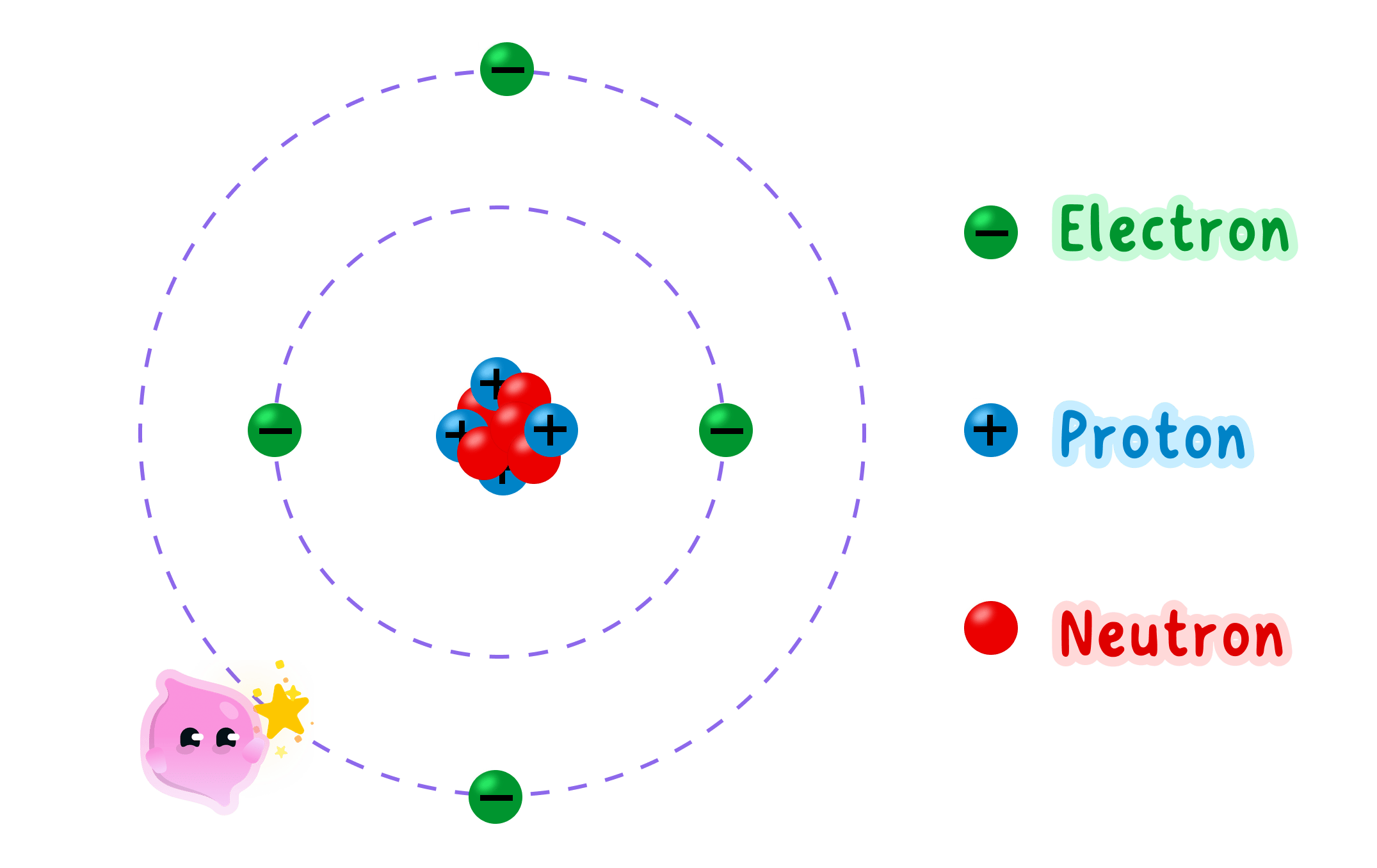
Example
- Sodium has 111111 electrons, so 222 fill the first shell, 888 fill the second and the last 111 starts the third, giving 2.8.12.8.12.8.1.
- Potassium has 191919 electrons, so the first three shells take 222, 888 and 888, and the nineteenth electron starts the fourth, giving 2.8.8.12.8.8.12.8.8.1.
The period number counts the occupied shells
Definition
Period
A horizontal row of the periodic table, along which the atomic number increases by one from each element to the next.
- Count how many numbers appear in the configuration, because each one stands for an occupied shell.
- Hydrogen and helium have one number each, so they lie in period 111.
- Lithium to neon have two numbers, so they lie in period 222.
- Sodium to argon have three numbers, so they lie in period 333.
- Potassium and calcium have four numbers, so they lie in period 444.
- A number written as 111 still counts, because that shell does hold an electron.
- The period changes at the point where a new shell starts, such as between argon 2.8.82.8.82.8.8 and potassium 2.8.8.12.8.8.12.8.8.1.
Note
- The numbers add to the atomic number, which catches most slips straight away.
- Full stops separate the shells, so 2.8.12.8.12.8.1 is right and 281281281 is not.
The group number comes from the outer-shell electrons
Definition
Group
A vertical column of the periodic table, whose elements have the same number of outer-shell electrons and so have similar chemical properties.
- Read the last number in the configuration to find the outer-shell electron count.
- One outer-shell electron places an element in group 111, and two place it in group 222.
- Counts of 333 to 777 place an element in groups 333 to 777 respectively.
- A full outer shell places an element in group 000, which holds the noble gases.
- Helium belongs to group 000 because its single shell is complete at 222 electrons.
- Chlorine 2.8.72.8.72.8.7 therefore lies in group 777, and magnesium 2.8.22.8.22.8.2 in group 222.
- Elements in one group behave similarly because the same outer-shell count takes part in their reactions.
Common Mistake
- The total electron count does not give the group, because only the outer shell is counted.
- Helium is in group 000, not group 222, because its outer shell is complete.
Going both ways between configuration and position
- Write the configuration from the atomic number, filling each shell before starting the next.
- Count the numbers for the period and read the last number for the group.
- Calcium 2.8.8.22.8.8.22.8.8.2 sits in period 444, group 222.
- Argon 2.8.82.8.82.8.8 sits in period 333, group 000.
- The same two counts work from a shell diagram: occupied circles give the period, and electrons on the outer circle give the group.
- Working backwards, an element in period 333 and group 666 has three occupied shells and six outer-shell electrons, giving 2.8.62.8.62.8.6.
Self review
- How many electrons fill the first shell, and how many fill the second?
- What is the electronic configuration of sulfur?
- Which period and group hold an atom with the configuration 2.8.72.8.72.8.7?
- Why is helium placed in group 000 rather than group 222?
- Which configuration belongs to an element in period 444, group 111?
