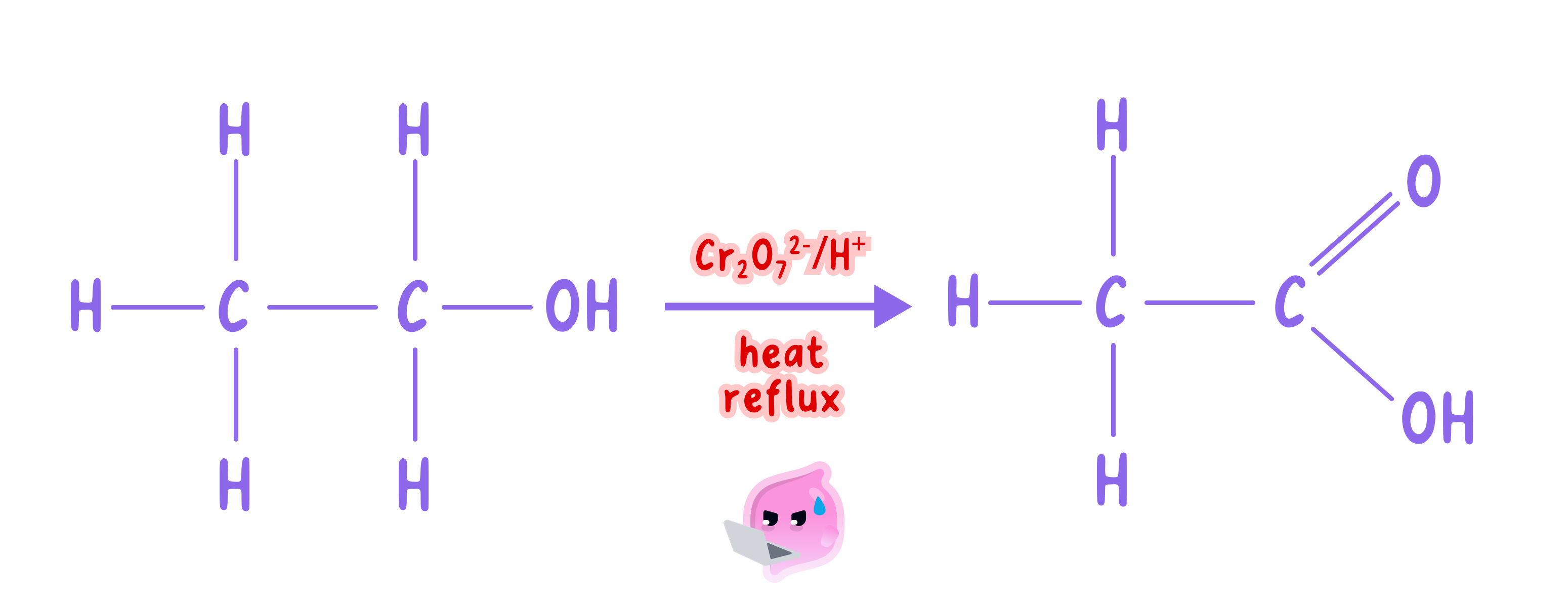
Ethanol can be oxidised to ethanoic acid
Definition
Oxidation
The loss of electrons by a substance.
- Ethanol can be converted into ethanoic acid.
- The change is an oxidation: ethanol+oxygen→ethanoic acid+water\text{ethanol} + \text{oxygen} \rightarrow \text{ethanoic acid} + \text{water}ethanol+oxygen→ethanoic acid+water
- The −OH-\text{OH}−OH group of the alcohol becomes the −COOH-\text{COOH}−COOH group of the acid.
- The number of carbon atoms in the molecule does not change.
- The reagents used to bring this about are not required here.
Key Idea
The carbon chain is untouched: only the functional group changes.
The same change happens to other alcohols
- Methanol is oxidised to methanoic acid.
- Propan-1-ol is oxidised to propanoic acid.
- Butan-1-ol is oxidised to butanoic acid.
- In each case the acid has the same number of carbons as the alcohol.
- The name changes from -ol to -oic acid, keeping the same stem.
Example
- Ethanol gives ethanoic acid, and propan-1-ol gives propanoic acid.
- The stem stays: eth- stays eth-, prop- stays prop-.
A homologous series reacts the same way throughout
Definition
Homologous series
A family of compounds with the same general formula, differing by CH2 from one member to the next, with similar chemical properties and a gradual change in physical properties.
- Members of a series all contain the same functional group.
- Reactions happen at that group, so they are the same for every member.
- The carbon chain attached to it changes the physical properties, not the chemistry.
- A reaction shown for one member can therefore be extended to the others.
- This is what makes a homologous series worth learning as a family.
Note
Similar does not mean identical: a longer chain often reacts a little more slowly.
Predicting the product for another member
- Identify the functional group in the molecule given.
- Recall what that group does in the reaction being asked about.
- Apply the same change to the molecule in front of you.
- Keep the carbon chain the same unless the reaction is one that breaks it.
- Name the product using the stem of the starting material.
Exam technique
- A prediction quotes the functional group as the reason, not the specific example learned.
- Counting the carbons before and after catches a miscounted product name.
- An answer that changes the chain length is almost always wrong for these reactions.
Self review
- What is ethanol oxidised to?
- Which functional group becomes which in that change?
- What is propan-1-ol oxidised to?
- Why do all the members of a homologous series react similarly?
- Predict the product when pentan-1-ol is oxidised.
