The first four carboxylic acids
Definition
Carboxylic acid
A member of the homologous series whose functional group is -COOH.
- Methanoic acid is HCOOH\text{HCOOH}HCOOH.
- Ethanoic acid is CH3COOH\text{CH}_3\text{COOH}CH3COOH.
- Propanoic acid is C2H5COOH\text{C}_2\text{H}_5\text{COOH}C2H5COOH.
- Butanoic acid is C3H7COOH\text{C}_3\text{H}_7\text{COOH}C3H7COOH.
- Each differs from the next by CH2\text{CH}_2CH2, so they are a homologous series.
Key Idea
Ethanoic acid is the acid in vinegar, which is the one met most often.
The functional group is -COOH
Definition
Functional group
The group of atoms in a molecule that gives a homologous series its characteristic reactions.
- Every carboxylic acid contains the group −COOH-\text{COOH}−COOH.
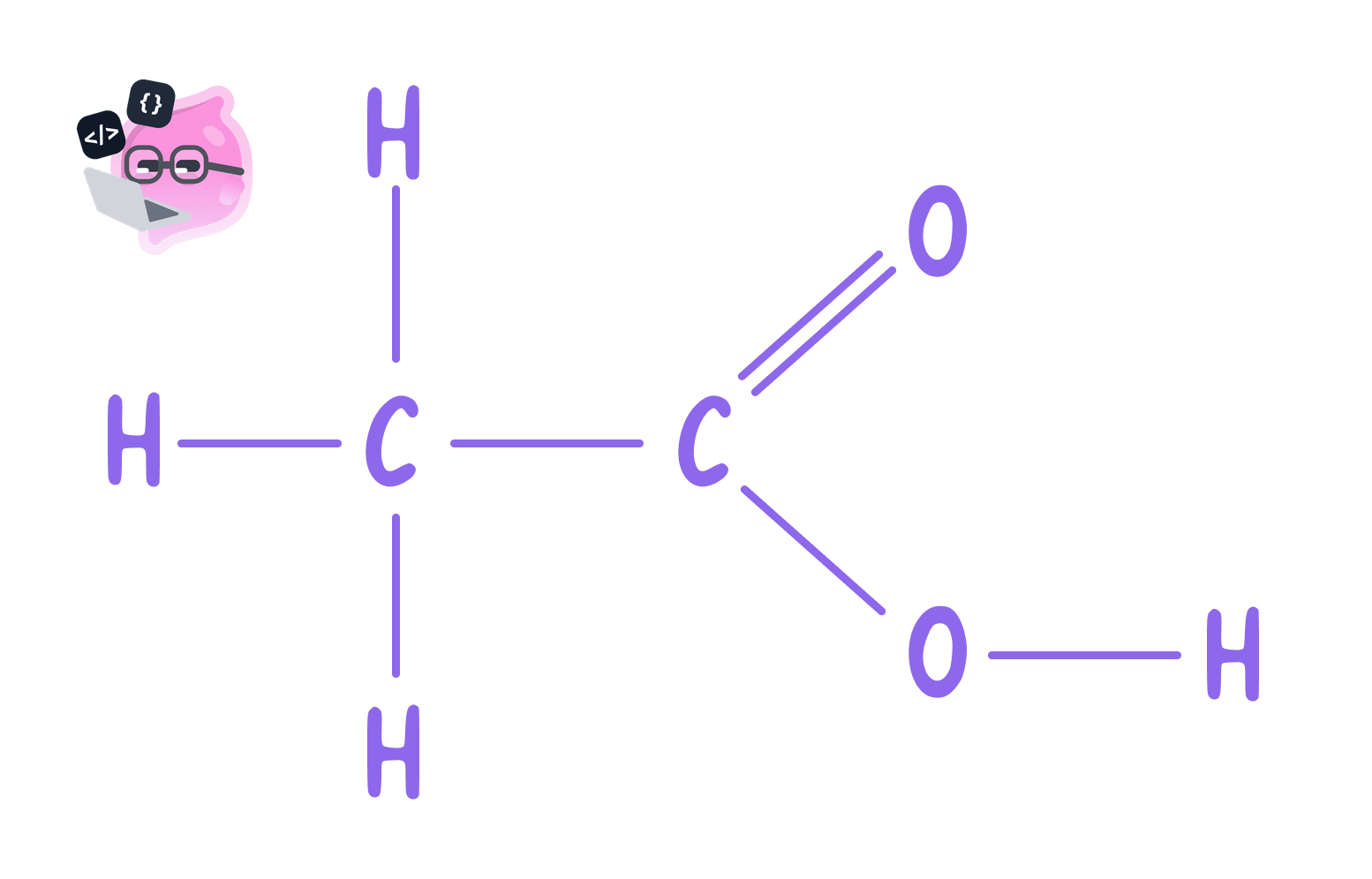
- That group is a carbon joined to an oxygen by a double bond and to an −OH-\text{OH}−OH group.
- It always sits at the end of the carbon chain.
- It is what gives the family its characteristic reactions.
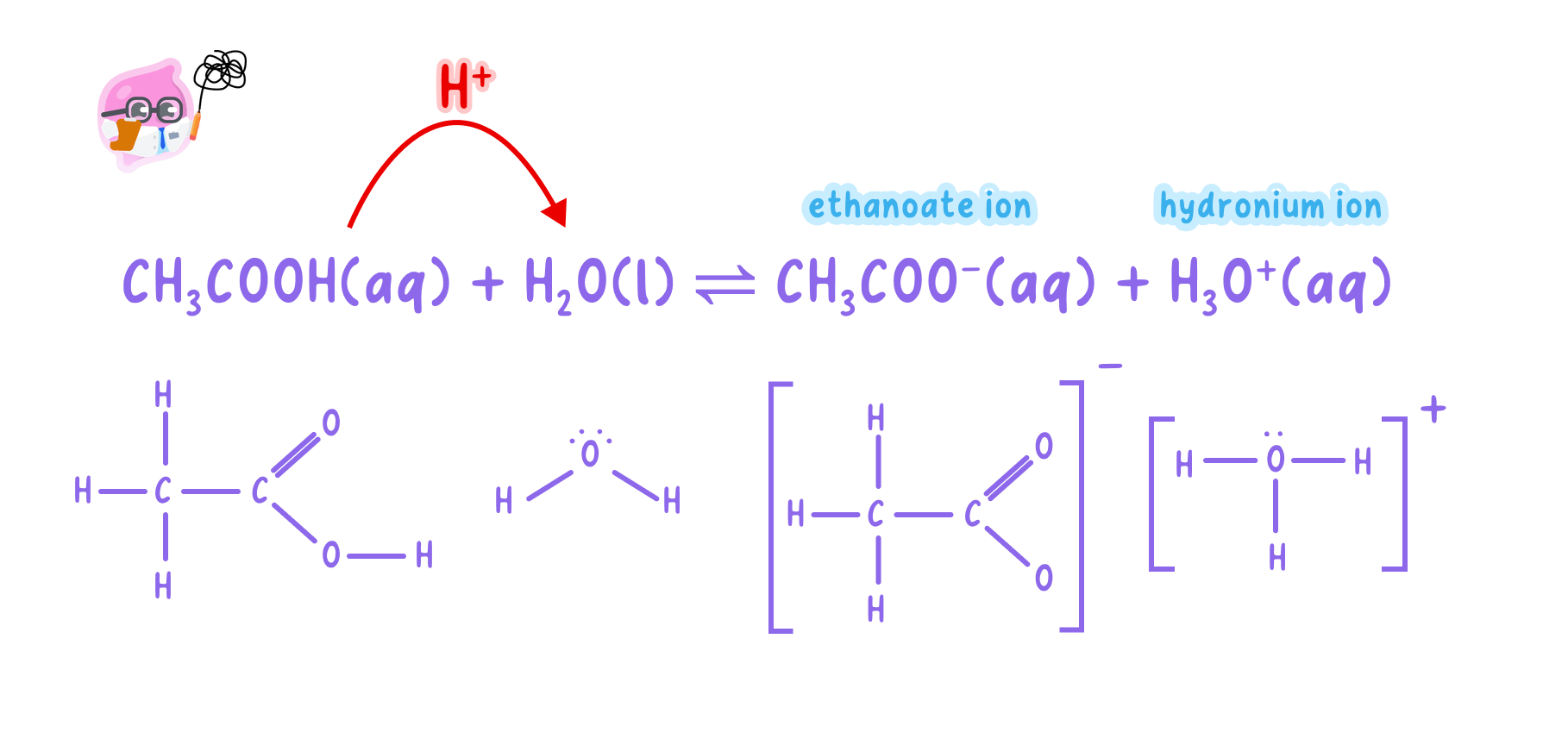
- The −OH-\text{OH}−OH inside it is what releases the hydrogen ion in solution.
Note
Writing the formula as −COOH-\text{COOH}−COOH rather than −CO2H-\text{CO}_2\text{H}−CO2H keeps the two oxygens distinct.
Drawing the structures
- The end carbon shows four bonds: two to one oxygen, one to the other oxygen, and one to the chain.
- The second oxygen carries a hydrogen, completing the −OH-\text{OH}−OH.
- Methanoic acid has a hydrogen in place of the carbon chain.
- Ethanoic acid has a CH3\text{CH}_3CH3 group attached to the −COOH-\text{COOH}−COOH.
- Counting two oxygens in the group is the usual check on the structure.
Example
- Methanoic acid: HCOOH\text{HCOOH}HCOOH, one carbon in all.
- Ethanoic acid: CH3COOH\text{CH}_3\text{COOH}CH3COOH, two carbons in all.
Their solutions show typical acidic properties
Definition
Acid
A substance that is a source of hydrogen ions when it dissolves in water.
- A carboxylic acid dissolves in water and releases hydrogen ions.
- Its solution therefore has a pH below 7 and turns litmus red.
- It reacts with a metal to give a salt and hydrogen: ethanoic acid+magnesium→magnesium ethanoate+hydrogen\text{ethanoic acid} + \text{magnesium} \rightarrow \text{magnesium ethanoate} + \text{hydrogen}ethanoic acid+magnesium→magnesium ethanoate+hydrogen
- It reacts with a carbonate to give a salt, water and carbon dioxide.
- It reacts with an alkali to give a salt and water, which is neutralisation.
Self review
- Give the formulae of methanoic, ethanoic, propanoic and butanoic acids.
- What is the functional group in a carboxylic acid?
- Describe the structure of ethanoic acid.
- Name the products when ethanoic acid reacts with magnesium.
- What would you see if ethanoic acid were added to a carbonate?
