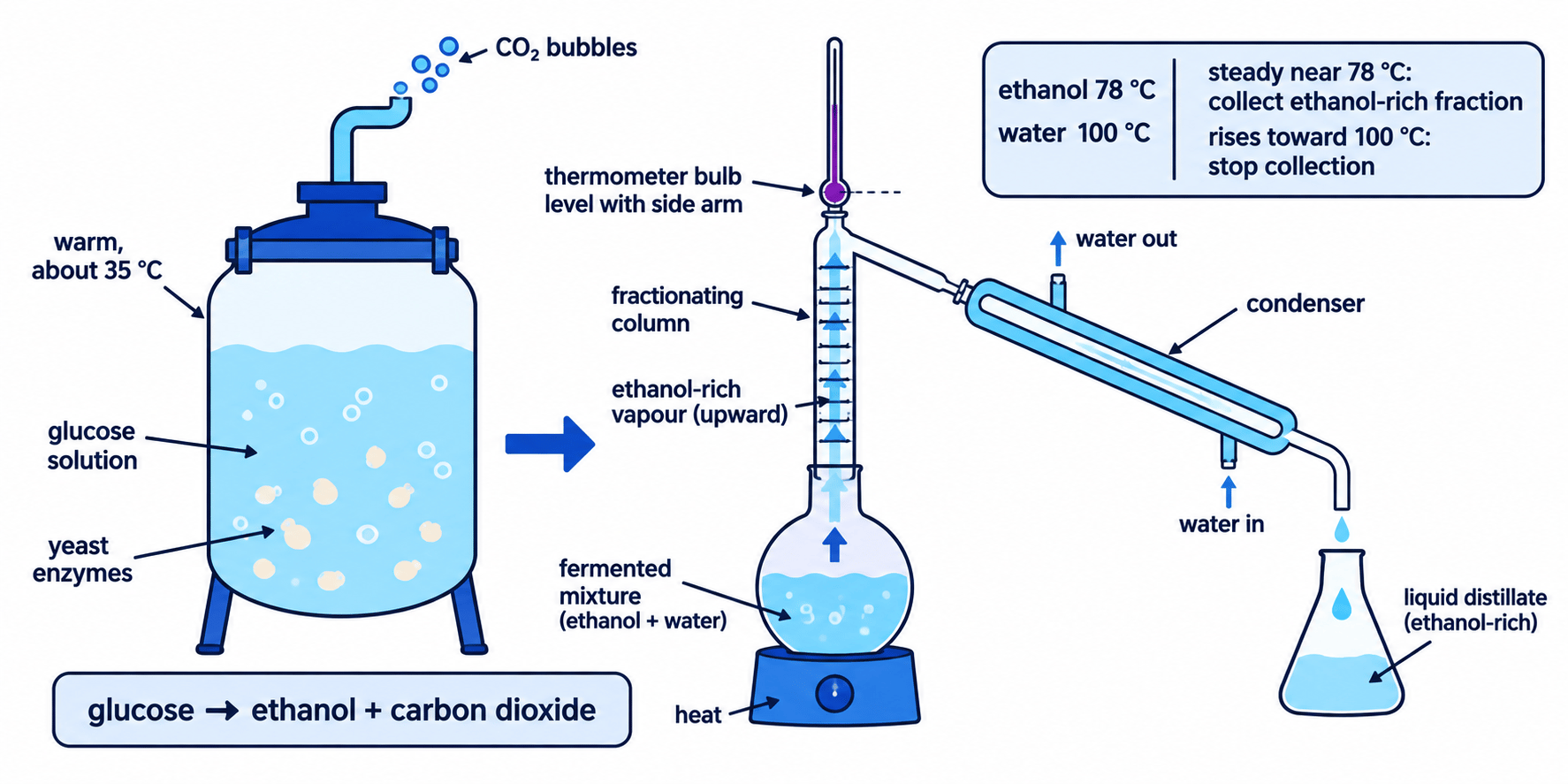
Fermentation converts carbohydrates into ethanol
Definition
Fermentation
The conversion of sugars into ethanol and carbon dioxide by the enzymes in yeast.
Definition
Enzyme
A biological catalyst that speeds up a reaction in a living organism.
- Yeast is added to a solution of carbohydrate in water.
- The yeast supplies the enzymes that bring the reaction about.
- The sugar is converted into ethanol and carbon dioxide: glucose→ethanol+carbon dioxide\text{glucose} \rightarrow \text{ethanol} + \text{carbon dioxide}glucose→ethanol+carbon dioxide
- The carbon dioxide escapes, so the mixture bubbles as the reaction runs.
- The carbohydrate must be in aqueous solution, since the enzymes work in water.
Key Idea
The enzymes in yeast are the catalyst, which is why the conditions suit a living organism.
The conditions fermentation needs
- A warm temperature is used, around body temperature.
- Too cold and the enzymes work too slowly to be useful.
- Too hot and the enzymes are damaged and stop working altogether.
- Air is kept out, because with oxygen the yeast respires aerobically and produces very little ethanol.
- Fermentation stops on its own once the ethanol concentration gets high enough to harm the yeast.
Common Mistake
- Fermentation alone cannot give concentrated ethanol, because the yeast dies first.
- Ethanol left standing in air later sours to ethanoic acid, but that is the work of other microorganisms.
Fractional distillation concentrates the ethanol
Definition
Fractional distillation
A method that separates miscible liquids with close boiling points, using a fractionating column in which vapours repeatedly condense and evaporate.
- The fermented mixture is mostly water, with ethanol dissolved in it.
- Ethanol boils at about 78 ∘C78\ ^{\circ}\text{C}78 ∘C and water at 100 ∘C100\ ^{\circ}\text{C}100 ∘C.
- Heating the mixture makes the ethanol evaporate first.
- The vapour passes up a fractionating column and through a condenser.
- The liquid collected is a far more concentrated solution of ethanol.
Note
The separation works because the two liquids have different boiling points.
Following the temperature during the distillation
- The thermometer bulb is placed level with the side arm, where the vapour leaves.
- The temperature steadies near 78 ∘C78\ ^{\circ}\text{C}78 ∘C while ethanol is distilling over.
- The liquid collected at that temperature is the ethanol-rich fraction.
- A rise towards 100 ∘C100\ ^{\circ}\text{C}100 ∘C shows that water is now coming over.
- Collection is stopped at that point, so that the product stays concentrated.
Self review
- What does yeast supply in fermentation?
- Write the word equation for the fermentation of glucose.
- Why must air be kept out during fermentation?
- Why does fermentation stop on its own?
- Why does ethanol distil over before water?