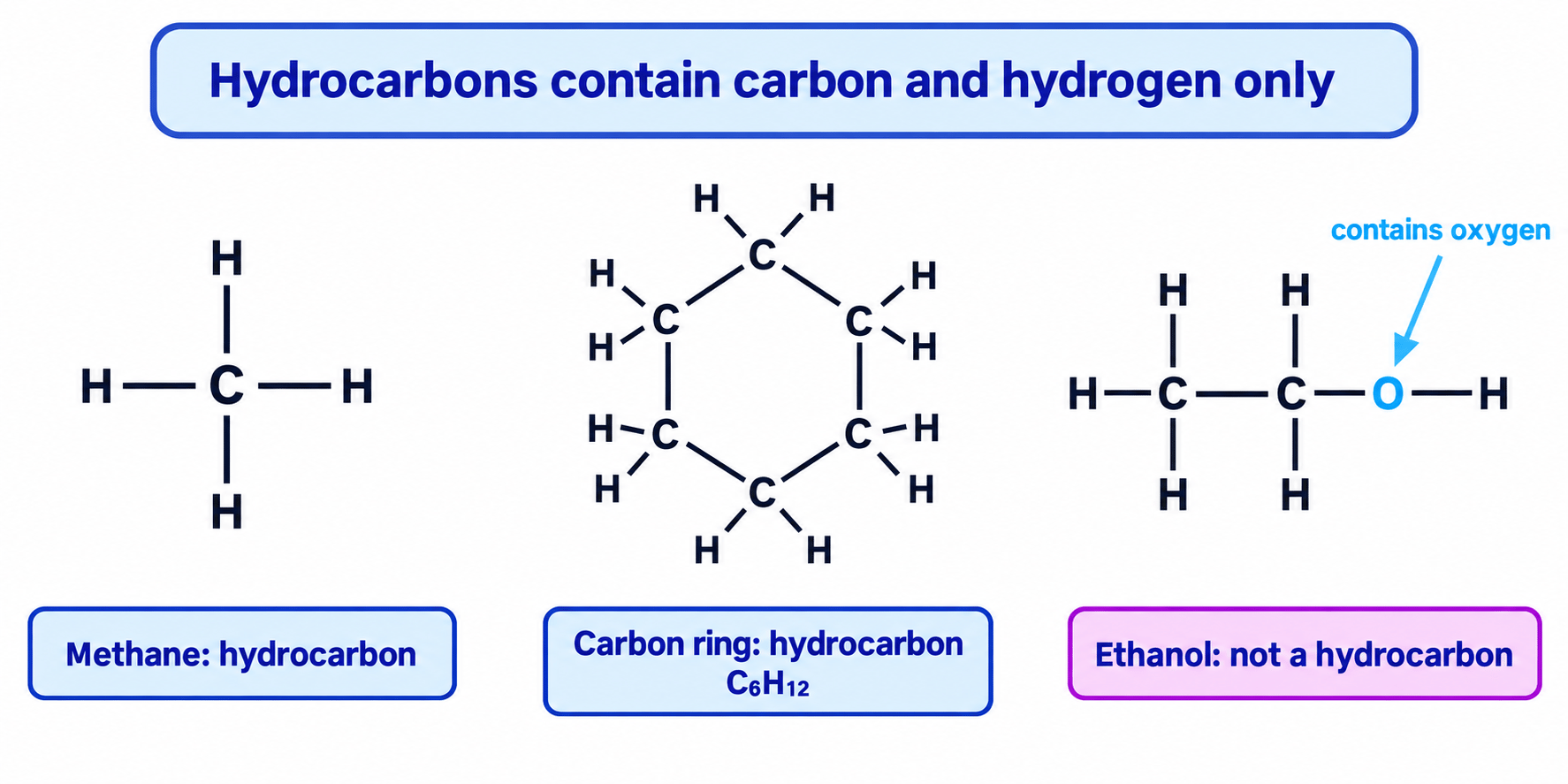
A hydrocarbon contains carbon and hydrogen only
Definition
Hydrocarbon
A compound that contains carbon and hydrogen only.
- Only two elements are present, and any third element rules the compound out.
- Methane, CH4\text{CH}_4CH4, is the simplest hydrocarbon.
- Ethanol contains oxygen as well, so it is not a hydrocarbon.
- The carbon atoms are joined to one another in chains or in rings.
- Carbon forms four bonds, which is what allows those long chains to exist.
Key Idea
Checking the formula for any element other than carbon and hydrogen settles the question at once.
Crude oil is a complex mixture of hydrocarbons
Definition
Crude oil
A complex mixture of hydrocarbons formed over millions of years, used as a source of fuels and of feedstock for the petrochemical industry.
Definition
Mixture
Two or more substances present together but not chemically bonded to each other.
- Crude oil holds a very large number of different hydrocarbons mixed together.
- The substances are not chemically joined, so they keep their own properties.
- Their molecules differ in the length of the carbon chain they contain.
- Some of the molecules have their carbon atoms arranged in rings rather than chains.
- A mixture can be separated by physical means, which is what makes crude oil useful.
Note
The names and structures of the ring molecules are not part of this course.
Crude oil formed over millions of years
Definition
Fossil fuel
A fuel formed over millions of years from the remains of living organisms, which is used up far faster than it forms.
- Crude oil formed from the remains of ancient organisms buried in mud on the sea floor.
- Heat and pressure over millions of years turned those remains into oil.
- It is therefore a fossil fuel, like natural gas and coal.
- New oil forms far more slowly than the rate at which it is taken out of the ground.
- Crude oil is a finite resource, so the supply will eventually run out.
Common Mistake
Finite means the supply is limited, not that it will run out on a particular date.
Crude oil supplies fuels and feedstock
- Most of the crude oil taken from the ground is burned as fuel.
- Petrol, diesel oil and kerosene all come from crude oil.
- The rest is used as feedstock, the raw material for the petrochemical industry.
- That industry makes polymers, solvents, detergents and medicines from oil molecules.
- Burning oil as fuel uses it up, while using it as feedstock turns it into lasting products.
Example
- As a fuel: petrol burned in a car engine.
- As feedstock: ethene turned into poly(ethene) for plastic bags.
Self review
- What two elements does a hydrocarbon contain?
- Why is crude oil described as a mixture?
- Why is crude oil a finite resource?
- Give one use of crude oil other than as a fuel.
- Is ethanol a hydrocarbon? Explain your answer.