Activation energy is the minimum a collision must carry
Definition
Activation energy
The minimum energy that colliding particles must have for a reaction to happen.
- Colliding particles react only if they bring at least a certain minimum energy.
- That minimum is the activation energy for the reaction.
- A collision with less than it leaves the particles unchanged.
- Energy is needed because the bonds in the reactants have to be broken first.
- A high activation energy makes a reaction slow, because few collisions clear the bar.
Key Idea
Activation energy is a property of the reaction, not of how much reactant is present.
A reaction profile plots energy against progress
Definition
Reaction profile
A diagram showing the energy of the reactants and products during a reaction, and the activation energy between them.
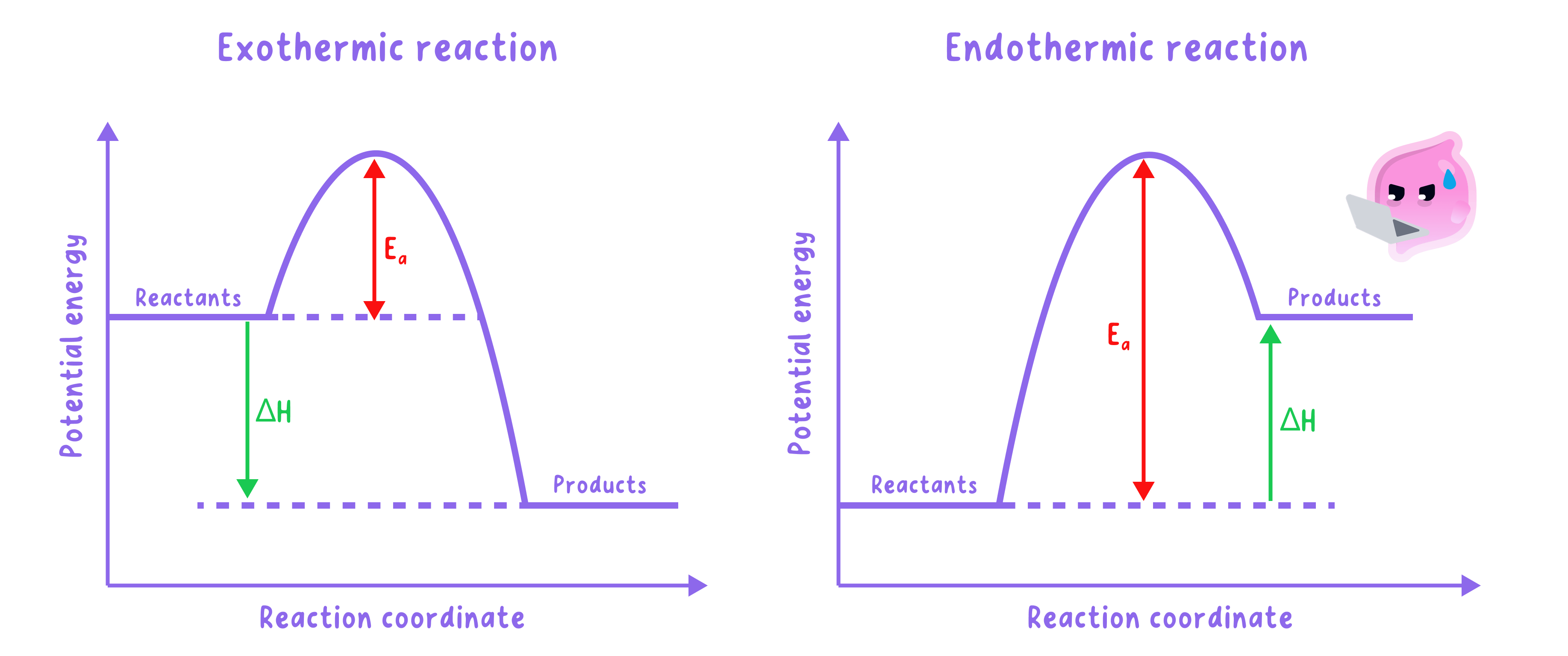
- The horizontal axis shows the progress of the reaction, from reactants to products.
- The vertical axis shows the energy of the substances.
- The reactants sit at the left of the diagram and the products at the right.
- Between them the line rises to a peak and then falls.
- The peak is the point at which the old bonds have broken and the new ones have not yet formed.
Note
The height of the peak above the reactants is the activation energy, whichever type of reaction is drawn.
An exothermic profile ends lower than it starts
- In an exothermic reaction the products hold less energy than the reactants.
- The product line is therefore drawn below the reactant line.
- The line still rises to a peak first, because bonds must be broken to get started.
- The drop from reactants to products is the overall energy change.
- That difference is the energy given out to the surroundings.
Example
Combustion: the products sit well below the reactants, and the drop is the energy released.
An endothermic profile ends higher than it starts
- In an endothermic reaction the products hold more energy than the reactants.
- The product line is therefore drawn above the reactant line.
- The peak sits above both, so the activation energy is still measured from the reactants up.
- The rise from reactants to products is the overall energy change.
- That difference is the energy taken in from the surroundings.
Common Mistake
The activation energy is measured from the reactants to the peak, never from the products.
Labelling a reaction profile
- Both axes are labelled, energy on the vertical and progress of reaction on the horizontal.
- The reactants and the products are each labelled on their own level.
- An arrow from the reactant level to the peak is labelled activation energy.
- An arrow between the reactant and product levels is labelled the overall energy change.
- The direction of that second arrow shows whether the reaction is exothermic or endothermic.
Self review
- What is meant by the activation energy of a reaction?
- What do the two axes of a reaction profile show?
- Where are the products drawn on an exothermic profile?
- From which level is the activation energy measured?
- Which two arrows are labelled on a complete reaction profile?
