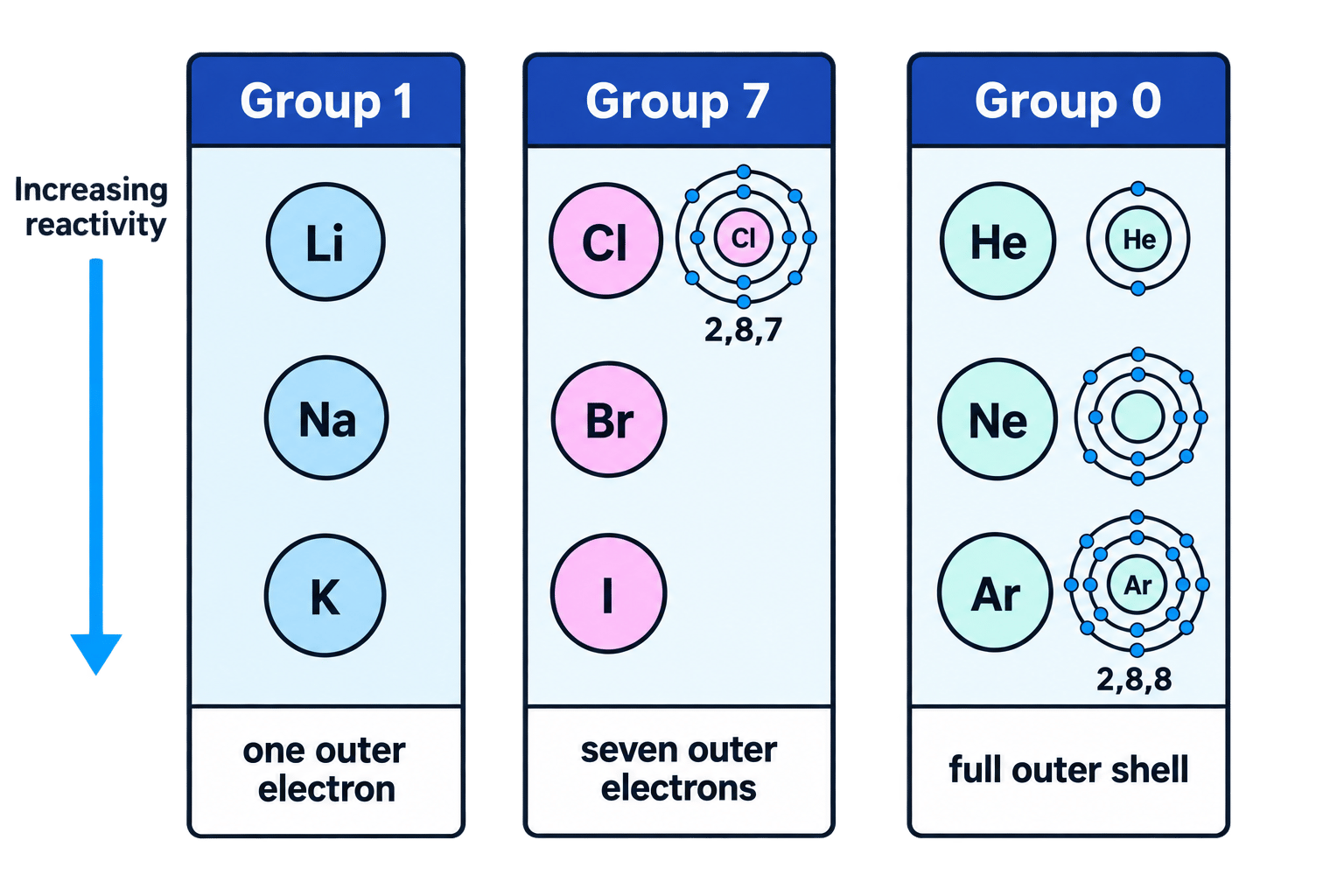
7.1.1 Classifying elements by group in the periodic table
A group collects elements that behave alike
Group
A vertical column of the periodic table, whose elements have the same number of outer-shell electrons and so have similar chemical properties.
Periodic table
A chart of all the elements arranged in order of increasing atomic number, so that elements with similar properties fall in the same column.
- Elements in the same group are placed together because they react in similar ways.
- Every element in a main group has the same number of electrons in its outer shell.
- That shared outer arrangement is what makes their chemistry similar.
- For the main groups the group number gives that count, except for Group 0.
- Three groups have names of their own: Group 1, Group 7 and Group 0.
Position in the table is not a label applied afterwards: it predicts how an element will react.
Group 1 elements are the alkali metals
Alkali metal
An element in Group 1 of the periodic table, which has one electron in its outer shell.
- The alkali metals make up Group 1, and include lithium, sodium and potassium.
- Each has one electron in its outer shell.
- Losing that single electron leaves an ion with a charge of 1+1+1+.
- They are metals, so they are shiny when freshly cut and conduct electricity.
- Hydrogen sits above them in many layouts but is a non-metal and is not an alkali metal.
The name comes from the alkaline solutions these metals give when they react with water.
Group 7 elements are the halogens
Halogen
An element in Group 7 of the periodic table, which has seven electrons in its outer shell.
- The halogens make up Group 7, and include chlorine, bromine and iodine.
- Each has seven electrons in its outer shell.
- Gaining one electron completes the shell and gives an ion with a charge of 1−1-1−.
- They are non-metals, and they exist as molecules of two atoms such as Cl2\text{Cl}_2Cl2.
- Their compounds with metals are called halides, as in sodium chloride.
- Chlorine: seven outer electrons, forms Cl−\text{Cl}^{-}Cl−.
- Sodium: one outer electron, forms Na+\text{Na}^{+}Na+.
- Together: the two ions give sodium chloride, NaCl\text{NaCl}NaCl.
Group 0 elements are the noble gases
Noble gas
An element in Group 0 of the periodic table, which has a full outer shell of electrons.
- The noble gases make up Group 0, and include helium, neon and argon.
- Each has a full outer shell, which is eight electrons for every one except helium.
- Helium is full with two electrons, because the first shell holds only two.
- Having a full shell means there is nothing to gain, lose or share, so they barely react.
- The group number 000 reflects that they form no ordinary compounds, not that they have no outer electrons.
Group 000 is the one place where the group number does not give the count of outer electrons.
The electronic configuration places an element in its group
Electronic configuration
The arrangement of an atom's electrons in its shells, written as the number in each shell from the innermost outwards.
- Writing out the electron arrangement shows how many electrons occupy the outer shell.
- Sodium is 2,8,12,8,12,8,1, so its single outer electron places it in Group 1.
- Chlorine is 2,8,72,8,72,8,7, so its seven outer electrons place it in Group 7.
- Argon is 2,8,82,8,82,8,8, so its full outer shell places it in Group 0.
- Two elements with the same outer count sit in the same group however many inner shells they have.
- What do all the elements in a group have in common?
- How many outer electrons does a halogen atom have?
- Why is helium a noble gas when it has only two outer electrons?
- Which group does an element with the configuration 2,8,12,8,12,8,1 belong to?
- Why does the group number not give the outer electron count for Group 0?
7.1.2 Properties and reactions of the alkali metals
The alkali metals are soft and melt at low temperatures
Alkali metal
An element in Group 1 of the periodic table, which has one electron in its outer shell.
- Lithium, sodium and potassium are soft enough to be cut with a knife.
- A freshly cut surface is shiny, then dulls within seconds as it reacts with air.
- Their melting points are low for metals, and they fall down the group.
- Sodium melts at about 98 ∘C98\ ^{\circ}\text{C}98 ∘C, which is below the boiling point of water.
- They are stored under oil to keep air and moisture away from the metal.
Softness and low melting points set these metals apart from typical metals such as iron.
Lithium, sodium and potassium all react with water
- Each of the three gives an alkaline solution and a gas: metal+water→metal hydroxide+hydrogen\text{metal} + \text{water} \rightarrow \text{metal hydroxide} + \text{hydrogen}metal+water→metal hydroxide+hydrogen
- Lithium fizzes steadily, floats, and slowly disappears.
- Sodium melts into a ball that darts across the surface, fizzing rapidly.
- Potassium reacts so vigorously that the hydrogen ignites with a lilac flame.
- The solution left behind turns universal indicator purple, because a hydroxide has formed.
- Sodium and water: 2Na+2H2O→2NaOH+H22\text{Na} + 2\text{H}_2\text{O} \rightarrow 2\text{NaOH} + \text{H}_22Na+2H2O→2NaOH+H2.
- The gas test: a lit splint gives a squeaky pop, confirming hydrogen.
Reactivity increases down the group
- The three reactions differ in vigour, not in the products they give.
- Lithium is the least vigorous of the three and potassium the most.
- The order lithium, sodium, potassium is therefore an order of increasing reactivity.
- The same order appears in how quickly each metal tarnishes in air.
- A pattern that holds for three members of a group can be extended to the rest of it.
Rubidium and caesium react explosively with water, so neither is used in a school demonstration.
Predicting the reactivity of rubidium and caesium
- Rubidium lies below potassium, so it reacts with water more vigorously than potassium does.
- Caesium lies below rubidium, so it is more vigorous still.
- The products follow the same pattern, so rubidium gives: 2Rb+2H2O→2RbOH+H22\text{Rb} + 2\text{H}_2\text{O} \rightarrow 2\text{RbOH} + \text{H}_22Rb+2H2O→2RbOH+H2
- Their melting points continue to fall, so caesium melts a little above room temperature.
- A prediction of this kind is made by extending the trend, not by recalling a result.
A prediction is worth stating together with the trend it comes from.
Electronic configuration explains the pattern
Electronic configuration
The arrangement of an atom's electrons in its shells, written as the number in each shell from the innermost outwards.
- Every alkali metal atom has one electron in its outer shell, and reacting means losing it.
- Down the group each atom has more shells, so the outer electron sits further from the nucleus.
- The inner shells also shield the outer electron from the nucleus's positive charge.
- Distance and shielding together mean the outer electron is held less strongly.
- An electron that is lost more easily makes the metal more reactive, which is the pattern observed.
- An explanation of the trend needs three parts: more shells, greater distance, and more shielding.
- The conclusion is that the outer electron is lost more easily, which is what reactivity means here.
- Naming the products is not an explanation, because all three metals give the same products.
- Name two physical properties that make the alkali metals unusual for metals.
- Write the word equation for an alkali metal reacting with water.
- How does the reaction of potassium differ from that of lithium?
- Predict what happens when rubidium is added to water.
- Why does reactivity increase down Group 1?