7.2.1 Physical properties of the halogens
Colours and states of the halogens at room temperature
Halogen
An element in Group 7 of the periodic table, which has seven electrons in its outer shell.
- Chlorine is a pale green gas.
- Bromine is a red-brown liquid that gives off an orange vapour.
- Iodine is a dark grey solid that forms a purple vapour when warmed.
- All three exist as molecules of two atoms, written Cl2\text{Cl}_2Cl2, Br2\text{Br}_2Br2 and I2\text{I}_2I2.
- The colours deepen down the group, from pale green through red-brown to almost black.
Gas, liquid and solid in one group is itself the pattern: the state changes as you go down.
Melting and boiling points rise down the group
- Chlorine boils at about −34 ∘C-34\ ^{\circ}\text{C}−34 ∘C, well below room temperature.
- Bromine boils at about 59 ∘C59\ ^{\circ}\text{C}59 ∘C, so it is a liquid at room temperature.
- Iodine melts at about 114 ∘C114\ ^{\circ}\text{C}114 ∘C, so it is a solid at room temperature.
- Both melting point and boiling point increase steadily down the group.
- The change of state from gas to liquid to solid is a direct consequence of that rise.
- Room temperature: chlorine gas, bromine liquid, iodine solid.
- The reason: room temperature lies above chlorine's boiling point and below iodine's melting point.
Larger molecules are held to one another more strongly
Intermolecular force
A force of attraction between neighbouring molecules, much weaker than the covalent bonds inside a molecule.
- A halogen is a simple molecular substance, so melting separates whole molecules.
- The intermolecular forces between molecules are what has to be overcome.
- Molecules get larger down the group, from Cl2\text{Cl}_2Cl2 to Br2\text{Br}_2Br2 to I2\text{I}_2I2.
- Larger molecules attract one another more strongly, so more energy is needed to separate them.
- The covalent bonds inside each molecule are not broken when a halogen melts or boils.
Melting a halogen separates its molecules, so the strength of the covalent bond is not what matters.
Predicting fluorine and astatine
- Fluorine sits above chlorine, so its melting and boiling points are lower still.
- Fluorine is therefore a gas at room temperature, and its colour is paler than chlorine's.
- Astatine sits below iodine, so its melting and boiling points are higher.
- Astatine is therefore a solid at room temperature, and darker than iodine.
- Each prediction extends the trend rather than recalling a measured value.
A prediction is stated as a direction along the trend, such as higher or darker, rather than as a figure.
Reading a table of halogen data
- Data are usually laid out in group order, from fluorine at the top downwards.
- Checking that a quantity rises or falls steadily confirms which trend is present.
- A state at room temperature is deduced by comparing 20 ∘C20\ ^{\circ}\text{C}20 ∘C with the melting and boiling points.
- A value above the boiling point means a gas, and below the melting point means a solid.
- A missing entry is filled by placing the element in the order and reading the neighbouring values.
- Give the colour and state of chlorine, bromine and iodine at room temperature.
- What happens to boiling point down Group 7?
- Why does iodine have a higher melting point than chlorine?
- Predict the state and colour of astatine.
- How do you decide from a data table whether an element is a liquid at room temperature?
7.2.2 Reactions of the halogens
The chemical test for chlorine
- Damp blue litmus paper is held in the gas being tested.
- Chlorine turns the paper red and then bleaches it white.
- The bleaching is the part that identifies chlorine, since other acidic gases only turn it red.
- The paper must be damp, because the gas has to dissolve before it can act.
- The test is carried out in a fume cupboard, as chlorine is toxic.
Red then white is the full result: red alone does not identify chlorine.
Halogens react with metals to form metal halides
Metal halide
A compound formed when a metal reacts with a halogen.
- A halogen reacts with a metal to give an ionic compound.
- The metal atoms lose electrons and the halogen atoms gain them.
- Sodium burns in chlorine with a bright yellow flame: 2Na+Cl2→2NaCl2\text{Na} + \text{Cl}_2 \rightarrow 2\text{NaCl}2Na+Cl2→2NaCl
- Hot iron wool reacts with chlorine to give a brown solid: 2Fe+3Cl2→2FeCl32\text{Fe} + 3\text{Cl}_2 \rightarrow 2\text{FeCl}_32Fe+3Cl2→2FeCl3
- The product is named from the halogen, giving a chloride, bromide or iodide.
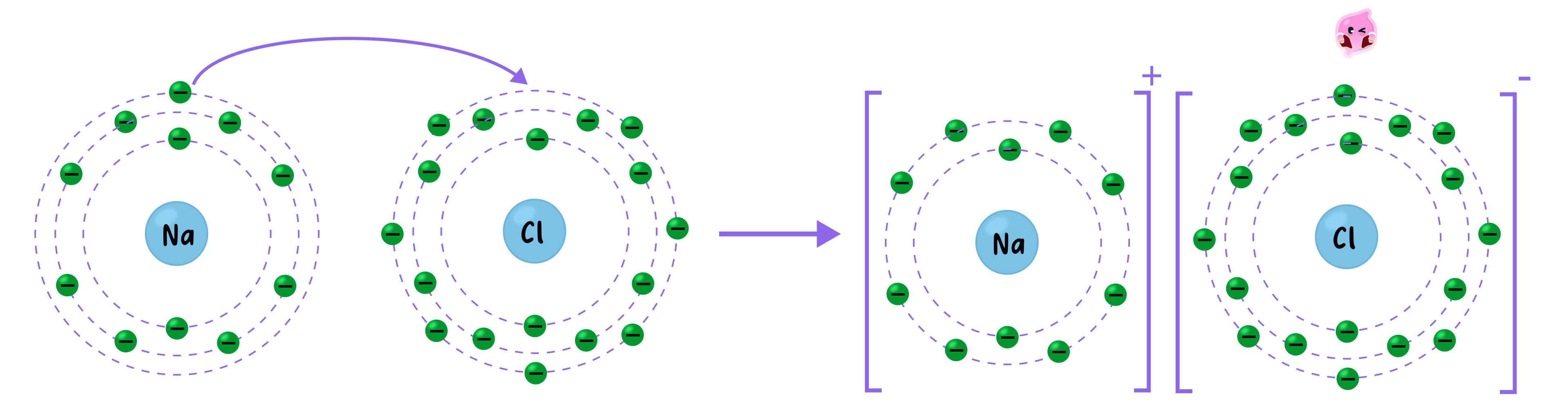
- Sodium and chlorine: sodium chloride, a white solid.
- Sodium and bromine: sodium bromide, by the same pattern.
- Iron and chlorine: iron(III) chloride, a brown solid.
Predicting the reaction of other halogens with metals
- Every halogen reacts with a metal in the same way, differing only in vigour.
- The reaction gets less vigorous down the group, so iodine reacts more slowly than chlorine.
- The general pattern lets any metal halide be predicted: metal+halogen→metal halide\text{metal} + \text{halogen} \rightarrow \text{metal halide}metal+halogen→metal halide
- The charge on the metal ion decides the formula, so magnesium gives MgCl2\text{MgCl}_2MgCl2.
- A halide ion always carries a charge of 1−1-1−, whichever halogen it came from.
Predicting a formula means balancing the charges, not copying the pattern of sodium chloride.
Halogens form hydrogen halides
Hydrogen halide
A compound of hydrogen and a halogen, which dissolves in water to give an acidic solution.
- A halogen reacts with hydrogen to give a compound of the two.
- Hydrogen and chlorine give hydrogen chloride: H2+Cl2→2HCl\text{H}_2 + \text{Cl}_2 \rightarrow 2\text{HCl}H2+Cl2→2HCl
- The bonding here is covalent, because both elements are non-metals.
- Bromine gives hydrogen bromide and iodine gives hydrogen iodide, by the same pattern.
- All the hydrogen halides are gases at room temperature.
The reaction with hydrogen is less vigorous down the group, as with the metals.
Hydrogen halides dissolve to give acidic solutions
Acid
A substance that is a source of hydrogen ions when it dissolves in water.
- A hydrogen halide is very soluble in water.
- On dissolving it splits into ions, releasing hydrogen ions into the solution.
- Hydrogen ions are what make a solution acidic, so the solution has a low pH.
- Hydrogen chloride dissolved in water is hydrochloric acid.
- Hydrogen bromide and hydrogen iodide give hydrobromic and hydroiodic acid in the same way.
- Describe the test for chlorine and its full result.
- Write the equation for sodium reacting with chlorine.
- Predict the product when magnesium reacts with bromine, and give its formula.
- What type of bonding holds a hydrogen halide together?
- Why is a solution of hydrogen chloride acidic?
7.2.3 Relative reactivity and displacement reactions of the halogens
A more reactive halogen displaces a less reactive one
Displacement reaction
A reaction in which a more reactive metal takes the place of a less reactive metal in a compound.
Halide ion
The negative ion formed when a halogen atom gains one electron.
- A halogen is added to a solution containing the halide ion of another halogen.
- If the added halogen is more reactive, it takes the place of the one in the compound.
- The displaced halogen is set free and colours the solution.
- If the added halogen is less reactive, nothing happens at all.
- Testing every pair in turn puts the halogens in order of reactivity.
A colour appearing means a reaction; no change is an equally useful result.
What the displacement tests show
- Chlorine displaces bromine, turning the solution orange: Cl2+2KBr→2KCl+Br2\text{Cl}_2 + 2\text{KBr} \rightarrow 2\text{KCl} + \text{Br}_2Cl2+2KBr→2KCl+Br2
- Chlorine displaces iodine, turning the solution brown: Cl2+2KI→2KCl+I2\text{Cl}_2 + 2\text{KI} \rightarrow 2\text{KCl} + \text{I}_2Cl2+2KI→2KCl+I2
- Bromine displaces iodine, again turning the solution brown: Br2+2KI→2KBr+I2\text{Br}_2 + 2\text{KI} \rightarrow 2\text{KBr} + \text{I}_2Br2+2KI→2KBr+I2
- Iodine displaces neither chlorine nor bromine, so those mixtures show no change.
- Bromine does not displace chlorine, which completes the picture.
- Chlorine water with potassium bromide: colourless to orange.
- Chlorine water with potassium iodide: colourless to brown.
- Iodine solution with potassium chloride: no change.
Reactivity decreases down the group
- Chlorine displaces both of the others, so it is the most reactive of the three.
- Bromine displaces iodine but not chlorine, so it sits between them.
- Iodine displaces neither, so it is the least reactive of the three.
- The order chlorine, bromine, iodine is therefore one of decreasing reactivity.
- This runs opposite to Group 1, where reactivity increases down the group.
The two groups trend in opposite directions, because one loses an electron and the other gains one.
Predicting astatine
- Astatine lies below iodine, so it is less reactive than iodine.
- It would therefore displace none of chlorine, bromine or iodine from their compounds.
- Any of the three would displace astatine from a solution of an astatide.
- Chlorine and potassium astatide would react: Cl2+2KAt→2KCl+At2\text{Cl}_2 + 2\text{KAt} \rightarrow 2\text{KCl} + \text{At}_2Cl2+2KAt→2KCl+At2
- Fluorine, above chlorine, would displace every one of the others.
A prediction here rests on position in the group, and is stated with that reason attached.
Electronic configuration explains the trend
Electronic configuration
The arrangement of an atom's electrons in its shells, written as the number in each shell from the innermost outwards.
- Every halogen atom has seven outer electrons, and reacting means gaining one more.
- Down the group each atom has more shells, so the outer shell sits further from the nucleus.
- The inner shells also shield the outer shell from the nucleus's positive charge.
- Distance and shielding together mean an incoming electron is attracted less strongly.
- An electron that is gained less easily makes the halogen less reactive, which is the pattern observed.
- What is seen when chlorine water is added to potassium bromide solution?
- Write the equation for bromine reacting with potassium iodide.
- Why does adding iodine to potassium chloride solution give no change?
- Predict whether astatine would displace bromine, and say why.
- Why does reactivity decrease down Group 7 when it increases down Group 1?
7.2.4 Halogen displacement as a redox reaction
Electrons move from the halide ion to the halogen molecule
Redox reaction
A reaction in which oxidation and reduction happen at the same time.
Halide ion
The negative ion formed when a halogen atom gains one electron.
- A halide ion carries an extra electron, which is what gives it its 1−1-1− charge.
- In a displacement the more reactive halogen takes that electron.
- Loss of electrons is oxidation and gain of electrons is reduction.
- Both happen in the same reaction, which makes the displacement a redox change.
- The electrons pass directly between the two species, with no circuit involved.
The halide ion is oxidised and the free halogen molecule is reduced, in every one of these reactions.
Half equations show each change separately
Half equation
An equation showing the electrons gained or lost by the species reacting at one electrode.
- Bromide ions lose electrons, which is oxidation: 2Br−→Br2+2e−2\text{Br}^{-} \rightarrow \text{Br}_2 + 2\text{e}^{-}2Br−→Br2+2e−
- Chlorine molecules gain electrons, which is reduction: Cl2+2e−→2Cl−\text{Cl}_2 + 2\text{e}^{-} \rightarrow 2\text{Cl}^{-}Cl2+2e−→2Cl−
- Two halide ions are needed in each half equation, because a halogen molecule holds two atoms.
- The electrons lost in one half equation equal the electrons gained in the other.
- Adding the two together cancels the electrons and rebuilds the overall change.
Electrons sit on the right of an oxidation half equation and on the left of a reduction one.
Naming what is oxidised and what is reduced
- The species that loses electrons is the one oxidised, which is the halide ion.
- The species that gains electrons is the one reduced, which is the free halogen.
- Charge is the giveaway: Br−\text{Br}^{-}Br− to Br2\text{Br}_2Br2 is a loss, since the charge rises to zero.
- Cl2\text{Cl}_2Cl2 to Cl−\text{Cl}^{-}Cl− is a gain, since the charge falls from zero to 1−1-1−.
- Naming the substance rather than the element is what makes the answer unambiguous.
- Oxidised: the bromide ion, Br−\text{Br}^{-}Br−, losing an electron each.
- Reduced: chlorine, Cl2\text{Cl}_2Cl2, gaining two electrons in all.
- Spectator: the potassium ion, K+\text{K}^{+}K+, unchanged throughout.
The ionic equation leaves out the spectators
Ionic equation
An equation that shows only the ions and substances that change during a reaction, with the spectator ions left out.
Spectator ion
An ion that is unchanged by the reaction and appears on both sides of the full ionic equation, so it is cancelled out.
- Potassium bromide in solution is present as separate K+\text{K}^{+}K+ and Br−\text{Br}^{-}Br− ions.
- The potassium ions are unchanged on both sides, so they take no part.
- Leaving them out gives the ionic equation: Cl2+2Br−→2Cl−+Br2\text{Cl}_2 + 2\text{Br}^{-} \rightarrow 2\text{Cl}^{-} + \text{Br}_2Cl2+2Br−→2Cl−+Br2
- Only the species whose charge changes remain in the equation.
- The same ionic equation describes the reaction whichever soluble bromide was used.
An ionic equation balances for charge as well as for atoms, which is a quick way to check it.
A worked example: chlorine and potassium iodide
- Chlorine is above iodine, so the iodide ions are the species that lose electrons.
- The oxidation half equation is: 2I−→I2+2e−2\text{I}^{-} \rightarrow \text{I}_2 + 2\text{e}^{-}2I−→I2+2e−
- The reduction half equation is: Cl2+2e−→2Cl−\text{Cl}_2 + 2\text{e}^{-} \rightarrow 2\text{Cl}^{-}Cl2+2e−→2Cl−
- Adding them and cancelling the electrons gives: Cl2+2I−→2Cl−+I2\text{Cl}_2 + 2\text{I}^{-} \rightarrow 2\text{Cl}^{-} + \text{I}_2Cl2+2I−→2Cl−+I2
- The solution turns brown as iodine is released, which is the visible evidence.
- An answer names the substance oxidised and the substance reduced, then says which electrons moved.
- Colour change is evidence of a reaction, not an explanation of the electron transfer.
- Two half equations are added only once the electrons on each side are equal.
- In a halogen displacement, which species is oxidised?
- Write the half equation for iodide ions forming iodine.
- Why do two halide ions appear in each half equation?
- Write the ionic equation for chlorine reacting with bromide ions.
- Why is the potassium ion described as a spectator?
