Diamond and graphite are both giant covalent forms of carbon
Definition
Giant covalent structure
A structure in which a very large number of atoms are joined to their neighbours by strong covalent bonds in a continuous network.
- Both are made only of carbon atoms joined to their neighbours by strong covalent bonds.
- Neither contains separate molecules, so the bonding runs continuously through the whole solid.
- Melting either one means breaking covalent bonds, so both have very high melting points.
- They are the same element, so every difference between them comes from how the atoms are joined.
- Each carbon atom has four outer electrons, and the two structures use them differently.
Key Idea
- Same element, different structure, which is why one is the hardest substance known and the other is soft enough to write with.
- The bonding decides the property, not the identity of the atoms.
Diamond: four bonds pointing in three dimensions
- Each carbon atom in diamond is covalently bonded to four others.
- Those bonds point outwards in three dimensions, giving a rigid network with no layers and no weak direction.
- Moving one atom would mean breaking several strong covalent bonds at once, which is why diamond is so hard.
- All four outer electrons on every carbon atom are used in bonding.
- With no delocalised electrons, diamond does not conduct electricity.
- Diamond is used in cutting tools, because it is hard enough to cut other materials and keeps its shape while doing so.
Example
- Cutting tools: a diamond tip grinds through harder materials without wearing to a different shape.
- No conduction: every outer electron sits in a covalent bond, so none is free to carry charge.
Graphite: three bonds, layers, and one spare electron
Definition
Delocalised electron
An electron that is free to move through a structure instead of being held between two particular atoms.
- Each carbon atom in graphite is covalently bonded to three others.
- Those bonds form flat layers built from hexagonal rings.
- Only weak forces act between one layer and the next.
- The fourth outer electron on each carbon atom is not used in a covalent bond and becomes delocalised.
- Those electrons move along the layers and carry charge, so graphite conducts electricity.
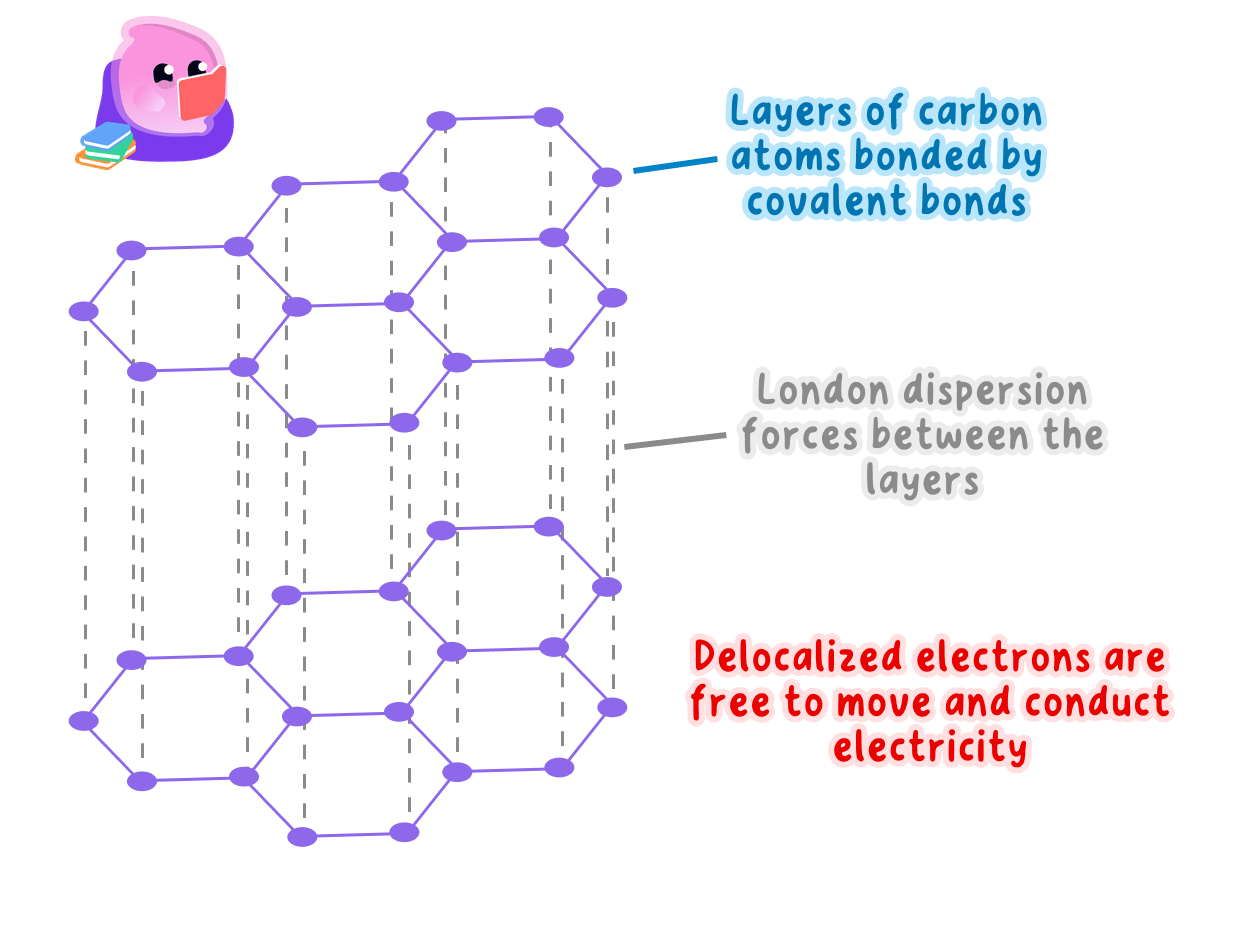
- The weak forces between layers let one layer slide over another, so graphite is soft and slippery.
Common Mistake
- The layers slide, the covalent bonds do not break, so graphite is still graphite after it has lubricated something.
- Electrons move along a layer, not between layers, because nothing bonds one layer to the next.
Diamond and graphite side by side
- Both are giant covalent, so both need an enormous amount of energy to melt.
- Diamond bonds each carbon atom to four others, and graphite bonds each to three.
- Diamond uses all four outer electrons in bonds, and graphite leaves one delocalised per atom.
- Diamond has no layers, and graphite is built from layers held by weak forces.
- Diamond is hard and does not conduct, and graphite is slippery and does conduct.
- Every one of those differences follows from the number of bonds each carbon atom forms.
Note
- Three bonds against four is the single fact that separates the two structures.
- Everything else follows from it, including the spare electron, the layers and the hardness.
From structure to use
- Electrodes: delocalised electrons move along graphite's layers, so graphite carries current into the cell.
- Lubricant: weak forces between graphite's layers let them slide, so friction between surfaces falls.
- Cutting tools: diamond's rigid three-dimensional network of covalent bonds makes it hard enough to cut other materials.
- Graphite also survives high temperatures, because the covalent bonds within each layer are strong.
- Stating only the property leaves out the part of the answer the question is really asking about.
Self review
- Why are diamond and graphite both described as giant covalent?
- How many other carbon atoms is each carbon atom bonded to in diamond, and how many in graphite?
- Why does graphite conduct electricity when diamond does not?
- Why can graphite act as a lubricant?
- Why is diamond used in cutting tools?
