Nanoparticles sit between atoms and everyday particles
Definition
Nanoparticle
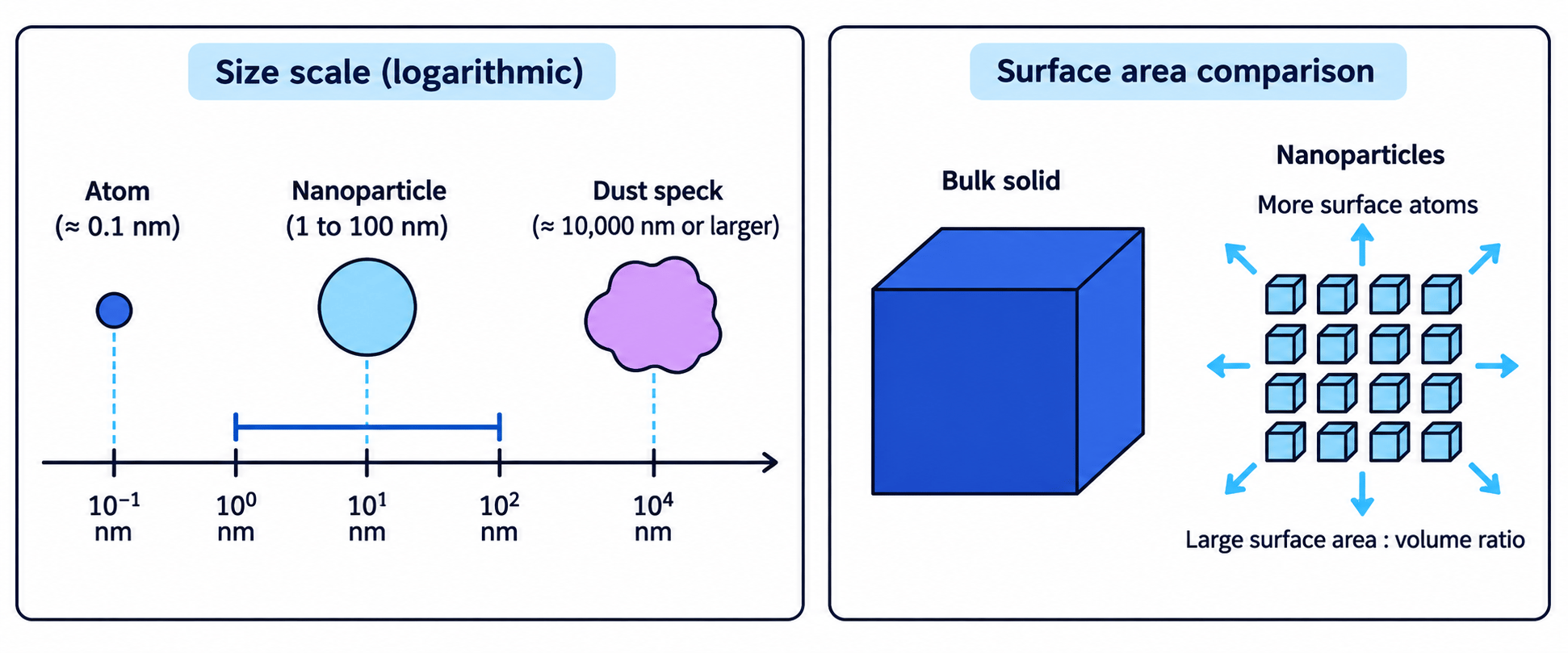
A particle between about 1 and 100 nanometres across, which is far larger than an atom but far smaller than a speck of dust.
- A nanoparticle measures between about 111 and 100100100 nanometres across.
- A single atom is roughly a tenth of a nanometre across.
- A nanoparticle therefore holds anything from a few tens of atoms to many millions.
- It is far larger than an atom or a small molecule, though a large molecule such as a protein reaches this size.
- It is far smaller than anything visible, including a speck of dust.
Key Idea
Nanoparticles occupy a gap in scale: far larger than ordinary molecules, yet too small to behave like bulk material.
A large surface area to volume ratio changes behaviour
Definition
Surface area to volume ratio
The surface area of a solid compared with its volume, which increases as the solid is broken into smaller pieces.
- Dividing a solid into smaller pieces raises its surface area to volume ratio.
- At nanoparticle size, that ratio becomes very large.
- A large proportion of the atoms therefore sits at the surface.
- Reactions happen at surfaces, so nanoparticles are far more reactive than the bulk material.
- A much smaller mass can therefore do the same job.
Example
- Bulk solid: almost all of its atoms are buried inside.
- Nanoparticles: a large share of the atoms are exposed at the surface.
Uses that depend on that behaviour
- Sunscreens use nanoparticles of titanium dioxide or zinc oxide.
- The particles block ultraviolet light while being too small to look white on the skin.
- An older sunscreen using the bulk powder left a visible white layer.
- Nanoparticle catalysts work with a much smaller mass of expensive metal.
- Other uses include self-cleaning surfaces and stronger, lighter materials.
Note
The sunscreen still blocks the same ultraviolet light: only its appearance on the skin has changed.
The possible risks
- Some may be able to pass through the skin, and they are small enough to be breathed deep into the lungs.
- Their high reactivity may cause effects that the bulk material does not.
- The long-term effects on health are not yet fully known.
- Particles washed off into rivers and the sea may affect wildlife.
- Risk depends on which material the particles are made of, so a result for one says little about another.
Self review
- What size range counts as a nanoparticle?
- How does a nanoparticle compare in size with an atom?
- Why does a large surface area to volume ratio make nanoparticles more reactive?
- Why are nanoparticles used in sunscreens?
- Give two possible risks of using nanoparticles.