Losing or gaining electrons turns an atom into an ion
Definition
Ion
An atom, or a group of atoms, with an overall electrical charge because it has lost or gained electrons.
Definition
Cation
A positively charged ion, formed when an atom or group of atoms loses electrons.
Definition
Anion
A negatively charged ion, formed when an atom or group of atoms gains electrons.
- An atom holds equal numbers of protons and electrons, so its charges cancel and it is neutral.
- Removing an electron leaves more protons than electrons, so the particle carries a positive charge.
- Adding an electron leaves more electrons than protons, so the particle carries a negative charge.
- Only electrons move, because the protons sit inside the nucleus and stay there.
- The size of the charge equals the number of electrons lost or gained.
- A sodium atom that loses one electron becomes Na+\text{Na}^{+}Na+, and a chlorine atom that gains one becomes Cl−\text{Cl}^{-}Cl−.
Key Idea
- Charge comes from an imbalance between the protons and the electrons.
- The nucleus is untouched, so an ion has the same proton number as the atom it came from.
Groups 1, 2, 6 and 7 tell you which ion an atom forms
- For groups 111, 222, 666 and 777, the group number gives the number of outer-shell electrons.
- A group 111 atom loses its single outer electron to form a 1+1+1+ ion.
- A group 222 atom loses both outer electrons to form a 2+2+2+ ion.
- A group 666 atom gains two electrons to form a 2−2-2− ion.
- A group 777 atom gains one electron to form a 1−1-1− ion.
- Either route leaves the ion with a full outer shell, which is why these are the ions that form.
- Groups 111 and 222 hold metals that supply electrons, while groups 666 and 777 hold non-metals that accept them.
Common Mistake
- Group 6 and group 7 atoms gain electrons, so writing that they lose electrons reverses the chemistry.
- A group 7 ion carries a 1−1-1− charge, not 7−7-7−, because only one electron is gained.
An ionic bond is the attraction between the ions that form
Definition
Ionic bond
The strong electrostatic attraction between oppositely charged ions.
- Electron transfer from a metal atom to a non-metal atom produces one positive ion and one negative ion.
- Opposite charges attract, and that attraction is what holds the two ions together.
- The transfer makes the ions, and the attraction that follows is the bond itself.
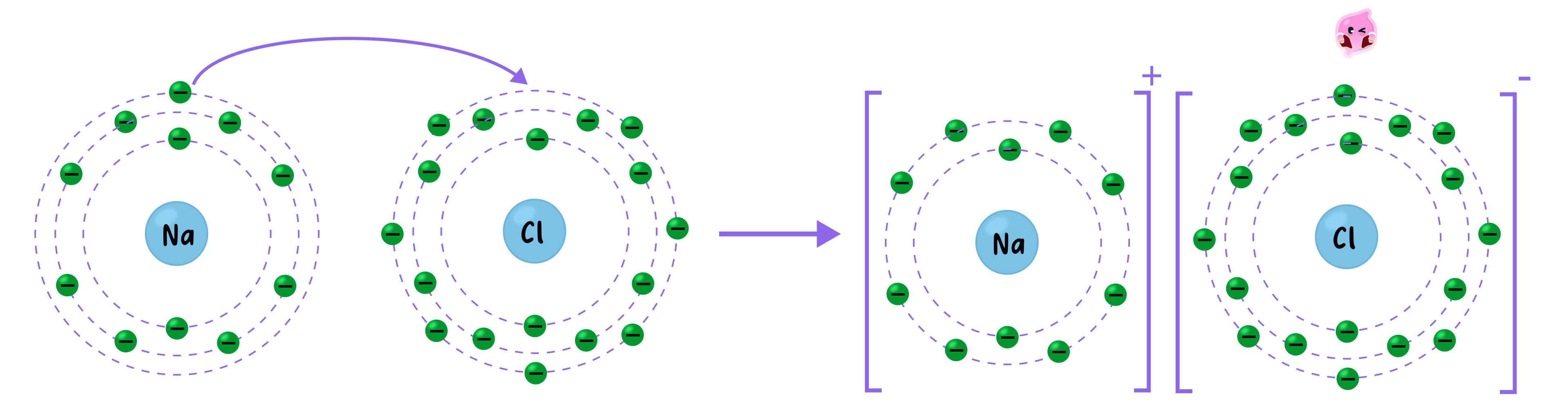
- Sodium gives one electron to chlorine: Na→Na++e−\text{Na} \rightarrow \text{Na}^{+} + e^{-}Na→Na++e− and Cl+e−→Cl−\text{Cl} + e^{-} \rightarrow \text{Cl}^{-}Cl+e−→Cl−.
- Magnesium gives two electrons to oxygen, forming Mg2+\text{Mg}^{2+}Mg2+ and O2−\text{O}^{2-}O2−.
- The compound as a whole is neutral, because the positive and negative charges inside it balance exactly.
Example
- Sodium chloride: sodium loses one electron and chlorine gains it, giving Na+\text{Na}^{+}Na+ and Cl−\text{Cl}^{-}Cl− in a 1:11:11:1 ratio.
- Magnesium oxide: magnesium loses two electrons and oxygen gains both, giving Mg2+\text{Mg}^{2+}Mg2+ and O2−\text{O}^{2-}O2− in a 1:11:11:1 ratio.
- Magnesium chloride: magnesium loses two electrons, one to each of two chlorine atoms, giving Mg2+\text{Mg}^{2+}Mg2+ and two Cl−\text{Cl}^{-}Cl−.
Dot-and-cross diagrams show which atom supplied each electron
- A dot-and-cross diagram draws the outer-shell electrons of each atom, using dots for one atom and crosses for the other.
- Dots and crosses both stand for electrons, and the two symbols only record where each electron came from.
- Draw both atoms with their outer shells first, then move the transferred electrons across.
- For sodium chloride, chlorine's seven electrons are dots and the single electron from sodium is a cross, giving eight around chlorine.
- Enclose each ion in square brackets and write its charge outside the top right corner.
- The sodium ion is drawn with an empty outer shell and a 1+1+1+ charge, because its outer electron has gone.
- For magnesium chloride, draw one magnesium atom and two chlorine atoms, with one electron moving to each chlorine.
Note
- Dots for one element and crosses for the other, kept consistent, is what makes the transfer readable.
- Brackets and a charge belong on every ion, and a drawing without them shows atoms rather than ions.
Counting protons, neutrons and electrons in an ion
Definition
Atomic number
The number of protons in the nucleus of an atom, which is unique to each element.
Definition
Mass number
The total number of protons and neutrons in the nucleus of an atom.
- The proton count does not change when an ion forms, so it is still the atomic number.
- The neutron count is the mass number minus the atomic number, and it does not change either.
- For a positive ion, subtract the charge from the atomic number to get the electron count.
- For a negative ion, add the charge to the atomic number to get the electron count.
- Na+\text{Na}^{+}Na+, with atomic number 111111 and mass number 232323, has 111111 protons, 121212 neutrons and 101010 electrons.
- O2−\text{O}^{2-}O2−, with atomic number 888 and mass number 161616, has 888 protons, 888 neutrons and 101010 electrons.
- Both of those ions hold 101010 electrons, the same number as a neon atom.
Exam technique
- An ion question is answered in two moves: decide whether electrons are lost or gained, then count how many.
- The proton count comes from the atomic number and never changes, so only the electron count is adjusted for the charge.
- A dot-and-cross drawing without brackets and charges describes atoms, so those two marks are what finish it.
Self review
- Why does an atom become positively charged when it loses an electron?
- Which ion does a group 666 atom form, and how many electrons does it gain?
- What is the difference between the electron transfer and the ionic bond itself?
- How many protons, neutrons and electrons are in Mg2+\text{Mg}^{2+}Mg2+, atomic number 121212 and mass number 242424?
- Why are brackets and a charge drawn around each ion in a dot-and-cross diagram?
