Question 6
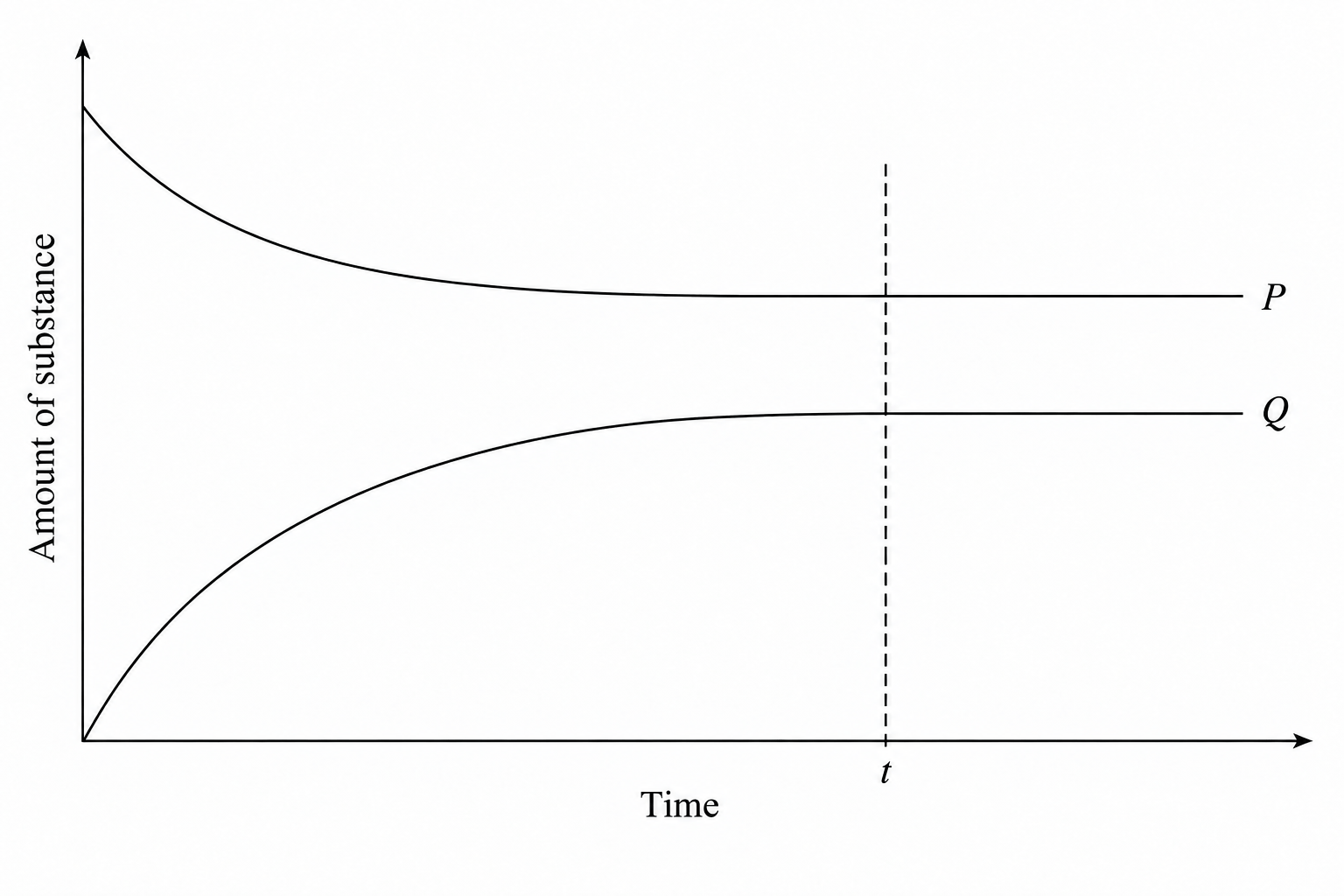
HThe graph shows qualitative changes in the amounts of nitrogen and ammonia in a closed Haber-process vessel at constant temperature. It is schematic and not drawn to a numerical scale. Hydrogen is also present but its curve is omitted. P and Q represent nitrogen and ammonia, in an order to be identified. The forward reaction is exothermic.
N2(g)+3H2(g)⇌2NH3(g)\mathrm{N_2(g)+3H_2(g)\rightleftharpoons 2NH_3(g)}N2(g)+3H2(g)⇌2NH3(g)
a.[3]
Identify P and Q for a mixture that initially contains nitrogen and hydrogen but no ammonia. Explain why the different plateau heights are consistent with equilibrium.
b.[2]
At a time after t, the pressure is increased by reducing the vessel's volume while keeping temperature constant. Predict the change in the equilibrium amount of ammonia and explain it using the equation.
c.[3]
A manufacturer proposes both lowering the temperature and removing the iron catalyst. Evaluate the effects of these changes on equilibrium yield and on the time needed to approach equilibrium.
6.3 Dynamic equilibria Questions
43 exam-style questions on Edexcel GCSE Chemistry 6.3 Dynamic equilibria, covering 6.3.1 The Haber process as a reversible reaction, 6.3.2 Conditions and rate in industrial equilibria, and 6.3.3 Fertilisers and the preparation of ammonium sulfate. Each one has a worked solution and a mark scheme showing where the marks go.