A catalyst speeds a reaction without being used up
Definition
Catalyst
A substance that speeds up a reaction without being used up in the reaction.
- Adding a catalyst lets a reaction reach the same point in a shorter time.
- Nothing uses it up, so all of it is still there when the reaction has finished.
- Being unchanged chemically, it can be recovered and used again.
- Its mass at the end is the same as its mass at the start.
- A small mass of catalyst can therefore serve a reaction many times over.
Key Idea
Being neither reactant nor product, it appears on neither side of the equation.
A catalyst lowers the activation energy
Definition
Activation energy
The minimum energy that colliding particles must have for a reaction to happen.
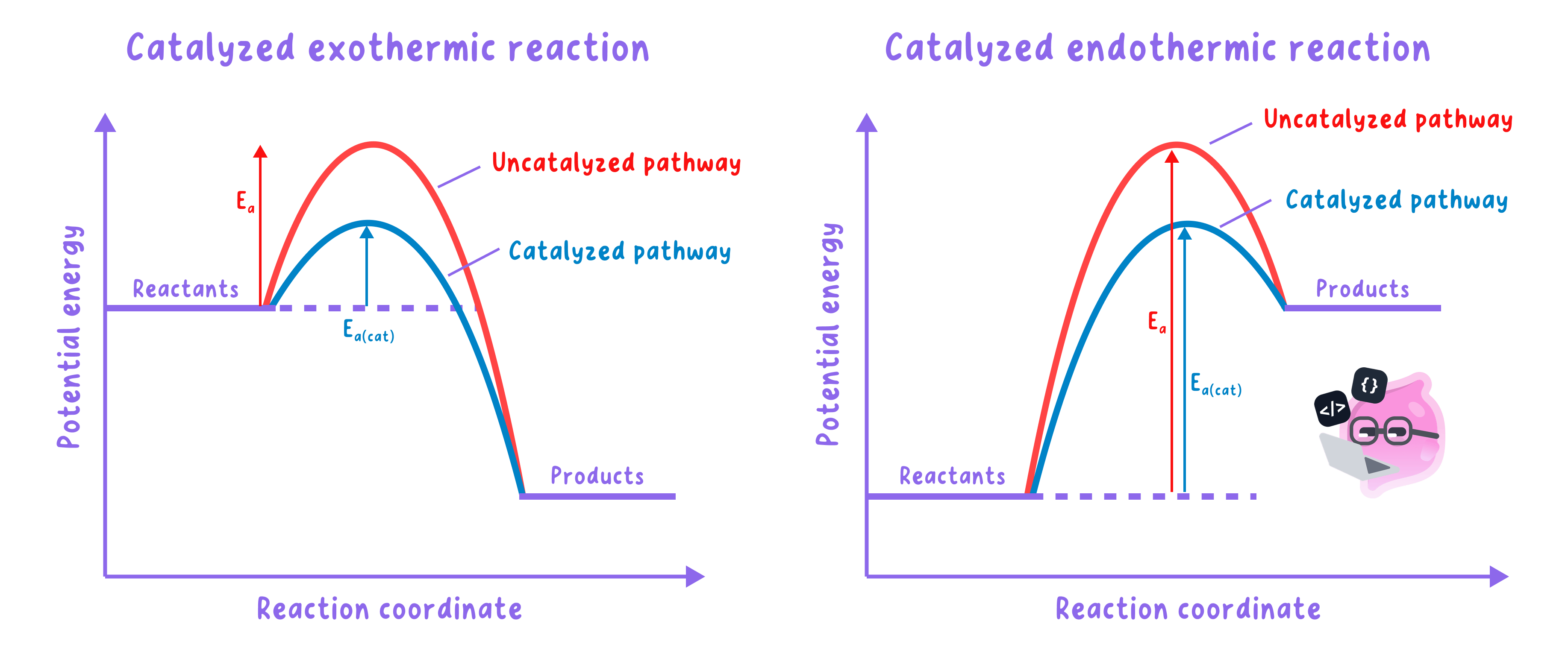
- A catalyst provides a different route from reactants to products.
- That route has a lower activation energy than the uncatalysed one.
- A lower activation energy means a larger proportion of collisions is successful.
- More successful collisions in the same time means a faster reaction.
- The particles themselves are unchanged, so it is the route that has changed, not their energy.
Common Mistake
A catalyst does not give the particles more energy; it lowers the bar they have to clear.
A catalyst does not change the products
- The products are exactly the same with a catalyst as without one.
- The amount of product is the same too, because the reactants are unchanged.
- Only the time taken to get there is different.
- On a graph, a catalysed reaction rises more steeply but levels off at the same height.
- Different reactions need different catalysts, so a catalyst is specific to its reaction.
Example
- Iron: catalyses the formation of ammonia in the Haber process.
- Nickel: catalyses the addition of hydrogen to unsaturated oils.
Enzymes are biological catalysts
Definition
Enzyme
A biological catalyst that speeds up a reaction in a living organism.
- Living organisms make their own catalysts, and these are called enzymes.
- Enzymes work in the same way as any other catalyst, by lowering the activation energy.
- They are highly specific, so each enzyme catalyses one reaction or one type of reaction.
- They work best within a narrow range of temperature and pH.
- Too high a temperature damages the enzyme and it stops working.
Note
Being damaged by heat is the opposite of the usual rate pattern, so a hotter enzyme reaction can be slower.
Enzymes in the production of alcoholic drinks
- Yeast contains the enzymes that convert sugar into alcohol.
- This process is called fermentation.
- Glucose is converted into ethanol and carbon dioxide: glucose→ethanol+carbon dioxide\text{glucose} \rightarrow \text{ethanol} + \text{carbon dioxide}glucose→ethanol+carbon dioxide
- The carbon dioxide is what makes the fermenting mixture bubble.
- Keeping the mixture warm lets the enzymes work quickly without damaging them.
Self review
- Give three things that are true of a catalyst at the end of a reaction.
- How does a catalyst increase the rate of a reaction?
- Does a catalyst change the amount of product formed?
- What is an enzyme?
- Write the word equation for the fermentation of glucose.
