Question 4
FSports drinks contain dissolved glucose.
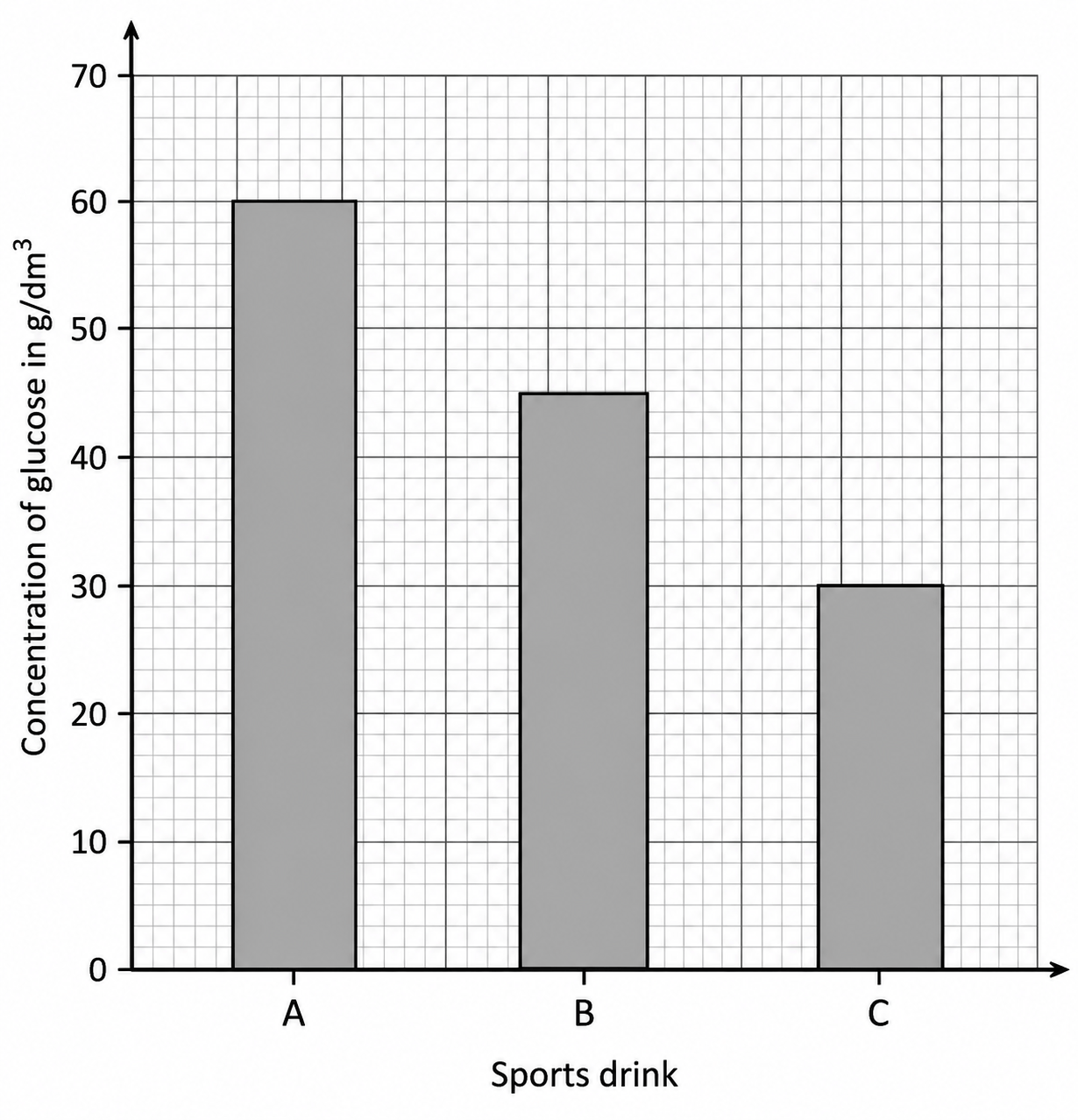
Figure shows the concentration of glucose in three sports drinks, A, B and C.
Figure: Concentration of glucose in three sports drinks
a.[1]
Give the concentration of glucose in drink B.
b.[2]
Calculate the mass of glucose dissolved in 2.0 dm3 of drink A.
c.[1]
A student drinks 1.0 dm3 of drink C.
Give the mass of glucose the student drinks.
3.2 Use of amount of substance in relation to masses of pure substances Questions
40 exam-style questions on AQA GCSE Chemistry 3.2 Use of amount of substance in relation to masses of pure substances, covering 3.2.1 Moles, 3.2.2 Amounts of substances in equations, 3.2.3 Using moles to balance equations, 3.2.4 Limiting reactants, 3.2.5a Concentration of solutions, and 3.2.5b Relating mass, volume and concentration. Each one has a worked solution and a mark scheme showing where the marks go.