States of matter: temperature and energy decide whether a substance is solid, liquid or gas
Definition
Melting point
The melting point is the temperature at which a substance changes from a solid to a liquid.
- The three states of matter are solid, liquid and gas.
- A change of state is a physical change, so no new substance forms.
- Melting changes a solid into a liquid.
- Freezing changes a liquid into a solid.
- Melting and freezing take place at the substance's melting point.
- Boiling changes a liquid into a gas throughout the liquid.
- Condensing changes a gas into a liquid.
- Boiling and condensing take place at the substance's boiling point.
Common Mistake
- Do not describe a melting point or boiling point as an amount of energy, because each one is a temperature.
- Melting and freezing happen at the same temperature for a pure substance.
- Boiling and condensing happen at the same temperature for a pure substance.
The particle model: arrangement and movement distinguish the three states
Definition
Particle theory
The model that explains the properties and behaviour of matter using the arrangement, movement and energy of particles.
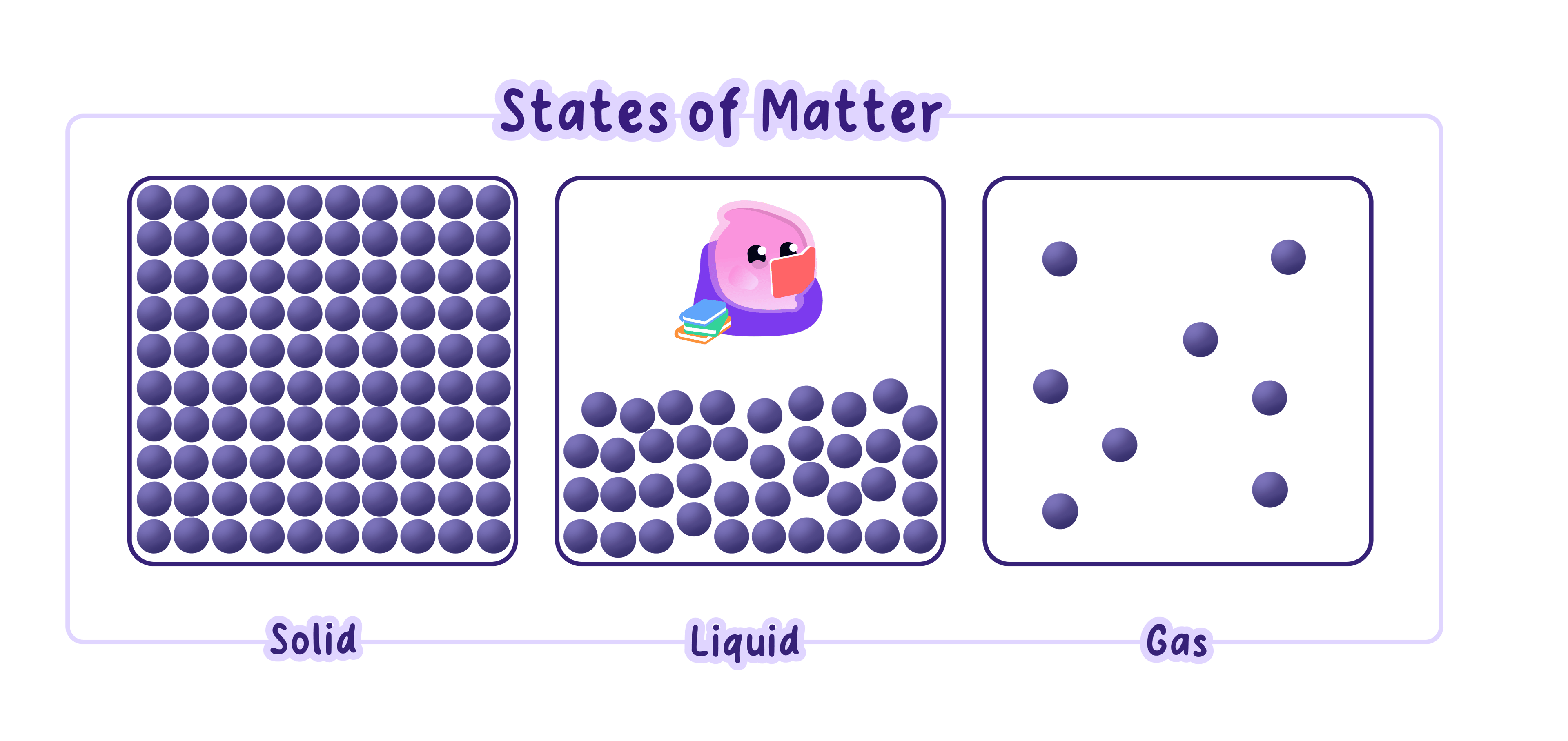
- The particle model represents particles as small solid spheres.
- The spheres may represent atoms, molecules or ions, depending on the bonding and structure of the substance.
- Particle theory links the arrangement, movement and energy of these particles to the state of the substance.
- Solid
- The particles are packed closely together in a fixed, regular arrangement.
- The particles vibrate around fixed positions but do not move past one another.
- A solid has a fixed shape and a fixed volume.
- Liquid
- The particles are close together in an irregular arrangement.
- The particles move past one another while staying close together.
- A liquid has a fixed volume but takes the shape of its container.
- Gas
- The particles are far apart with no fixed arrangement.
- The particles move rapidly in random directions.
- A gas has no fixed shape or volume and spreads out to fill its container.
Example
- Ice, liquid water and water vapour are the same substance in three different states.
- The particles stay as H2O\text{H}_2\text{O}H2O molecules during each change of state.
- Only the arrangement, movement and separation of the molecules change.
Changes of state: energy transfers alter how particles move and arrange
Definition
Boiling point
The temperature at which a substance rapidly turns from a liquid into a gas throughout the liquid.
- Heating transfers energy from the surroundings to a substance.
- Cooling transfers energy from a substance to the surroundings.
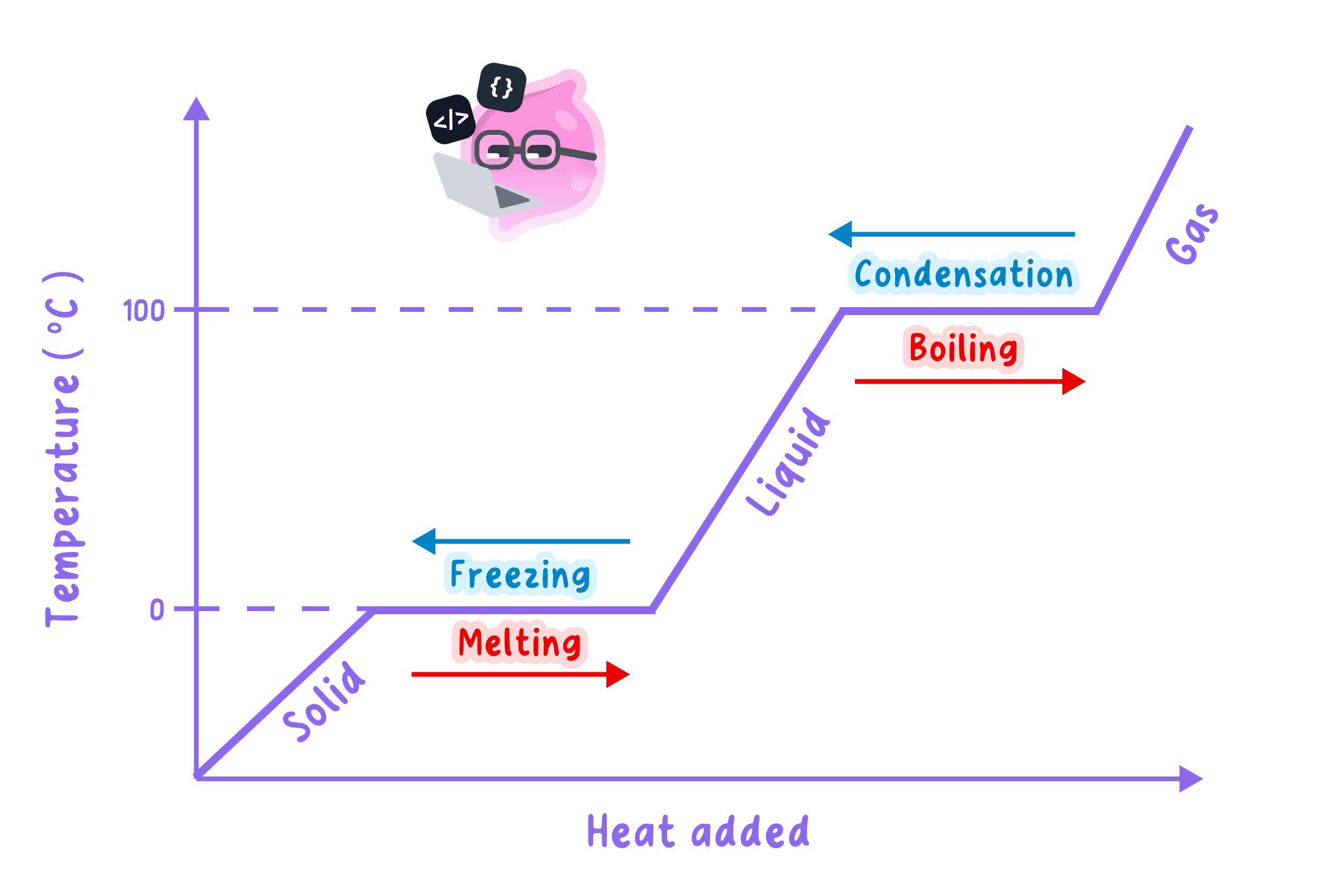
- Melting
- Heating makes the particles in a solid vibrate more.
- At the melting point, the particles gain enough energy to overcome some of the forces holding them in fixed positions.
- The particles can then move past one another, so the solid becomes a liquid.
- Boiling
- Further heating increases the energy of the particles in the liquid.
- At the boiling point, the particles gain enough energy to overcome the forces holding them close together.
- The particles separate and move freely, so the liquid becomes a gas.
- Freezing
- Energy is transferred from the liquid to the surroundings.
- The particles move less and become held in fixed positions by the forces between them.
- Condensing
- Energy is transferred from the gas to the surroundings.
- The particles move less and come close enough for the forces between them to hold them together as a liquid.
- During a change of state, the temperature of a pure substance stays at its melting point or boiling point until the change is complete.
- The transferred energy changes the arrangement of the particles rather than raising the temperature during the change.
Common Mistake
- Do not say that the particles themselves melt, freeze, boil or expand.
- The particles stay the same size while their movement, arrangement and separation change.
- Do not say that particles disappear when a substance becomes a gas; they have only spread further apart.
Bonding and structure: stronger forces give higher melting and boiling points
Definition
Intermolecular force
A force of attraction between separate molecules or polymer chains.
- The energy needed to melt or boil a substance depends on the strength of the forces between its particles.
- Stronger forces need more energy to overcome, so the substance has a higher melting point and boiling point.
- Weaker forces need less energy to overcome, so the substance has a lower melting point and boiling point.
- The particles and forces involved depend on the type of bonding and the structure of the substance.
- Simple molecular substances
- The particles are molecules held by strong covalent bonds inside each molecule.
- Weaker intermolecular forces act between separate molecules.
- Melting and boiling overcome the intermolecular forces without breaking the covalent bonds inside the molecules.
- Simple molecular substances therefore often have low melting and boiling points.
- Ionic substances
- The particles are oppositely charged ions arranged in a giant structure.
- Strong electrostatic attractions act between the positive and negative ions.
- A large amount of energy is needed to overcome these attractions, so ionic substances have high melting and boiling points.
- Giant covalent substances
- The particles are atoms joined by many strong covalent bonds.
- A large amount of energy is needed to overcome these bonds, so giant covalent substances have very high melting points.
- Metals
- Metals contain positive metal ions and delocalised electrons that can move through the structure.
- Strong metallic bonding acts between the positive ions and the delocalised electrons.
- Metals therefore usually have high melting and boiling points.
Example
- Chlorine consists of small Cl2\text{Cl}_2Cl2 molecules with weak intermolecular forces between them, so it has a low boiling point.
- Boiling chlorine overcomes the forces between its molecules without breaking the covalent bond inside each Cl2\text{Cl}_2Cl2 molecule.
- Sodium chloride, NaCl\text{NaCl}NaCl, has strong electrostatic attractions between its ions, so much more energy is needed to melt or boil it.
Predicting state from data: compare the temperature with both change points
- You can predict a substance's state by comparing the given temperature with its melting point and boiling point.
- Below the melting point
- The substance is a solid.
- Between the melting point and boiling point
- The substance is a liquid.
- Above the boiling point
- The substance is a gas.
- At the melting point, solid and liquid may both be present while melting or freezing takes place.
- At the boiling point, liquid and gas may both be present while boiling or condensing takes place.
Example
- Substance X has a melting point of 18 ∘C18\,^\circ\text{C}18∘C and a boiling point of 65 ∘C65\,^\circ\text{C}65∘C.
- At 10 ∘C10\,^\circ\text{C}10∘C it is a solid, because the temperature is below its melting point.
- At 40 ∘C40\,^\circ\text{C}40∘C it is a liquid, because the temperature lies between its melting and boiling points.
- At 80 ∘C80\,^\circ\text{C}80∘C it is a gas, because the temperature is above its boiling point.
- At 18 ∘C18\,^\circ\text{C}18∘C it may contain both solid and liquid while it changes state.
Bulk properties: many particles and their structure create material behaviour
- Bulk properties include a material's state, hardness, density, melting point and boiling point.
- An individual atom does not have the bulk properties of the material that contains it.
- Bulk properties arise from the bonding, forces and arrangement of very large numbers of particles.
- A single carbon atom is not hard like diamond or soft like graphite, because those properties come from the different arrangements and bonding of many carbon atoms.
- Explain a material's properties using its particles, bonding and structure, rather than assigning those properties to one atom.
Self review
- What are the three states of matter?
- Which two changes of state take place at the melting point?
- How are the particles arranged and how do they move in a gas?
- Why do stronger forces between particles produce higher melting and boiling points?
- A substance melts at 30 ∘C30\,^\circ\text{C}30∘C and boils at 90 ∘C90\,^\circ\text{C}90∘C, so what is its state at 50 ∘C50\,^\circ\text{C}50∘C?
