- What a metal’s giant structure looks like.
- What delocalised electrons are and why they matter.
- How strong metallic bonds form.
- How to recognise metallic bonding from diagrams in exam questions.
An atom has a tiny central nucleus and electrons arranged in shells around it. For bonding, the most important electrons are the outer-shell electrons because these are the ones involved when atoms join together.
Metals are found on the left and in the centre of the periodic table. In metallic bonding, metal atoms do not form small separate molecules. Instead, huge numbers of metal atoms pack together in a repeating arrangement.
A giant structure is a structure containing a very large number of particles joined together in a continuous network.
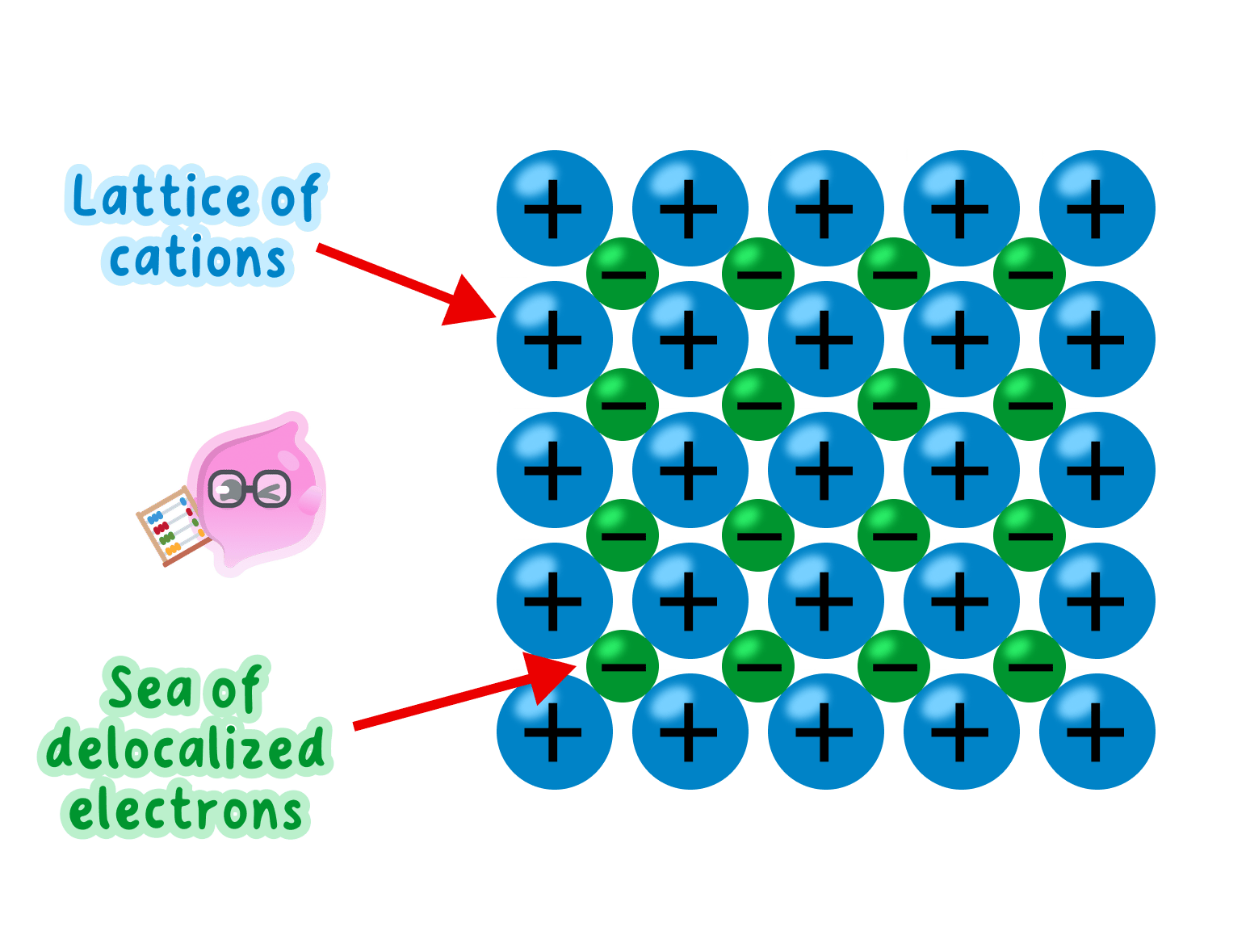
In metals, the particles are arranged in a regular pattern. This means the arrangement repeats over and over again, like a 3D grid. You may see this called a lattice, which just means a regular repeating arrangement of particles.
Giant metallic structure
A metal consists of a giant structure of metal atoms arranged in a regular pattern. The structure continues in all directions, so it is not made of separate molecules.
Even though diagrams are often drawn in 2D, you should imagine the real metal as 3D: rows and layers of metal particles extending throughout the solid.
In a metal, the outer-shell electrons are not fixed to one particular atom. They become delocalised.
Delocalised electrons
Delocalised electrons are electrons that are free to move through the whole structure, rather than belonging to one specific atom.
When these outer electrons become delocalised, the remaining metal particles are shown as positive metal ions. They are positive because they have lost the negative charge of some outer-shell electrons.
The electrons have not gone away. They are still inside the metal structure, moving between the positive metal ions.

Electrons do not leave the metal
Do not say the electrons are “lost from the metal”. In metallic bonding, the outer-shell electrons are delocalised within the metal structure. The metal as a whole is still neutral overall.
A metallic bond is the strong electrostatic attraction between:
- positive metal ions
- delocalised electrons
“Electrostatic attraction” means attraction between opposite charges. Positive metal ions are attracted to the negative delocalised electrons.
Metallic bond
A metallic bond is the strong electrostatic attraction between positive metal ions and the delocalised electrons that move through the whole metal structure.
This attraction happens throughout the entire giant structure. That is why the bonding in metals is described as strong.
Metallic bonding in one sentence
Metals are giant regular structures of positive metal ions surrounded by delocalised electrons, with strong metallic bonds caused by attraction between the ions and electrons.
In GCSE diagrams, metallic bonding is usually shown using:
- circles or spheres for positive metal ions
- plus signs to show the ions are positive
- small dots, crosses, or minus signs for delocalised electrons
- a regular pattern to show a giant lattice
A 2D diagram is only a simplified model of a 3D structure. In real metals, the positive ions are arranged in layers, and the delocalised electrons can move through the whole structure.
If a question gives you a bonding diagram, you can identify metallic bonding by combining several clues.
Recognising metallic bonding from a diagram
A diagram shows many particles arranged in rows. Each particle has a plus sign inside it. Small negative symbols are spread between the particles and are not attached to any one particle. Decide whether this shows metallic bonding.
-
The particles are arranged in a repeating pattern, so this suggests a giant structure rather than separate molecules.
-
The plus signs show positive particles, which fits the model of positive metal ions in a metal lattice.
-
The negative symbols are spread between all the positive particles, so they represent delocalised electrons. A giant regular structure with positive metal ions and delocalised electrons is metallic bonding.
Diagram clue
For metallic bonding, look for positive ions in a regular pattern plus electrons spread throughout the structure. If the electrons are shown between just two atoms, that is more likely to be covalent bonding, not metallic bonding.
A metal contains a very large number of positive metal ions and delocalised electrons. Each positive ion is attracted to the surrounding delocalised electrons.
Because this attraction occurs throughout the whole lattice, the bonding is strong. A lot of energy is needed to overcome these attractions.
This helps explain why many metals have high melting points and boiling points. To melt a metal, you must overcome some of the strong attractions holding the giant structure together.
Breaking the wrong thing
When a metal melts, the metal atoms are not being split into protons, neutrons and electrons. The change is about overcoming attractions between positive metal ions and delocalised electrons so the structure can move more freely.
Explaining a metal’s high melting point
A student says: “Metals often have high melting points because they contain strong metallic bonds.” Improve this explanation using the structure of a metal.
-
Start with the structure: a metal has a giant regular lattice of positive metal ions.
-
Add the bonding particles: the positive ions are surrounded by delocalised electrons that can move through the whole structure.
-
Link bonding to energy: there is strong electrostatic attraction between the positive ions and delocalised electrons, so a lot of energy is needed to overcome these attractions during melting.
Metals can conduct electricity because they contain charged particles that are free to move. The moving charged particles in metals are the delocalised electrons.
When a potential difference is applied in a circuit, these electrons can move through the metal and carry charge.
This is different from ionic compounds in the solid state. Solid ionic compounds have charged ions, but the ions are fixed in place, so they cannot move and carry charge. In metals, the delocalised electrons are already mobile in the solid.
Explaining why a metal conducts electricity
Explain why copper conducts electricity when solid.
-
Copper has metallic bonding, so it contains positive metal ions in a giant regular structure surrounded by delocalised electrons.
-
The delocalised electrons are free to move through the whole copper structure.
-
Because these electrons are charged and mobile, they can carry electrical charge through the solid metal.
Use the key word mobile
For conductivity questions, “delocalised” alone is not quite enough. Say the electrons are delocalised and free to move, so they can carry charge.
It is easy to mix up the bonding types, so keep the models separate.
In ionic bonding, electrons are transferred from metal atoms to non-metal atoms, forming oppositely charged ions. Ionic compounds form giant ionic lattices.
In covalent bonding, non-metal atoms share pairs of electrons. Covalent substances may be simple molecules or giant covalent structures.
In metallic bonding, metal atoms contribute outer-shell electrons to a shared sea of delocalised electrons. These electrons are shared throughout the whole metallic structure.
Do not mix the bonding models
Metallic bonding is not “metal atoms sharing pairs of electrons”. It is a giant structure of positive metal ions attracted to delocalised electrons.
For this specification, the safest wording is:
- metals consist of giant structures
- atoms are arranged in a regular pattern
- outer-shell electrons are delocalised
- delocalised electrons are free to move through the whole structure
- metallic bonds are strong electrostatic attractions between positive metal ions and delocalised electrons
If you include these ideas accurately, your explanation will usually be very close to the mark scheme.
In the exam
-
When describing metallic bonding, always mention both parts: positive metal ions and delocalised electrons.
-
If asked about a diagram, identify the regular giant structure first, then explain what the plus signs and free electrons represent.
-
If explaining a property such as conductivity or high melting point, link the property back to the bonding: mobile delocalised electrons for conductivity, strong electrostatic attractions for high melting point.
Check yourself
- What does “delocalised” mean when describing electrons in a metal?
- Why are the metal ions in a metallic lattice positive?
- How would you recognise metallic bonding in a diagram?