x

Relative electrical charges of subatomic particles

What you'll learn

  • The three main subatomic particles in atoms: protons, neutrons and electrons.
  • What their relative electrical charges are.
  • Why atoms have no overall electrical charge.
  • How atomic number identifies an element.

1. Atoms and subatomic particles

An atom is the smallest particle of an element that still has the chemical properties of that element. At GCSE, you describe atoms using a simple model called the nuclear model.

A subatomic particle is a particle smaller than an atom. The three subatomic particles you need here are protons, neutrons and electrons.

Definition

Nuclear model

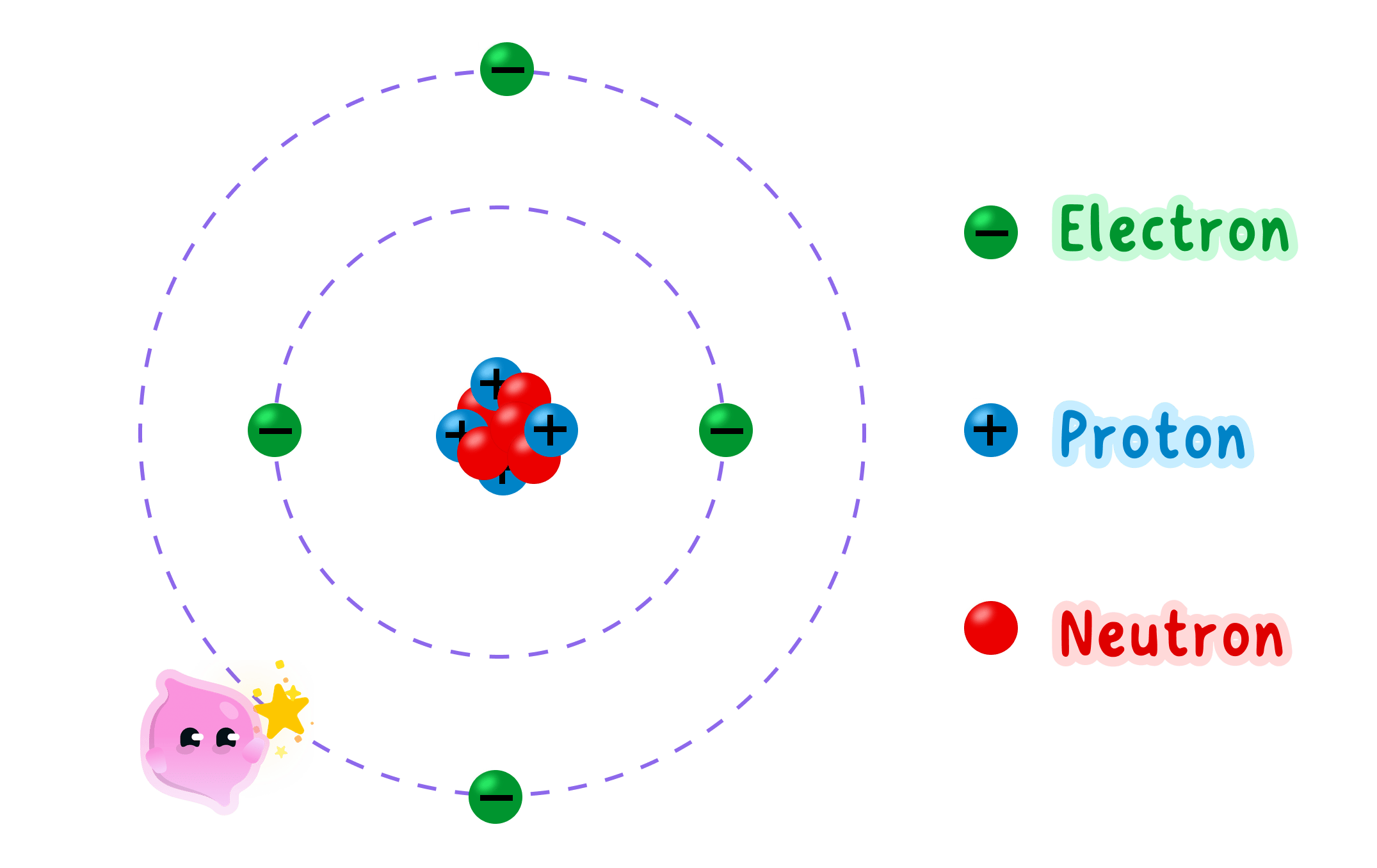
In the nuclear model, an atom has a tiny central nucleus containing protons and neutrons, with electrons arranged around the nucleus in shells.

A nucleus is the small, central part of an atom. A shell is a region around the nucleus where electrons are found.

The diagram shows the basic positions and charges of the particles in the nuclear model.

Labelled nuclear model of an atom showing protons, neutrons and electrons with their relative charges

Common Mistake

Diagrams are not to scale

Atom diagrams usually draw the nucleus much too large and the electrons much too close. In reality, atoms are mostly empty space, but the model is still very useful for describing where the particles are and what charges they have.

2. Relative electrical charge

Electrical charge is a property of particles. It can be positive, negative or zero. A particle with zero charge is described as neutral.

At GCSE, you use relative electrical charge rather than the actual charge measured in coulombs. “Relative” means the charges are compared using simple numbers.

Definition

Relative electrical charge

Relative electrical charge compares particle charges using the simple values +1, 0 and −1. A proton has charge +1, a neutron has charge 0, and an electron has charge −1.

Charges of the three subatomic particles

Subatomic particleWhere it is foundRelative electrical charge
ProtonIn the nucleus+1
NeutronIn the nucleus0
ElectronIn shells around the nucleus−1

A proton is a positively charged subatomic particle in the nucleus.

A neutron is a neutral subatomic particle in the nucleus.

An electron is a negatively charged subatomic particle found in shells around the nucleus.

Key Idea

Charges to memorise

The charges are: proton +1, neutron 0, electron −1. The proton and electron have equal-sized but opposite charges.

Common Mistake

Charge is not the same as mass

Do not say a neutron has charge +1 because you remember it has a relative mass of about 1. For charge, a neutron is always 0.

3. Overall electrical charge of an atom

The overall electrical charge is the total charge when all the particle charges are added together.

In an atom, the number of electrons is equal to the number of protons in the nucleus.

That means the positive charges from the protons cancel out the negative charges from the electrons. So atoms have no overall electrical charge.

Key Idea

Neutral atoms

A neutral atom has the same number of protons as electrons, so its overall relative charge is 0.

Neutrons do not affect the overall charge because each neutron has charge 0.

Example

Finding the overall charge of an atom

A carbon atom has 6 protons, 6 electrons and 6 neutrons. Work out its overall relative charge.

  1. Calculate the positive charge from the protons: 6×(+1)=+66 \times (+1) = +66×(+1)=+6.
  2. Calculate the negative charge from the electrons: 6×(−1)=−66 \times (-1) = -66×(−1)=−6. The neutrons contribute 6×0=06 \times 0 = 06×0=0.
  3. Add the charges: +6+(−6)+0=0+6 + (-6) + 0 = 0+6+(−6)+0=0, so the atom has no overall electrical charge.
Tip

Quick charge check

For a neutral atom, the number of protons and electrons must match. If they do not match, you are no longer describing a neutral atom.

4. The nucleus is positive overall

The nucleus contains protons and neutrons.

Protons have charge +1. Neutrons have charge 0. There are no electrons inside the nucleus in the GCSE nuclear model.

So the nucleus is positive overall, unless there are no protons at all. In ordinary atoms, the nucleus is positive because it contains one or more protons.

Key Idea

Charge of the nucleus

The nucleus is positive overall because it contains positive protons and neutral neutrons.

This is slightly different from the whole atom. The nucleus is positive, but the atom as a whole is neutral because the negative electrons balance the positive protons.

5. Atomic number

An element is a substance made from only one type of atom. The “type” of atom is decided by the number of protons it has.

Definition

Atomic number

The atomic number is the number of protons in the nucleus of an atom.

All atoms of a particular element have the same number of protons. Atoms of different elements have different numbers of protons.

For example, every atom with 6 protons is carbon. If an atom has 7 protons, it is not carbon — it is a different element.

Example

Using atomic number to describe an atom

An atom has atomic number 11 and has no overall electrical charge. Describe what this tells you about its protons and electrons.

  1. Atomic number means number of protons, so the atom has 11 protons in its nucleus.
  2. The atom has no overall electrical charge, so it is neutral. Therefore, the number of electrons equals the number of protons.
  3. The atom must have 11 electrons. Its protons and electrons balance because 11×(+1)+11×(−1)=011 \times (+1) + 11 \times (-1) = 011×(+1)+11×(−1)=0.
Common Mistake

Atomic number is not overall charge

The atomic number tells you the number of protons, not the charge of the whole atom. A neutral atom with atomic number 8 has 8 protons and 8 electrons, giving an overall charge of 0.

6. Describing atoms using the nuclear model

When you are asked to describe an atom using the nuclear model, include the position and charge of each particle.

A strong GCSE description would say:

  • The atom has a small central nucleus.
  • The nucleus contains protons and neutrons.
  • Protons have relative charge +1.
  • Neutrons have relative charge 0.
  • Electrons are arranged around the nucleus in shells.
  • Electrons have relative charge −1.
  • In a neutral atom, the number of electrons equals the number of protons.

You do not need to explain the detailed history of the model for this sub-topic. Focus on particles, positions and charges.

Exam technique

In the exam

  1. For charge questions, compare protons and electrons; neutrons do not change the charge.
  2. For element identity questions, use the number of protons — this is the atomic number.
  3. If asked to describe the nuclear model, mention the nucleus, protons and neutrons inside it, and electrons in shells around it.
Self review

Check yourself

  • What are the relative electrical charges of a proton, a neutron and an electron?
  • Why does a neutral atom have no overall electrical charge?
  • What does the atomic number tell you about an atom?
PreviousNext

How was this guide?

Relative electrical charges of subatomic particles Revision Guide

  1. GCSE
  2. /Chemistry
  3. /Relative electrical charges of subatomic particles