x

The development of the model of the atom (common content with physics)

What you'll learn

  • How ideas about atoms changed as new evidence was discovered.
  • The difference between the plum pudding model and the nuclear model.
  • Why the alpha particle scattering experiment changed scientists’ view of the atom.
  • How Bohr, protons and neutrons fitted into the later atomic model.

Big idea: scientific models can change

Scientists use models to explain things we cannot directly see. Atoms are far too small to see with an ordinary microscope, so scientists built models of atomic structure using evidence from experiments.

Definition

Scientific model

A scientific model is a simplified description, diagram or idea that helps explain observations and make predictions. A model can be changed or replaced when new experimental evidence does not fit it.

This is one of the most important ideas in this topic: the atomic model did not appear all at once. It developed step by step as scientists found evidence that older models could not explain.

Key Idea

Models follow evidence

In GCSE answers, do not write that scientists changed the model “because they wanted to”. They changed it because new evidence supported a better explanation.

Here is the overall sequence you need to know.

Timeline of the development of atomic models from indivisible sphere to plum pudding, nuclear, Bohr, and later proton-neutron nucleus

Before the electron: tiny indivisible spheres

An atom is a tiny particle of an element. Before the electron was discovered, atoms were thought to be tiny solid spheres that could not be divided into anything smaller.

The word indivisible means “cannot be split into smaller parts”. So, in this early model, the atom had no internal structure: no nucleus, no electrons, no protons and no neutrons.

This model was simple, but it became inadequate once scientists discovered that atoms contain smaller particles.

Discovery of the electron and the plum pudding model

An electron is a negatively charged subatomic particle. A subatomic particle is a particle smaller than an atom.

The discovery of the electron showed that atoms were not indivisible after all. They contained smaller negative particles. Scientists therefore needed a new model of the atom.

The new model was called the plum pudding model.

Definition

Plum pudding model

The plum pudding model suggested that an atom is a ball of positive charge with negative electrons embedded throughout it.

In this model:

  • the “pudding” is the spread-out positive charge
  • the “plums” are the negative electrons
  • there is no central nucleus
  • the mass and charge are not concentrated in one tiny region
Example

Using the electron discovery

Scientists knew that atoms were usually neutral overall, but electrons were negatively charged. Why did the plum pudding model include positive charge?

  1. The discovery of electrons showed that atoms contain negative particles.
  2. A neutral atom cannot contain only negative charge, because the overall charge would be negative.
  3. The model therefore needed some positive charge to balance the electrons, so scientists suggested a positive ball with electrons embedded in it.
Common Mistake

Plum pudding is not the modern model

Do not describe the plum pudding model as having a nucleus. The whole point is that it had positive charge spread throughout the atom, not concentrated in the centre.

The alpha particle scattering experiment

The next major change came from the alpha particle scattering experiment, often linked with Rutherford and his team.

An alpha particle is a positively charged particle. In the experiment, alpha particles were fired at a very thin sheet of gold foil. A detector screen showed where the alpha particles went after hitting, or passing through, the foil.

Scattering means changing direction after an interaction.

Alpha particle scattering experiment showing most particles passing through, some deflecting, and very few rebounding

The results were surprising:

  • most alpha particles passed straight through the gold foil
  • some alpha particles were deflected slightly
  • a very small number were deflected through large angles or bounced back

The plum pudding model could not explain these results well. If positive charge were spread out evenly through the atom, alpha particles should mostly pass through with only tiny deflections.

Instead, some alpha particles were strongly repelled. This suggested that the positive charge was concentrated in a very small central region.

Definition

Nucleus

The nucleus is the small central part of the atom. In the GCSE model, it contains most of the atom’s mass and has positive charge because it contains protons.

Why the scattering evidence changed the model

The alpha scattering experiment led to the nuclear model of the atom.

Definition

Nuclear model

The nuclear model describes the atom as mostly empty space, with a tiny, dense, positively charged nucleus at the centre and electrons outside the nucleus.

The reasoning is very important for exams:

  • Most alpha particles passed straight through → atoms are mostly empty space.
  • Some alpha particles were deflected → there is positive charge in the atom, repelling the positive alpha particles.
  • A few alpha particles bounced back → the positive charge and mass must be concentrated in a tiny, dense nucleus.
Example

Explaining scattering observations

A student says: “In the alpha scattering experiment, most alpha particles went straight through, but a few bounced back.” What does this show about the atom?

  1. Because most alpha particles passed straight through, most of the atom cannot be solid material. The atom must be mostly empty space.
  2. Because alpha particles are positive, strong deflections must be caused by repulsion from a positive part of the atom.
  3. Because only a few alpha particles bounced back, this positive part must be very small, but because it can repel alpha particles strongly, it must be dense and contain most of the mass.
Common Mistake

Forgetting the positive repulsion

Alpha particles are positive. If you explain deflection, mention that they are repelled by the positive nucleus. Do not just say “they hit the nucleus” — most deflections were due to repulsion, not direct collisions.

Plum pudding model vs nuclear model

You must be able to describe the difference between these two models clearly.

Plum pudding model

The plum pudding model has:

  • positive charge spread throughout the atom
  • negative electrons embedded in the positive charge
  • no nucleus
  • no mostly empty space

Nuclear model

The nuclear model has:

  • a tiny central nucleus
  • positive charge concentrated in the nucleus
  • most of the mass concentrated in the nucleus
  • electrons outside the nucleus
  • the atom mostly empty space
Example

Comparing the two models

Explain why the nuclear model replaced the plum pudding model after the alpha scattering experiment.

  1. The plum pudding model predicted that positive charge was spread out, so alpha particles should not be strongly repelled by one tiny region.
  2. The experiment showed that a few alpha particles were deflected through large angles or bounced back, which needed a concentrated positive charge.
  3. The nuclear model explained this better because it placed the positive charge and most of the mass in a small central nucleus.
Tip

A strong comparison sentence

A useful exam phrase is: “In the plum pudding model, positive charge is spread throughout the atom, whereas in the nuclear model, positive charge is concentrated in a tiny nucleus.”

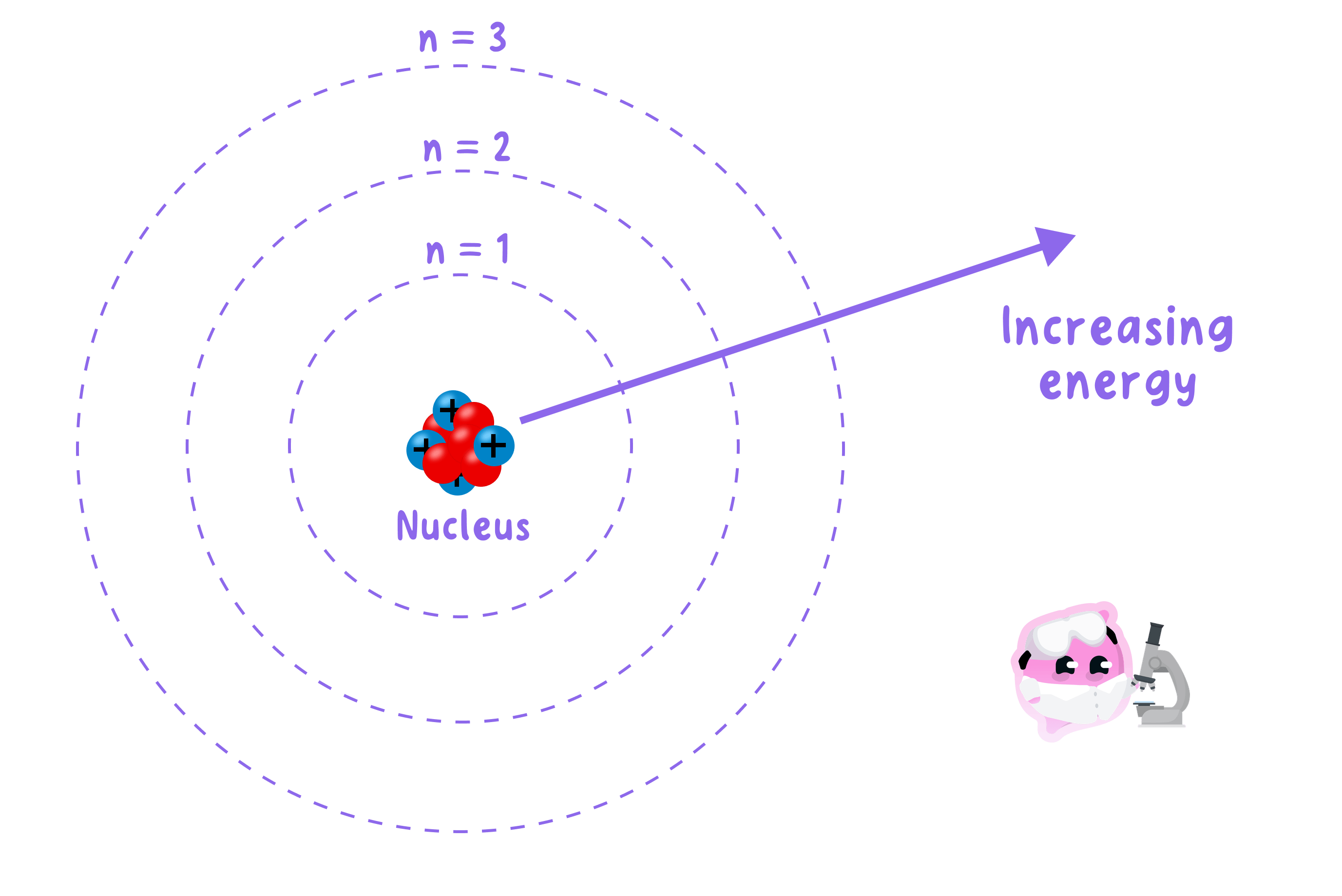
Bohr’s improvement: electrons in shells

The nuclear model still needed improving. Niels Bohr adapted it by suggesting that electrons orbit the nucleus at specific distances.

At GCSE, these specific distances are usually described as electron shells or energy levels.

Definition

Electron shell

An electron shell is a fixed region around the nucleus where electrons may be found in the GCSE model of atomic structure.

Bohr’s theoretical calculations agreed with experimental observations, so his model was accepted as an improvement.

You do not need to know the details of the experiments or calculations that supported Bohr’s model for this specification. You just need to know that Bohr suggested electrons are not anywhere at random: they are arranged at specific distances from the nucleus.

Key Idea

Bohr’s change

Bohr kept the nucleus from the nuclear model but added the idea that electrons orbit in fixed shells.

Protons: positive charge in smaller units

Later experiments showed that the positive charge of a nucleus could be divided into a whole number of smaller particles. Each of these particles had the same amount of positive charge.

These particles were named protons.

Definition

Proton

A proton is a positively charged subatomic particle found in the nucleus.

This improved the nuclear model because the nucleus was no longer just described as a vague “positive centre”. It was made of identifiable positive particles.

Neutrons: Chadwick’s evidence

The final part of this story, for GCSE, is the neutron.

A neutron is a neutral subatomic particle found in the nucleus. Neutral means it has no charge.

Definition

Neutron

A neutron is a subatomic particle found in the nucleus with no electrical charge.

James Chadwick provided experimental evidence for the existence of neutrons. This was about 20 years after the nucleus had become accepted.

You do not need to know the details of Chadwick’s experimental work. You do need to know that his work provided evidence for neutrons in the nucleus.

Tip

Remember the order

A simple order to remember is: sphere → plum pudding → nuclear → Bohr shells → protons and neutrons.

Why this topic matters

This topic is not just about memorising names. It shows how science works:

  • scientists propose a model
  • experiments produce evidence
  • the evidence is compared with the model
  • if the model cannot explain the evidence, it is changed or replaced

That is why the alpha scattering experiment is so important: it gave results that the plum pudding model could not explain, but the nuclear model could.

Exam technique

In the exam

  1. If asked why the atomic model changed, link the change to new experimental evidence, especially the alpha particle scattering results.
  2. If asked about scattering, match each observation to a conclusion: most straight through means mostly empty space; some deflected means positive charge; very few rebounded means a tiny dense nucleus.
  3. If comparing models, use “whereas” sentences: for example, “positive charge is spread out in the plum pudding model, whereas it is concentrated in the nucleus in the nuclear model.”
Self review

Check yourself

  • Why did the discovery of the electron mean the tiny solid sphere model had to change?
  • What did the alpha particle scattering experiment show about the position of mass and positive charge in the atom?
  • How did Bohr’s model improve the nuclear model?
PreviousNext

How was this guide?

The development of the model of the atom (common content with physics) Revision Guide

  1. GCSE
  2. /Chemistry
  3. /The development of the model of the atom (common content with physics)