x

Size and mass of atoms

What you'll learn

  • How small atoms and nuclei are, using nanometres and standard form.
  • Why almost all the mass of an atom is in the nucleus.
  • What atomic number and mass number mean.
  • How to calculate the numbers of protons, neutrons and electrons in atoms, ions and isotopes.

The basic model of an atom

An atom is the smallest part of an element that still has the chemical properties of that element. At GCSE, you use a simple model where an atom has a tiny central nucleus with electrons arranged around it in shells.

Definition

Subatomic particles

Subatomic particles are the smaller particles that make up atoms: protons, neutrons and electrons. Protons and neutrons are found in the nucleus, while electrons are found around the nucleus in shells.

The diagram below shows the key idea: the atom is tiny, but the nucleus is far, far smaller than the atom as a whole.

Labelled atom showing electron shells, a tiny nucleus, protons, neutrons, electrons, and the relative scale of atom and nucleus

How small is an atom?

A typical atom has a radius of about 0.1 nanometres.

Definition

Radius

The radius of an object is the distance from its centre to its edge.

A nanometre is a very small unit of length. The prefix nano- means one billionth.

1 nm=1×10⁻⁹ m1\text{ nm} = 1 \times 10^{-9}\text{ m}1 nm=1×10⁻⁹ m

So 0.1 nm is:

0.1 nm=1×10⁻¹⁰ m0.1\text{ nm} = 1 \times 10^{-10}\text{ m}0.1 nm=1×10⁻¹⁰ m
Definition

Standard form

Standard form writes very large or very small numbers as a number from 1 up to, but not including, 10 multiplied by a power of ten. For example, 1×10⁻¹⁰ m1 \times 10^{-10}\text{ m}1×10⁻¹⁰ m is standard form.

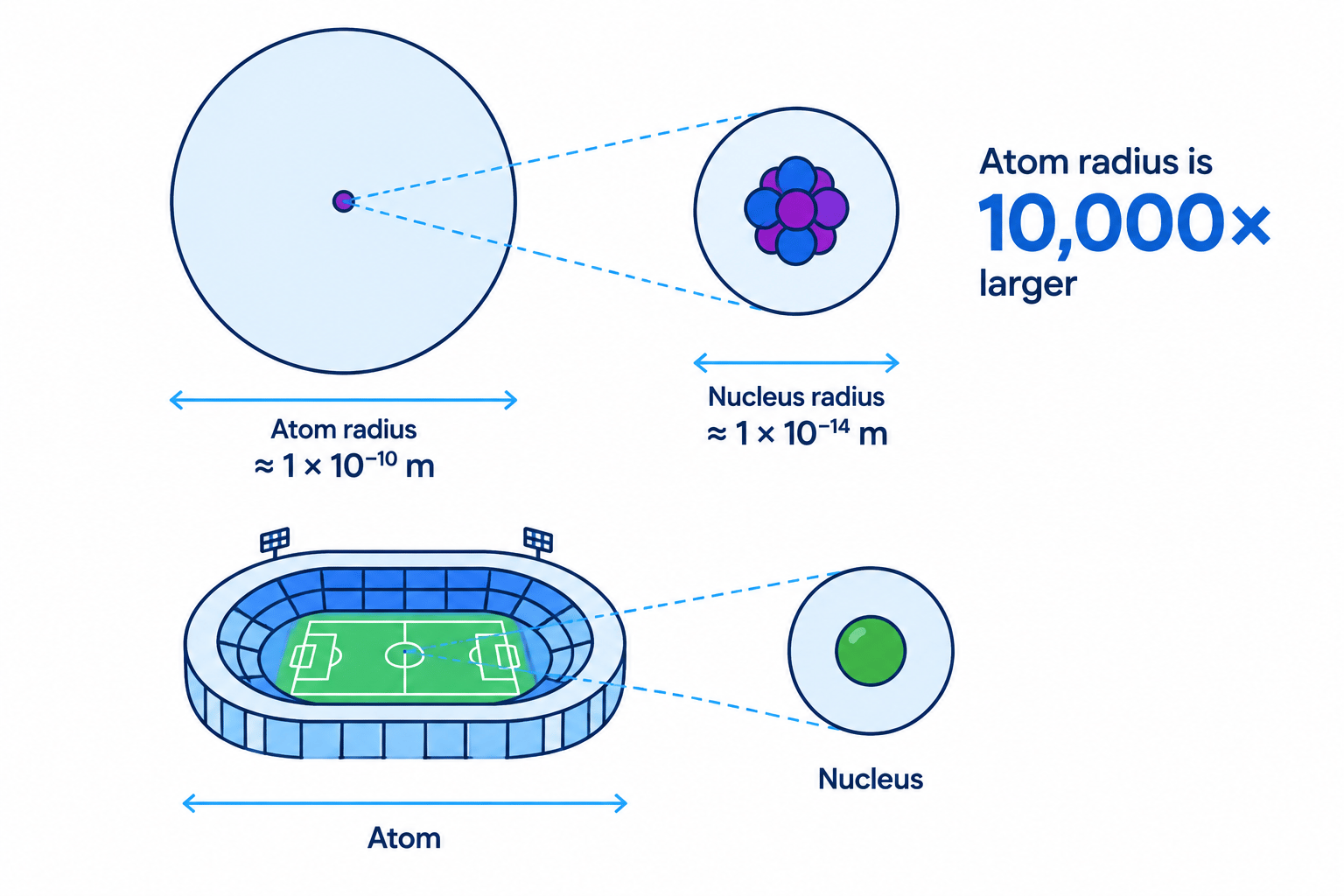
The nucleus has a radius of about 1×10⁻¹⁴ m1 \times 10^{-14}\text{ m}1×10⁻¹⁴ m, which is less than one ten-thousandth of the radius of the atom.

Example

Comparing atom and nucleus radii

An atom has radius 1×10⁻¹⁰ m1 \times 10^{-10}\text{ m}1×10⁻¹⁰ m. Its nucleus has radius 1×10⁻¹⁴ m1 \times 10^{-14}\text{ m}1×10⁻¹⁴ m. How many times larger is the atom’s radius than the nucleus’s radius?

  1. Set up the comparison as a ratio:

    atom radiusnucleus radius=1×10−101×10−14\frac{\text{atom radius}}{\text{nucleus radius}} = \frac{1 \times 10^{-10}}{1 \times 10^{-14}}nucleus radiusatom radius​=1×10−141×10−10​
  2. Divide the numbers and subtract the powers of ten:

    1×10−101×10−14=1×10⁴\frac{1 \times 10^{-10}}{1 \times 10^{-14}} = 1 \times 10^{4}1×10−141×10−10​=1×10⁴
  3. Interpret the answer: 1×1041 \times 10^{4}1×10⁴ means 10 000, so the atom’s radius is about 10 000 times larger than the nucleus’s radius.

Key Idea

Atomic scale

Atoms are about 1×10⁻¹⁰ m1 \times 10^{-10}\text{ m}1×10⁻¹⁰ m in radius, while nuclei are about 1×10⁻¹⁴ m1 \times 10^{-14}\text{ m}1×10⁻¹⁴ m in radius. The nucleus is tiny compared with the whole atom.

Analogy

A stadium-sized atom

If an atom were scaled up so its radius was about 100 m, the nucleus would have a radius of about 1 cm. Most of the atom would be empty space in this simple model.

Where is the mass of an atom?

Almost all the mass of an atom is in the nucleus. This is because protons and neutrons have much more mass than electrons.

Definition

Relative mass

Relative mass compares particle masses without using extremely small values in kilograms. At GCSE, a proton has relative mass 1, a neutron has relative mass 1, and an electron has a very small relative mass.

ParticleWhere it is foundChargeRelative mass
ProtonNucleusPositive1
NeutronNucleusNo charge1
ElectronShells around nucleusNegativeVery small

Because electrons have such a small mass, you usually ignore their mass when finding the mass number of an atom.

Key Idea

Mass is concentrated in the nucleus

The nucleus is tiny, but it contains the protons and neutrons, so almost all the mass of the atom is found there.

Atomic number and mass number

To describe atoms properly, you need two numbers: the atomic number and the mass number.

Definition

Atomic number

The atomic number is the number of protons in the nucleus of an atom. It identifies the element.

For example, every sodium atom has 11 protons. If an atom has 11 protons, it is sodium.

Definition

Mass number

The mass number is the total number of protons and neutrons in the nucleus.

So:

number of neutrons=mass number−atomic number\text{number of neutrons} = \text{mass number} - \text{atomic number}number of neutrons=mass number−atomic number

Atoms can be written using nuclear notation. For sodium-23:

1123Na{}^{23}_{11}\text{Na}1123​Na
  • The top number, 23, is the mass number.
  • The bottom number, 11, is the atomic number.
  • The symbol Na tells you the element is sodium.
Example

Finding protons, neutrons and electrons

Find the numbers of protons, neutrons and electrons in a neutral atom of 1123Na{}^{23}_{11}\text{Na}1123​Na.

  1. Use the atomic number to find protons: the atomic number is 11, so sodium has 11 protons.

  2. Use the mass number to find neutrons:

    neutrons=23−11=12\text{neutrons} = 23 - 11 = 12neutrons=23−11=12
  3. The atom is neutral, so the number of electrons equals the number of protons. It has 11 electrons.

Common Mistake

Mixing up the two numbers

The mass number is the larger top number and means protons plus neutrons. The atomic number is the smaller bottom number and means protons only.

Atoms and ions

A neutral atom has no overall charge. That means it has the same number of protons and electrons.

An ion is a charged particle formed when an atom gains or loses electrons. The nucleus does not change when an ion forms, so the numbers of protons and neutrons stay the same.

Definition

Ion

An ion is an atom or group of atoms with an overall charge because it has gained or lost electrons.

  • A positive ion has lost electrons.
  • A negative ion has gained electrons.
Tip

Electron shortcut for ions

Positive charge means fewer electrons than protons. Negative charge means more electrons than protons.

Example

Finding electrons in an ion

Find the numbers of protons, neutrons and electrons in 1224Mg2+{}^{24}_{12}\text{Mg}^{2+}1224​Mg2+.

  1. Use the atomic number to find protons: magnesium has atomic number 12, so it has 12 protons.

  2. Use the mass number to find neutrons:

    neutrons=24−12=12\text{neutrons} = 24 - 12 = 12neutrons=24−12=12
  3. The ion has a 2+ charge, so it has lost 2 electrons:

    electrons=12−2=10\text{electrons} = 12 - 2 = 10electrons=12−2=10
Common Mistake

Changing protons instead of electrons

When atoms become ions, they gain or lose electrons, not protons. Changing the number of protons would change the element.

Isotopes

Atoms of the same element always have the same number of protons. However, they can have different numbers of neutrons.

Definition

Isotopes

Isotopes are atoms of the same element with the same number of protons but different numbers of neutrons.

Because isotopes have different numbers of neutrons, they have different mass numbers.

Example

Identifying isotopes

Decide whether 1735Cl{}^{35}_{17}\text{Cl}1735​Cl and 1737Cl{}^{37}_{17}\text{Cl}1737​Cl are isotopes of the same element.

  1. Compare the atomic numbers: both atoms have atomic number 17, so both have 17 protons and are chlorine atoms.

  2. Calculate the number of neutrons in each atom:

    35Cl: 35−17=18 neutrons37Cl: 37−17=20 neutrons\begin{aligned} {}^{35}\text{Cl}:&\ 35 - 17 = 18 \text{ neutrons} \\ {}^{37}\text{Cl}:&\ 37 - 17 = 20 \text{ neutrons} \end{aligned}35Cl:37Cl:​ 35−17=18 neutrons 37−17=20 neutrons​
  3. They have the same number of protons but different numbers of neutrons, so they are isotopes.

Key Idea

What makes isotopes different

Isotopes are the same element because they have the same number of protons, but they have different masses because they have different numbers of neutrons.

Quick calculation method

When you are given an atom or ion, use this order:

  1. Atomic number gives the number of protons.
  2. Mass number minus atomic number gives the number of neutrons.
  3. Charge tells you how many electrons have been gained or lost.

For a neutral atom:

electrons=protons\text{electrons} = \text{protons}electrons=protons

For ions, adjust the electrons only.

Exam technique

In the exam

  1. In notation like ZAX{}^{A}_{Z}\text{X}ZA​X, the bottom number ZZZ is the atomic number, so it gives the number of protons.

  2. Find neutrons using mass number−atomic number\text{mass number} - \text{atomic number}mass number−atomic number, not by using the charge.

  3. For ions, change the number of electrons only: positive ions have lost electrons, negative ions have gained electrons.

Self review

Check yourself

  • What is the approximate radius of an atom in metres, written in standard form?
  • How many protons, neutrons and electrons are in 1327Al3+{}^{27}_{13}\text{Al}^{3+}1327​Al3+?
  • Why are 612C{}^{12}_{6}\text{C}612​C and 614C{}^{14}_{6}\text{C}614​C isotopes of the same element?
PreviousNext

How was this guide?

Size and mass of atoms Revision Guide

  1. GCSE
  2. /Chemistry
  3. /Size and mass of atoms