Question 1
F54%A student investigated how the concentration of dilute hydrochloric acid affects the rate of reaction with magnesium ribbon.
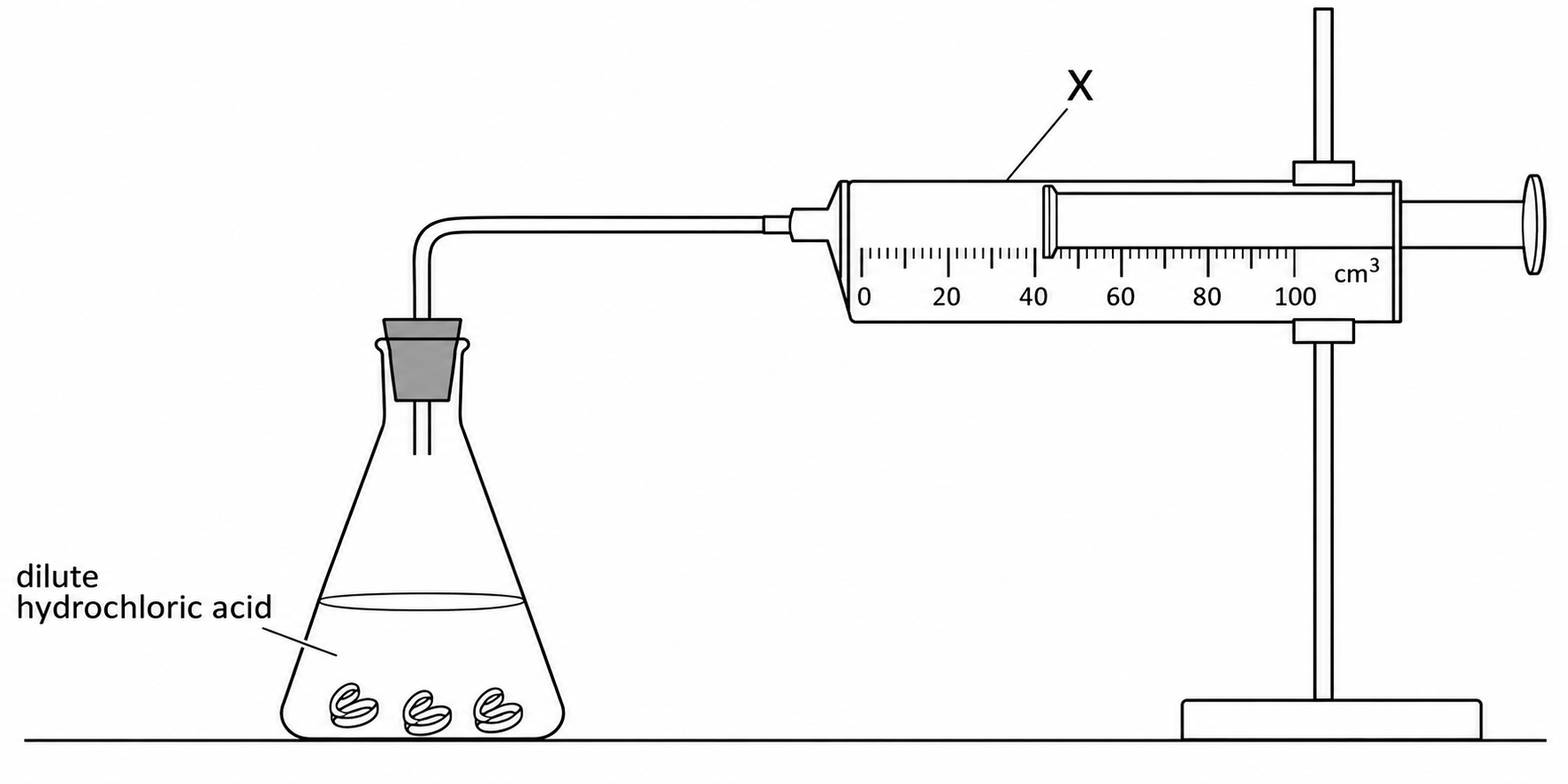
The figure shows the apparatus the student used.
Figure: The apparatus used to collect the gas given off in the reaction between magnesium ribbon and dilute hydrochloric acid
a.[1]
Name the piece of apparatus labelled X.
b.[1]
Name the gas that collects in the apparatus labelled X.
c.[2]
Give two variables the student should keep the same each time the experiment is repeated.
d.[2]
In one experiment the student collected 24 cm3 of hydrogen in 30 s.
Calculate the mean rate of this reaction. Give the unit.
6.1 Rate of reaction Questions
41 exam-style questions on AQA GCSE Chemistry 6.1 Rate of reaction, covering 6.1.1a Calculating rates of reactions, 6.1.1b Gradient of a tangent as rate, 6.1.2 Factors which affect the rates of chemical reactions, 6.1.3 Collision theory and activation energy, and 6.1.4 Catalysts. Each one has a worked solution and a mark scheme showing where the marks go.