x

Revision notes for AQA GCSE Chemistry Properties of small molecules. Open the guide for explanations and worked examples. Written against the AQA GCSE Chemistry (8462) specification, so the content matches what's examinable rather than general Chemistry background.

Properties of small molecules

What you'll learn

  • What a small molecular substance is.
  • Why many small molecular substances are gases or liquids at room temperature.
  • Why melting and boiling do not break covalent bonds.
  • Why small molecular substances usually do not conduct electricity.

Starting point: covalent bonds make molecules

A covalent bond is a strong bond formed when two non-metal atoms share a pair of electrons.

A molecule is a group of atoms joined together by covalent bonds. For example:

  • oxygen, O₂
  • water, H₂O
  • methane, CH₄
  • carbon dioxide, CO₂
  • chlorine, Cl₂

These are made from separate molecules, not giant lattices.

Definition

Small molecular substance

A small molecular substance is a substance made of small, separate molecules. The atoms inside each molecule are joined by strong covalent bonds.

From one molecule to the whole substance

A single molecule is not the same as a whole sample of the substance.

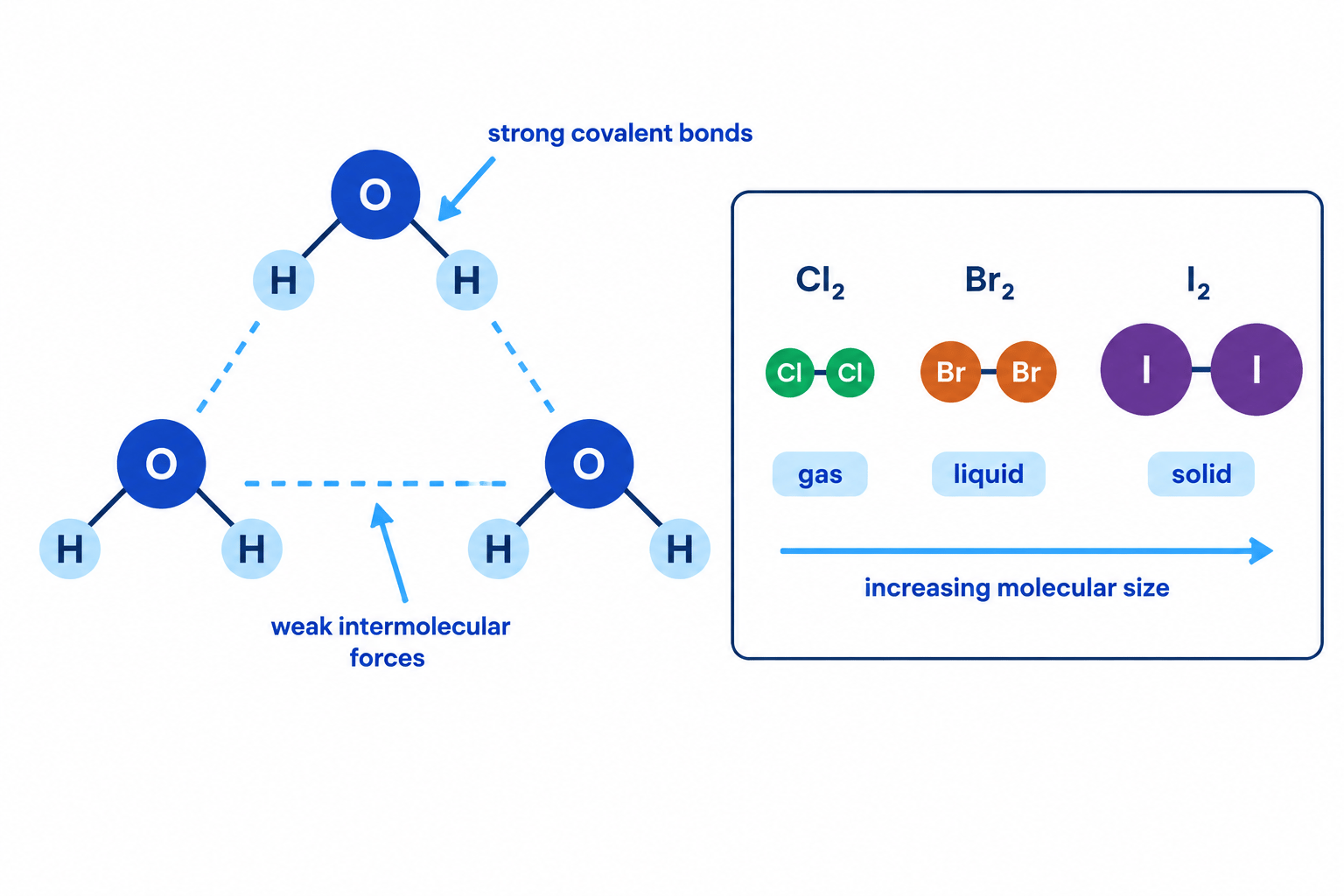
For example, a beaker of liquid bromine contains many Br₂ molecules. Each Br₂ molecule has a strong covalent bond inside it, but the separate Br₂ molecules are also attracted to each other by much weaker forces.

Definition

Intermolecular forces

Intermolecular forces are weak forces of attraction between molecules. “Inter” means “between”, so these are forces between separate molecules, not bonds inside a molecule.

In a molecular substance, heating mainly changes the distances between molecules, not the covalent bonds within each molecule.

Diagram showing covalent bonds inside molecules and weak intermolecular forces between molecules during melting or boiling

Key Idea

The key separation

Small molecular substances have strong covalent bonds within molecules but weak intermolecular forces between molecules. Melting and boiling overcome the weak forces between molecules.

Example

Explaining boiling without breaking molecules

Methane, CH₄, is a small molecular substance. Explain what happens to the particles when methane boils.

  1. Methane is made of separate CH₄ molecules. The carbon and hydrogen atoms inside each molecule are joined by strong covalent bonds.

  2. Boiling changes methane from a liquid to a gas, so the CH₄ molecules move further apart from each other.

  3. The energy supplied overcomes the weak intermolecular forces between CH₄ molecules. The covalent bonds inside each CH₄ molecule are not broken, so methane molecules remain CH₄.

Why melting points and boiling points are low

The melting point is the temperature at which a solid changes to a liquid.

The boiling point is the temperature at which a liquid changes to a gas.

Small molecular substances usually have low melting points and boiling points because only weak intermolecular forces need to be overcome. Weak forces need relatively little energy to overcome.

This is why many small molecular substances are gases or liquids at room temperature. For example, oxygen and carbon dioxide are gases, while bromine is a liquid.

Definition

Bulk properties

Bulk properties are properties of the whole substance, such as melting point, boiling point, state at room temperature, and electrical conductivity.

Example

Using melting and boiling points to predict state

Bromine has a melting point of -7°C and a boiling point of 59°C. What is its state at 20°C?

  1. Compare 20°C with the melting point. Since 20°C is above -7°C, bromine will not be solid.

  2. Compare 20°C with the boiling point. Since 20°C is below 59°C, bromine will not be gas.

  3. Therefore, bromine is a liquid at 20°C. Its melting and boiling points are fairly low because bromine is a small molecular substance with weak intermolecular forces.

Common Mistake

Breaking the wrong thing

Do not write “covalent bonds are broken when a small molecular substance boils”. In melting and boiling, the weak intermolecular forces are overcome. The covalent bonds inside the molecules stay intact.

Larger molecules have higher melting and boiling points

The intermolecular forces between molecules increase as the size of the molecules increases.

So, in general:

  • smaller molecules have weaker intermolecular forces
  • larger molecules have stronger intermolecular forces
  • stronger intermolecular forces need more energy to overcome
  • larger molecules usually have higher melting and boiling points

A good example is the halogens:

  • chlorine, Cl₂, is a gas at room temperature
  • bromine, Br₂, is a liquid at room temperature
  • iodine, I₂, is a solid at room temperature

The molecules get larger from chlorine to iodine, so the intermolecular forces get stronger.

Example

Comparing boiling points

Chlorine, Cl₂, has a lower boiling point than iodine, I₂. Explain why.

  1. Both chlorine and iodine are small molecular substances made of separate molecules.

  2. I₂ molecules are larger than Cl₂ molecules, so the intermolecular forces between I₂ molecules are stronger.

  3. More energy is needed to overcome the stronger intermolecular forces in iodine, so iodine has a higher boiling point than chlorine.

Tip

Molecule size, not sample size

When the exam says “larger molecules”, it means the molecules themselves contain larger atoms or more atoms. It does not mean you have a bigger lump of the substance.

Why small molecular substances do not conduct electricity

To conduct electricity, a substance must contain mobile charged particles.

These could be:

  • ions that can move, as in molten ionic compounds
  • delocalised electrons that can move, as in metals and graphite

Small molecular substances do not have these. Their molecules have no overall electric charge, so the molecules are neutral.

Definition

Mobile charged particle

A mobile charged particle is a charged particle that can move through a substance and carry electrical current.

Even if a small molecular substance is liquid or gas and its molecules can move around, the molecules are still neutral. Moving neutral molecules cannot carry electrical charge.

Example

Deciding whether liquid oxygen conducts

Oxygen, O₂, is a small molecular substance. Explain why liquid oxygen does not conduct electricity.

  1. Liquid oxygen contains O₂ molecules. Each O₂ molecule has no overall electric charge.

  2. The O₂ molecules can move in the liquid, but they are neutral molecules, not ions or delocalised electrons.

  3. Because there are no mobile charged particles, liquid oxygen cannot conduct electricity.

Common Mistake

Pure substance or solution?

A pure molecular substance usually does not conduct electricity. However, if a molecular substance reacts with water to form ions, the solution may conduct. For this topic, focus on the pure small molecular substance unless the question clearly says it is dissolved in water.

Building strong GCSE explanations

For this topic, exam answers are often about linking structure to properties.

A strong answer usually includes:

  1. the substance is made of small molecules
  2. there are weak intermolecular forces between the molecules
  3. little energy is needed to overcome these forces
  4. covalent bonds inside the molecules are not broken
  5. molecules have no overall charge, so there are no mobile charged particles
Tip

Three-part melting and boiling answer

For melting or boiling, use this structure: small molecules → weak intermolecular forces → little energy needed to overcome them.

Exam technique

In the exam

  1. For low melting or boiling points, say weak intermolecular forces between molecules need little energy to overcome.

  2. If comparing two molecular substances, identify the larger molecule, then link it to stronger intermolecular forces and a higher melting or boiling point.

  3. For electrical conductivity, mention that molecules have no overall charge, so there are no mobile charged particles to carry current.

Self review

Check yourself

  • When iodine melts, which forces are overcome: covalent bonds or intermolecular forces?
  • Why does bromine have a higher boiling point than chlorine?
  • Why does liquid methane not conduct electricity?

How bonding and structure are related to the properties of substances

Guide 4 of 8

You've reached the end

Test yourself on this topic, or move on to the next guide.

Next guidePolymersStart

How was this guide?

Properties of small molecules Revision Guide

  1. GCSE
  2. /Chemistry
  3. /Properties of small molecules