x

Revision notes for AQA GCSE Chemistry Properties of ionic compounds. Open the guide for explanations and worked examples. Written against the AQA GCSE Chemistry (8462) specification, so the content matches what's examinable rather than general Chemistry background.

Properties of ionic compounds

What you'll learn

  • What a giant ionic lattice is and why it is regular.
  • Why ionic compounds usually have high melting points and high boiling points.
  • Why ionic compounds conduct electricity when molten or dissolved in water, but not when solid.
  • How to explain these properties using structure and bonding language.

The starting point: ions and ionic bonding

Ionic compounds are made from ions. This usually happens when a metal atom transfers electrons to a non-metal atom.

The metal atom loses electron(s), so it becomes a positive ion. The non-metal atom gains electron(s), so it becomes a negative ion. Opposite charges attract, so positive and negative ions are held together.

Definition

Ion and ionic compound

An ion is an atom or group of atoms with an electric charge because it has lost or gained electrons. An ionic compound is a substance made from positive and negative ions held together by strong attractions.

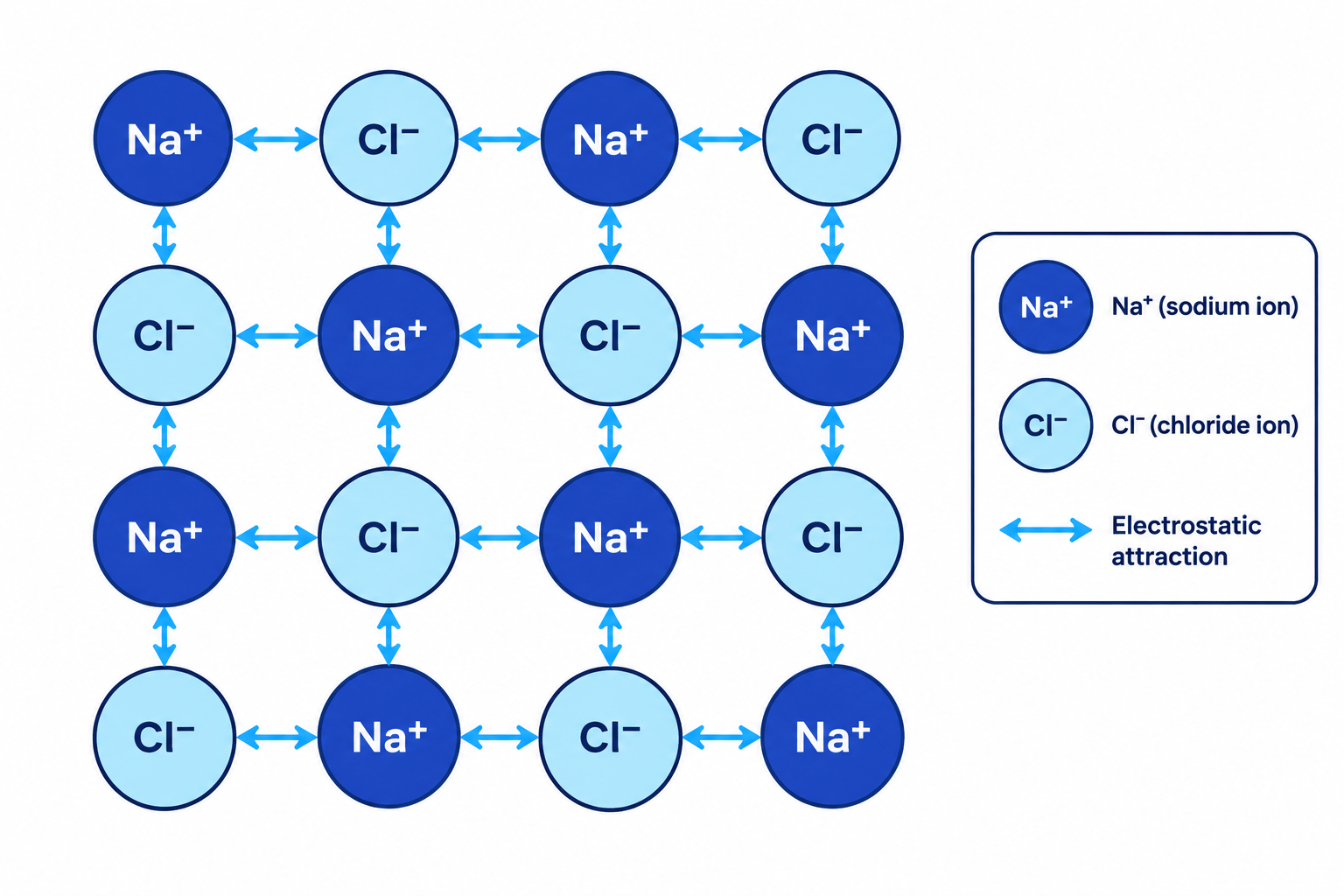
For example, sodium chloride contains Na⁺ ions and Cl⁻ ions. The important point is that these ions do not just pair up as little separate “molecules”. They form a huge repeating structure.

Giant ionic lattices

In a solid ionic compound, the ions are arranged in a regular pattern. Regular means the same pattern repeats again and again.

This structure is called a giant ionic lattice. “Giant” means the structure continues through the whole crystal, with millions of ions. “Lattice” means a regular 3D arrangement of particles.

Definition

Giant ionic lattice

A giant ionic lattice is a regular, repeating 3D arrangement of positive and negative ions, with strong electrostatic forces of attraction in all directions between oppositely charged ions.

An electrostatic force is a force between charged particles. Opposite charges attract, so positive ions are attracted to negative ions. In an ionic lattice, each ion is attracted to oppositely charged ions around it, not just to one partner.

Diagram comparing a solid sodium chloride ionic lattice with fixed ions and a melted ionic compound with mobile ions carrying charge

You only need to know the structure of sodium chloride as a model example. You do not need to memorise detailed structures of other ionic compounds.

Key Idea

The big structure idea

Ionic compounds are not made of small molecules. Their properties come from a giant lattice of many oppositely charged ions held by strong electrostatic attractions.

Common Mistake

Calling ionic compounds molecules

Avoid writing “sodium chloride molecules”. Sodium chloride is a giant ionic lattice. If you mean the ratio of ions, say the formula is NaCl.

Why ionic compounds have high melting and boiling points

The melting point is the temperature at which a solid turns into a liquid. The boiling point is the temperature at which a liquid turns into a gas.

Ionic compounds usually have high melting and boiling points because their lattices contain many strong electrostatic attractions. To melt or boil the substance, a large amount of energy is needed to overcome enough of these attractions so that the ions can move more freely.

The attractions act in all directions throughout the lattice. This makes the structure very strongly held together overall.

Key Idea

High melting and boiling points

Ionic compounds have high melting and boiling points because a large amount of energy is needed to overcome the many strong electrostatic attractions in the giant ionic lattice.

Example

Explaining a high melting point

Sodium chloride has a melting point of about 801 °C. Explain why it is high.

  1. Sodium chloride is an ionic compound, so in the solid state it forms a giant ionic lattice rather than separate molecules.
  2. The Na⁺ and Cl⁻ ions are held together by strong electrostatic attractions in all directions.
  3. Melting requires enough energy to overcome many of these strong attractions so that the ions can move, so the melting point is high.
Common Mistake

Breaking the wrong thing

When an ionic compound melts, the ions are not destroyed and atoms are not formed. The lattice attractions are overcome enough for the ions to move around.

Electrical conductivity: charges must be able to move

A substance conducts electricity when charge can flow through it. A moving charged particle is called a charge carrier.

In metals, the charge carriers are delocalised electrons. In ionic compounds, the charge carriers are ions — but only if the ions are free to move.

Definition

Electrical conductivity

Electrical conductivity is the ability of a substance to allow electric charge to flow through it. In ionic compounds, the moving charged particles are ions.

Solid ionic compounds do not conduct

In a solid ionic compound, the ions are charged, but they are fixed in position in the lattice. They can vibrate, but they cannot move through the structure.

So, a solid ionic compound does not conduct electricity.

Molten ionic compounds do conduct

Molten means melted. When an ionic compound melts, the lattice is no longer fixed. The ions can move around.

Because the positive and negative ions are free to move, charge can flow. This means molten ionic compounds conduct electricity.

For example:

NaCl(s) → NaCl(l)

In NaCl(l), the Na⁺ ions and Cl⁻ ions are mobile, so the liquid conducts.

Ionic compounds dissolved in water conduct

If an ionic compound dissolves in water, the ions separate and become free to move in the solution. The solution is described as aqueous, shown using the state symbol (aq).

For sodium chloride dissolving:

NaCl(s) → Na⁺(aq) + Cl⁻(aq)

The ions are now mobile in water, so the solution conducts electricity.

Common Mistake

Only if it dissolves

“Dissolved in water” means the ions have separated and are mobile in the solution. If an ionic compound is insoluble, it will not form an aqueous solution of mobile ions.

Comparing solid, molten, and aqueous ionic compounds

State of ionic compoundAre ions present?Can ions move through the substance?Conducts electricity?
Solid, (s)YesNo — fixed in latticeNo
Molten, (l)YesYes — mobile ionsYes
Aqueous, (aq)YesYes — mobile ions in waterYes

The key difference is not whether ions exist. Ions are present in all three cases. The key difference is whether the ions are free to move.

Example

Deciding whether an ionic compound conducts

Magnesium chloride is tested in three states: MgCl₂(s), MgCl₂(l), and MgCl₂(aq). Predict which conduct electricity.

  1. In MgCl₂(s), the compound is a solid ionic lattice, so the Mg²⁺ and Cl⁻ ions are fixed in position and cannot carry charge through the substance.
  2. In MgCl₂(l), the compound is molten, so the ions are mobile and can carry charge through the liquid.
  3. In MgCl₂(aq), the compound has dissolved in water, so the ions are mobile in solution and can carry charge.

So MgCl₂(l) and MgCl₂(aq) conduct electricity, but MgCl₂(s) does not.

Tip

The exam sentence for conductivity

For ionic compounds, use this structure: “It conducts when molten or aqueous because the ions are free to move and carry charge.”

How to link structure to properties

For this topic, exam answers usually want a clear chain of reasoning. Try to move from:

structure → bonding/forces → particles moving or not moving → property

For melting and boiling points:

  1. Ionic compounds have a giant ionic lattice.
  2. There are strong electrostatic forces between oppositely charged ions in all directions.
  3. A large amount of energy is needed to overcome these forces.
  4. Therefore, ionic compounds have high melting and boiling points.

For electrical conductivity:

  1. Ionic compounds contain charged ions.
  2. In a solid, the ions are fixed in position, so charge cannot flow.
  3. When molten or dissolved in water, the ions are free to move.
  4. Therefore, molten or aqueous ionic compounds conduct electricity.
Exam technique

In the exam

  1. For melting and boiling point questions, always mention giant ionic lattice, strong electrostatic attractions, and large amount of energy needed.
  2. For conductivity questions, focus on whether the ions are free to move; do not just say “it has ions”.
  3. Avoid saying ionic compounds have intermolecular forces — they do not form simple molecules, so talk about attractions between oppositely charged ions.
Self review

Check yourself

  • Why does a solid ionic compound not conduct electricity even though it contains charged ions?
  • What does “strong electrostatic forces of attraction in all directions” mean in an ionic lattice?
  • Explain why an ionic compound has a high melting point using the words “giant lattice”, “oppositely charged ions”, and “energy”.

How bonding and structure are related to the properties of substances

Guide 3 of 8

You've reached the end

Test yourself on this topic, or move on to the next guide.

Next guideProperties of small moleculesStart

How was this guide?

Properties of ionic compounds Revision Guide

  1. GCSE
  2. /Chemistry
  3. /Properties of ionic compounds