Polymers: giant molecules that stay solid at room temperature
Definition
Polymer
A substance made from very large molecules in which many atoms are linked by strong covalent bonds.
Definition
Molecule
A discrete group of two or more atoms held together by covalent bonds.
- A polymer is a material made from very large molecules.
- Each molecule contains many atoms joined into one long chain.
- A short section of the chain, called the repeating unit, is copied over and over to build the whole molecule.
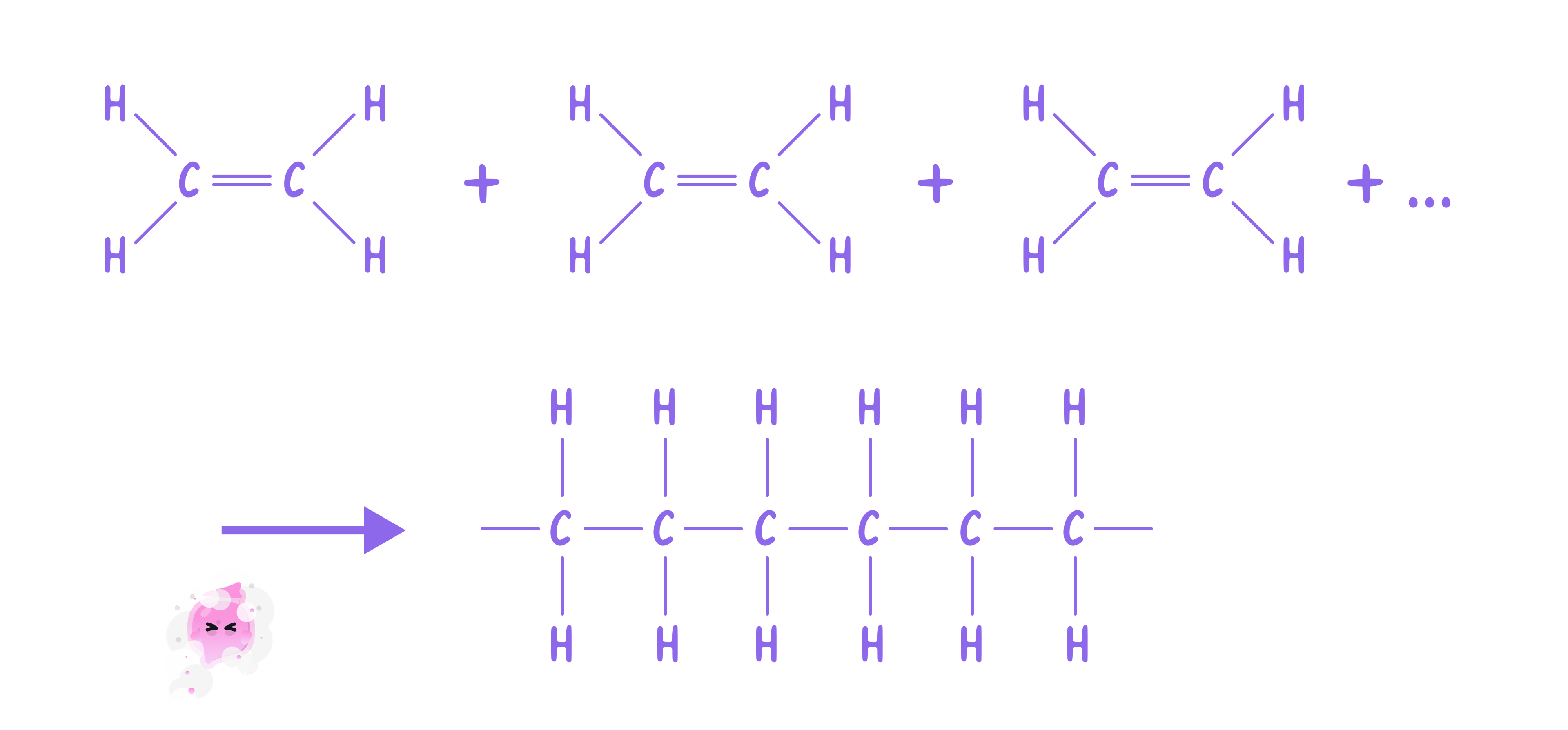
- Poly(ethene) is a familiar polymer, and part of its chain is written as −(CH2−CH2)n−-(\text{CH}_2-\text{CH}_2)_n-−(CH2−CH2)n−.
- The subscript nnn stands for a very large number of repeating units.
Key Idea
- A polymer is made of very large molecules containing many atoms.
- Every polymer molecule is a long chain of atoms bonded together.
Covalent bonds within a chain: strong bonds hold each molecule together
Definition
Covalent bond
A covalent bond is a strong electrostatic attraction between a shared pair of electrons and the nuclei of the bonded atoms.
- Within each polymer molecule, the atoms are joined by strong covalent bonds.
- A covalent bond is a shared pair of electrons between two atoms.
- In poly(ethene) each carbon atom, C\text{C}C, is covalently bonded to other carbon atoms and to hydrogen atoms, H\text{H}H.
- These covalent bonds run along the whole length of the chain, linking every atom in the molecule.
- Because covalent bonds are strong, a great deal of energy is needed to break them.
Note
- Covalent bonds act within each molecule, holding its atoms in a fixed chain.
- Breaking these bonds would split the molecule itself, so they stay intact in everyday use.
Intermolecular forces between chains: the reason polymers are solid
Definition
Intermolecular force
A force of attraction between separate molecules or polymer chains.
- Separate polymer molecules are attracted to one another by intermolecular forces.
- These forces act between whole molecules, not within them.
- Because each molecule is very large, the total attraction between two chains is relatively strong.
- The many points of contact along each long chain add up to a large overall attraction.
- A large amount of energy is needed to overcome these forces so the chains can move past one another.
- At room temperature there is not enough energy to separate the chains, so polymers are solid.
Common Mistake
- Do not say that covalent bonds between molecules make a polymer solid.
- Covalent bonds act within each chain, while intermolecular forces act between separate chains.
- It is the intermolecular forces, not the covalent bonds, that are overcome when a polymer melts.
Reading polymer diagrams: look for long chains of bonded atoms
- In a diagram, a polymer is drawn as a very long molecule of many atoms joined by lines.
- Each line between two atoms represents a strong covalent bond.
- A diagram usually shows only part of the chain, because the full molecule is far too large to draw.
- A repeating bracket or a row of dots shows that the pattern continues well beyond the drawn section.
- If several long chains are drawn side by side, each row is a separate polymer molecule.
- The spaces between the rows are bridged by intermolecular forces, not by covalent bonds.
- To explain why a polymer is solid, first state that it is made of very large molecules.
- Then state that the atoms in each molecule are held by strong covalent bonds.
- Next explain that the intermolecular forces between the molecules are relatively strong.
- Finally link this to the property by stating that the polymer is solid at room temperature.
- Keep the two attractions separate by using within for covalent bonds and between for intermolecular forces.
Self review
- What does the word polymer tell you about the size of its molecules?
- Which type of bond joins the atoms within a single polymer chain?
- Which forces act between separate polymer molecules?
- Why are polymers solid at room temperature?
- In a polymer diagram, how can you tell a covalent bond from an intermolecular force?
