- How a balanced equation gives you a mole ratio between reactants and products.
- What limiting reactant and excess reactant mean.
- How to identify the limiting reactant from amounts in moles or masses in grams.
- How the limiting reactant controls the maximum amount of product formed.
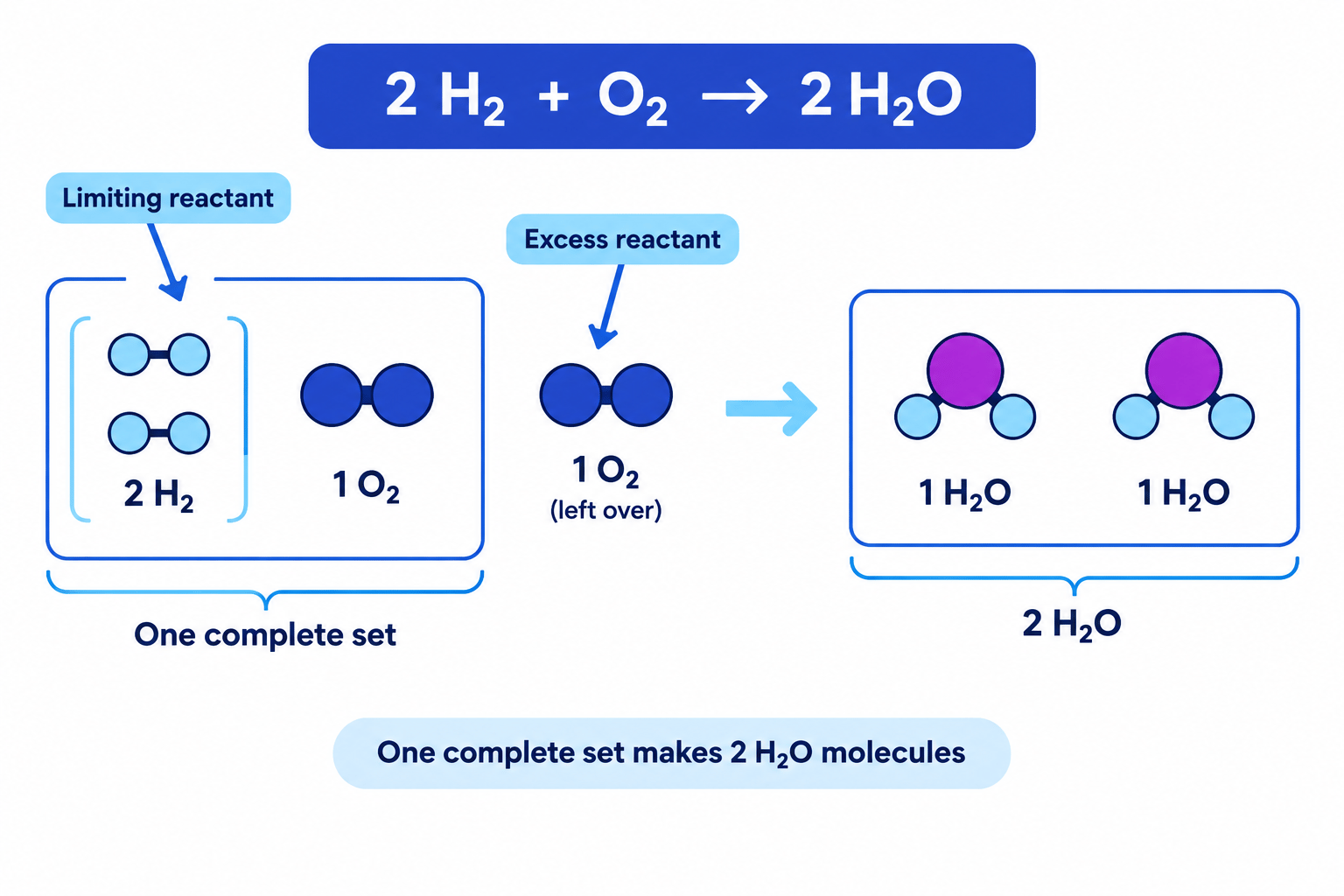
In real reactions, you often mix two reactants together. Usually, they are not present in the exact perfect ratio needed by the balanced equation. One reactant may run out first, while some of the other is left over.
This is Higher Tier only, but the idea is very logical: the reaction stops making more product when one required reactant has been used up.
The amount of substance is how much chemical you have in terms of particles. It is measured in moles, with the symbol nnn.
Mole
One mole is an amount of substance containing the same number of particles as there are atoms in 12 g of carbon-12. At GCSE, the most important idea is that moles let you compare chemicals using a balanced equation.
For pure substances, you can convert between mass and moles using:
n=mMrn = \frac{m}{M_r}n=Mrm
where nnn is amount in moles, mmm is mass in grams, and MrM_rMr is relative formula mass.
You can rearrange this to find mass:
m=n×Mrm = n \times M_rm=n×Mr
Converting mass to moles
Magnesium has Ar=24A_r = 24Ar=24. How many moles are in 6.0 g of magnesium?
-
Choose the correct equation because you are changing from mass to moles:
n=mMrn = \frac{m}{M_r}n=Mrm
-
Substitute the values, using mass in grams:
n=6.024n = \frac{6.0}{24}n=246.0
-
Calculate the amount:
n=0.25 moln = 0.25 \text{ mol}n=0.25 mol
A balanced symbol equation shows the same number of atoms of each element on both sides. The large numbers in front of formulae are called coefficients.
For example:
Mg(s) + 2HCl(aq) → MgCl2(aq) + H2(g)
This equation says:
- 1 mole of magnesium reacts with 2 moles of hydrochloric acid.
- 1 mole of magnesium chloride forms.
- 1 mole of hydrogen gas forms.
Mole ratio
A mole ratio is the ratio of amounts in moles shown by the coefficients in a balanced equation.
Balanced equations are mole recipes
The coefficients in a balanced equation compare moles, not masses. A ratio of 1:2 does not mean 1 g reacts with 2 g.
Using a mole ratio
For the reaction Mg(s) + 2HCl(aq) → MgCl2(aq) + H2(g), how many moles of hydrochloric acid are needed to react with 0.40 mol of magnesium?
-
Read the ratio from the balanced equation:
Mg : HCl is 1 : 2.
-
Scale the ratio up from 1 mol Mg to 0.40 mol Mg:
the amount of HCl needed is twice the amount of Mg.
-
Calculate:
0.40×2=0.80 mol HCl0.40 \times 2 = 0.80 \text{ mol HCl}0.40×2=0.80 mol HCl
In a reaction involving two reactants, one may be completely used up first. Once that happens, the reaction cannot make any more product.
Limiting reactant
The limiting reactant is the reactant that is completely used up in a reaction. It limits the amount of product that can be formed.
Excess reactant
An excess reactant is present in more than the amount needed. Some of it is left over when the reaction stops.
The diagram shows the idea using magnesium and hydrochloric acid. There is enough HCl for only 3 magnesium atoms to react, so magnesium is used up first in the example shown, while some HCl is left over.

Think of sandwiches
If each sandwich needs 2 slices of bread and 1 slice of cheese, then 10 slices of bread and 3 slices of cheese can only make 3 sandwiches. Cheese is the limiting ingredient; bread is in excess.
It is common to use an excess of one reactant to make sure all of the other reactant is used up.
For example, when making a salt from an acid and an insoluble base, the base is often added in excess. Any leftover solid base can be filtered off, leaving a solution where the acid has fully reacted.
Excess can be useful
Using an excess of one reactant makes sure the other reactant reacts completely. The limiting reactant decides the maximum amount of product.
The safest method is to compare how much of one reactant is needed with how much is actually available.
Use the balanced equation:
Mg(s) + 2HCl(aq) → MgCl2(aq) + H2(g)
The ratio is:
Mg : HCl = 1 : 2
So for every 1 mol of Mg, you need 2 mol of HCl.
Identifying the limiting reactant from moles
A student reacts 0.30 mol of magnesium with 0.50 mol of hydrochloric acid. Which reactant is limiting?
-
Use the balanced equation to find the required ratio:
1 mol Mg needs 2 mol HCl.
-
Work out how much HCl would be needed for 0.30 mol Mg:
0.30×2=0.60 mol HCl0.30 \times 2 = 0.60 \text{ mol HCl}0.30×2=0.60 mol HCl
-
Compare needed with available:
0.60 mol HCl is needed, but only 0.50 mol HCl is available.
-
Decide the limiting reactant:
hydrochloric acid is the limiting reactant, because there is not enough HCl to react with all the magnesium.
Comparing the numbers without the ratio
Do not just say 0.30 mol is less than 0.50 mol, so magnesium is limiting. You must use the balanced equation first, because the reactants may not react in a 1:1 ratio.
Exam questions often give masses in grams. You cannot compare the masses directly, because different substances have different relative formula masses.
The method is:
- Write or use the balanced equation.
- Convert each reactant’s mass into moles.
- Use the mole ratio to see which reactant runs out first.
- Use the limiting reactant to calculate the product.
Identifying the limiting reactant from masses
Zinc reacts with hydrochloric acid:
Zn(s) + 2HCl(aq) → ZnCl2(aq) + H2(g)
13.0 g of zinc reacts with 7.30 g of hydrochloric acid. Which reactant is limiting?
Use ArA_rAr: Zn = 65, H = 1, Cl = 35.5.
-
Calculate the moles of zinc:
n=13.065=0.200 mol Znn = \frac{13.0}{65} = 0.200 \text{ mol Zn}n=6513.0=0.200 mol Zn
-
Calculate the relative formula mass of HCl, then its moles:
Mr(HCl)=1+35.5=36.5M_r(\text{HCl}) = 1 + 35.5 = 36.5Mr(HCl)=1+35.5=36.5
n=7.3036.5=0.200 mol HCln = \frac{7.30}{36.5} = 0.200 \text{ mol HCl}n=36.57.30=0.200 mol HCl
-
Use the balanced equation ratio:
1 mol Zn needs 2 mol HCl, so 0.200 mol Zn would need 0.400 mol HCl.
-
Compare with what is available:
only 0.200 mol HCl is available, so hydrochloric acid is the limiting reactant.
Comparing grams instead of moles
A smaller mass does not automatically mean a limiting reactant. Always convert grams to moles before using the balanced equation.
Once you know the limiting reactant, ignore any excess reactant when calculating the maximum product. The excess reactant cannot force more product to form, because the limiting reactant has run out.
The key calculation choice
After identifying the limiting reactant, base the product calculation on the limiting reactant only.
Calculating the maximum mass of product
In the reaction below, 13.0 g of zinc reacts with 7.30 g of hydrochloric acid:
Zn(s) + 2HCl(aq) → ZnCl2(aq) + H2(g)
From the previous example, HCl is the limiting reactant. What maximum mass of zinc chloride can form?
Use ArA_rAr: Zn = 65, Cl = 35.5.
-
Start with the limiting reactant amount:
7.30 g HCl is 0.200 mol HCl.
-
Use the mole ratio from the balanced equation:
2 mol HCl forms 1 mol ZnCl2.
-
Calculate the moles of zinc chloride formed:
0.200÷2=0.100 mol ZnCl20.200 \div 2 = 0.100 \text{ mol ZnCl}_20.200÷2=0.100 mol ZnCl2
-
Calculate the relative formula mass of zinc chloride:
Mr(ZnCl2)=65+(2×35.5)=136M_r(\text{ZnCl}_2) = 65 + (2 \times 35.5) = 136Mr(ZnCl2)=65+(2×35.5)=136
-
Convert moles of product to mass:
m=0.100×136=13.6 g ZnCl2m = 0.100 \times 136 = 13.6 \text{ g ZnCl}_2m=0.100×136=13.6 g ZnCl2
If you add more of the limiting reactant, more product can form, as long as the other reactant is still in excess.
If you add more of the excess reactant, the amount of product does not increase, because the limiting reactant is still used up first.
Product amount is capped
The maximum amount of product is controlled by whichever reactant runs out first. Extra excess reactant is left unreacted and does not increase the product.
When you see a limiting reactant question, use this routine:
- Balance the equation if needed.
- Convert all given reactant masses into moles.
- Use the equation ratio to check which reactant is short.
- Identify the limiting reactant.
- Calculate product amount from the limiting reactant.
- Convert moles of product into grams if the question asks for mass.
Only use this for reacting substances
A limiting reactant calculation assumes the substances actually react according to the balanced equation given. Do not include catalysts, solvents, or substances stated to be in excess unless the question asks about leftover amounts.
In the exam
- Always start from the balanced equation and use the coefficients as mole ratios.
- If masses are given, convert to moles before deciding which reactant is limiting.
- Once you have found the limiting reactant, use only that reactant to calculate the maximum amount of product.
Check yourself
- Why can’t you identify the limiting reactant just by comparing masses in grams?
- In Mg(s) + 2HCl(aq) → MgCl2(aq) + H2(g), how many moles of HCl are needed for 0.25 mol Mg?
- If adding more of one reactant does not increase the product, what does that tell you about that reactant?