Welcome! This is a Higher Tier (HT) only topic that flips what you already know about moles and chemical equations upside down.
Usually, you are given a beautifully balanced equation and asked to calculate an unknown mass. Here, we are going to do the reverse: you will be given the raw experimental masses, and you will use them to discover what the balanced equation looks like.
What you'll learn:
- How to convert the masses of all reactants and products into moles.
- How to use those moles to find the simplest whole-number ratio.
- How to turn that ratio into the large balancing numbers (stoichiometric coefficients) in a symbol equation.
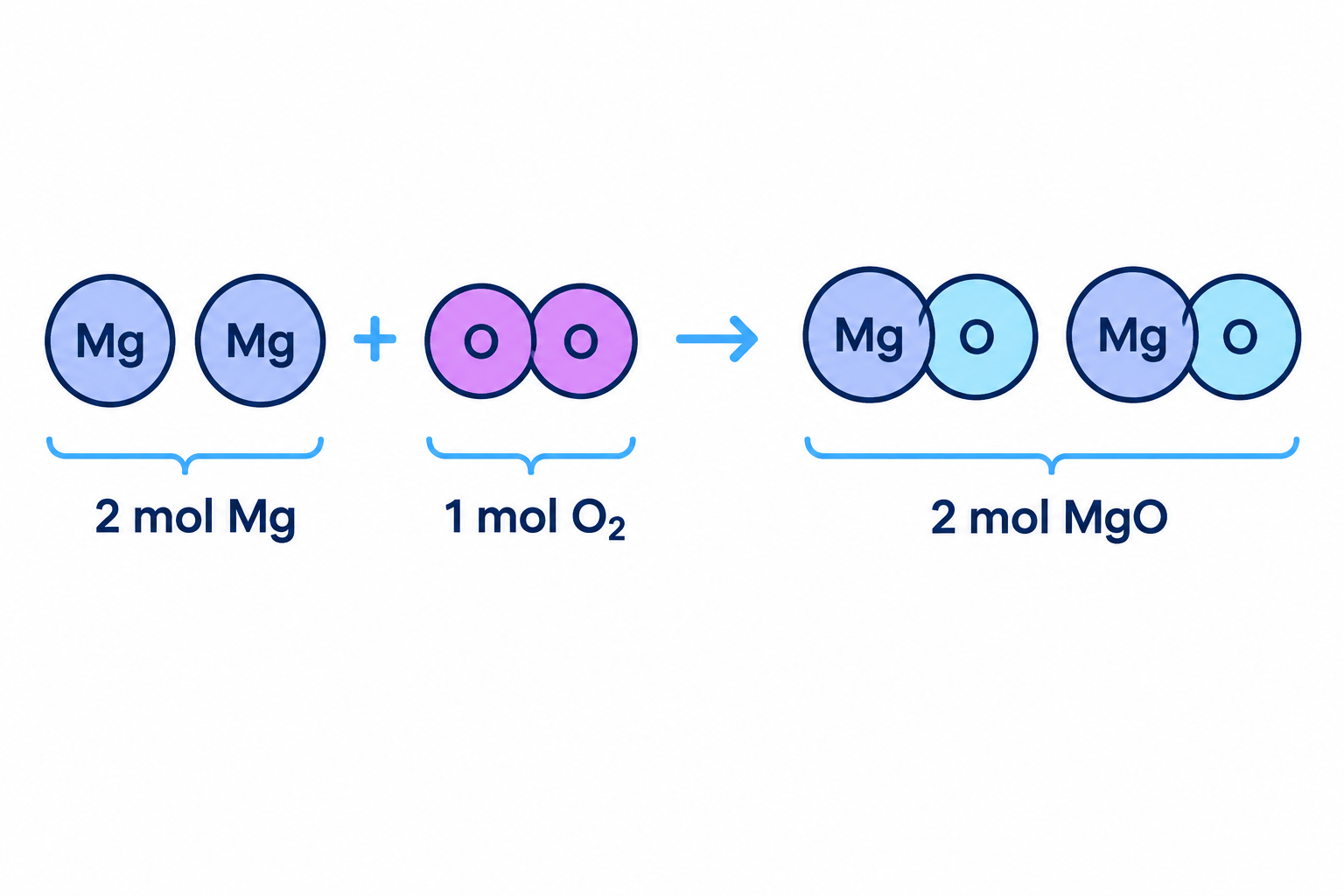
Every chemical reaction follows a recipe. The large numbers written in front of formulas in a balanced chemical equation tell us the ratio of moles involved in the reaction.
Balancing number
The large number placed in front of a chemical formula in an equation (e.g., the 2 in 2H2O2\text{H}_2\text{O}2H2O). It tells you how many moles of that substance take part in the reaction. If there is no number, it means 1.
If you do an experiment and weigh all your reactants and products, those masses alone don't tell you the balancing numbers because different atoms weigh different amounts. To find the correct ratio, we have to level the playing field by converting all the masses into moles.
The Golden Rule of Balancing with Masses
Masses don't give you the balancing numbers directly—moles do. Once you know how many moles of each substance you have, you just find their simplest whole-number ratio, and those become your balancing numbers.
To convert our masses into moles, we need the standard mole equation. You should be completely comfortable with rearranging this:
Moles=MassRelative formula mass
\text{Moles} = \frac{\text{Mass}}{\text{Relative formula mass}}
Moles=Relative formula massMass
n=mMr
n = \frac{m}{M_r}
n=Mrm
If you ever need to find the mass from the moles (which we won't do today, but is a vital skill), you rearrange it to make mass the subject: m=n×Mrm = n \times M_rm=n×Mr.
Using the balancing number to calculate Mr
When you calculate the relative formula mass (MrM_rMr) for this method, ignore the big numbers in front of the formula! You are trying to find the big numbers, so they don't exist yet. Just add up the atomic masses (ArA_rAr) of the small subscript numbers. For example, the MrM_rMr of O2\text{O}_2O2 is 16×2=3216 \times 2 = 3216×2=32.
We follow exactly four steps to get from raw mass data to a perfectly balanced symbol equation.
- Masses: Write down the given mass of every reactant and product.
- Mr / Ar: Calculate the relative formula mass (or relative atomic mass) for each substance.
- Moles: Divide each mass by its MrM_rMr to find the number of moles.
- Ratio: Divide all your mole values by the smallest mole value you found. This forces the smallest value to become 1 and reveals the simplest whole-number ratio.

Let's see this in action with a complete example.
Deducing the balanced equation for a displacement reaction
In an experiment, 6.5 g of zinc (Zn\text{Zn}Zn) reacts exactly with 8.0 g of copper oxide (CuO\text{CuO}CuO) to produce 8.1 g of zinc oxide (ZnO\text{ZnO}ZnO) and 6.4 g of copper (Cu\text{Cu}Cu).
Deduce the balanced symbol equation for this reaction.
(Relative atomic masses: Zn=65\text{Zn} = 65Zn=65, Cu=64\text{Cu} = 64Cu=64, O=16\text{O} = 16O=16)
- Calculate the MrM_rMr (or ArA_rAr) for each substance involved:
- Zn=65\text{Zn} = 65Zn=65
- CuO=64+16=80\text{CuO} = 64 + 16 = 80CuO=64+16=80
- ZnO=65+16=81\text{ZnO} = 65 + 16 = 81ZnO=65+16=81
- Cu=64\text{Cu} = 64Cu=64
- Divide the mass of each substance by its MrM_rMr to find the moles (n=m/Mrn = m / M_rn=m/Mr):
- Moles of Zn=6.565=0.1 mol\text{Zn} = \frac{6.5}{65} = 0.1 \text{ mol}Zn=656.5=0.1 mol
- Moles of CuO=8.080=0.1 mol\text{CuO} = \frac{8.0}{80} = 0.1 \text{ mol}CuO=808.0=0.1 mol
- Moles of ZnO=8.181=0.1 mol\text{ZnO} = \frac{8.1}{81} = 0.1 \text{ mol}ZnO=818.1=0.1 mol
- Moles of Cu=6.464=0.1 mol\text{Cu} = \frac{6.4}{64} = 0.1 \text{ mol}Cu=646.4=0.1 mol
- Divide all the mole values by the smallest value (which is 0.1) to find the simplest ratio:
- Zn:0.10.1=1\text{Zn}: \frac{0.1}{0.1} = 1Zn:0.10.1=1
- CuO:0.10.1=1\text{CuO}: \frac{0.1}{0.1} = 1CuO:0.10.1=1
- ZnO:0.10.1=1\text{ZnO}: \frac{0.1}{0.1} = 1ZnO:0.10.1=1
- Cu:0.10.1=1\text{Cu}: \frac{0.1}{0.1} = 1Cu:0.10.1=1
- Write the final balanced equation using this 1:1:1:1 ratio. Because the numbers are all 1, we don't write any numbers in front of the formulas:
Zn+CuO→ZnO+Cu
\text{Zn} + \text{CuO} \to \text{ZnO} + \text{Cu}
Zn+CuO→ZnO+Cu
Sometimes, dividing by the smallest number of moles doesn't give you a perfect whole number. You might end up with a ratio like 1 : 1.5 : 1.
You cannot write 1.51.51.5 as a balancing number in a standard GCSE chemical equation. Atoms react in whole numbers! If this happens, you must multiply all the numbers in your ratio by the same amount to clear the decimal.
Clearing decimals
- If your ratio ends in .5, multiply everything by 2.
- If your ratio ends in .33 or .67, multiply everything by 3.
- If your ratio ends in .25 or .75, multiply everything by 4.
Balancing an equation with an awkward ratio
22.4 g of iron (Fe\text{Fe}Fe) reacts with 42.6 g of chlorine gas (Cl2\text{Cl}_2Cl2) to form 65.0 g of iron(III) chloride (FeCl3\text{FeCl}_3FeCl3).
Deduce the balanced symbol equation for this reaction.
(Relative atomic masses: Fe=56\text{Fe} = 56Fe=56, Cl=35.5\text{Cl} = 35.5Cl=35.5)
- Calculate the MrM_rMr (or ArA_rAr) for each substance:
- Fe=56\text{Fe} = 56Fe=56
- Cl2=35.5×2=71\text{Cl}_2 = 35.5 \times 2 = 71Cl2=35.5×2=71
- FeCl3=56+(35.5×3)=162.5\text{FeCl}_3 = 56 + (35.5 \times 3) = 162.5FeCl3=56+(35.5×3)=162.5
- Calculate the moles of each substance by doing Mass ÷Mr\div M_r÷Mr:
- Moles of Fe=22.456=0.4 mol\text{Fe} = \frac{22.4}{56} = 0.4 \text{ mol}Fe=5622.4=0.4 mol
- Moles of Cl2=42.671=0.6 mol\text{Cl}_2 = \frac{42.6}{71} = 0.6 \text{ mol}Cl2=7142.6=0.6 mol
- Moles of FeCl3=65.0162.5=0.4 mol\text{FeCl}_3 = \frac{65.0}{162.5} = 0.4 \text{ mol}FeCl3=162.565.0=0.4 mol
- Divide each by the smallest number of moles (0.4) to find the ratio:
- Fe:0.40.4=1\text{Fe}: \frac{0.4}{0.4} = 1Fe:0.40.4=1
- Cl2:0.60.4=1.5\text{Cl}_2: \frac{0.6}{0.4} = 1.5Cl2:0.40.6=1.5
- FeCl3:0.40.4=1\text{FeCl}_3: \frac{0.4}{0.4} = 1FeCl3:0.40.4=1
- The ratio is 1:1.5:11 : 1.5 : 11:1.5:1. We have a
.5 decimal, so multiply all numbers by 2 to get whole numbers. The true ratio is 2:3:22 : 3 : 22:3:2.
- Write the equation with these big numbers in front of the corresponding formulas:
2Fe+3Cl2→2FeCl3
2\text{Fe} + 3\text{Cl}_2 \to 2\text{FeCl}_3
2Fe+3Cl2→2FeCl3
In the exam
- Draw a little table or grid to keep your workings tidy. Make the columns your substances, and the rows: Mass, MrM_rMr, Moles, Ratio.
- Don't panic if your moles look like weird decimals (e.g., 0.125). That is totally normal! As long as you divide them all by the smallest one, a neat, whole-number ratio will pop out.
- Once you've written your final equation, quickly check it like you would a normal balancing question. Do you have the same number of Iron atoms on both sides? Yes? Then you know for certain you've nailed the 4-6 marks.
Check yourself
- Do we use the large balancing numbers when calculating the MrM_rMr of a substance?
- If you divide your moles and get a ratio of 1 : 2.5 : 2, what should your final balancing numbers be?
- How do you rearrange n=mMrn = \frac{m}{M_r}n=Mrm to make mass (mmm) the subject?