Question 3
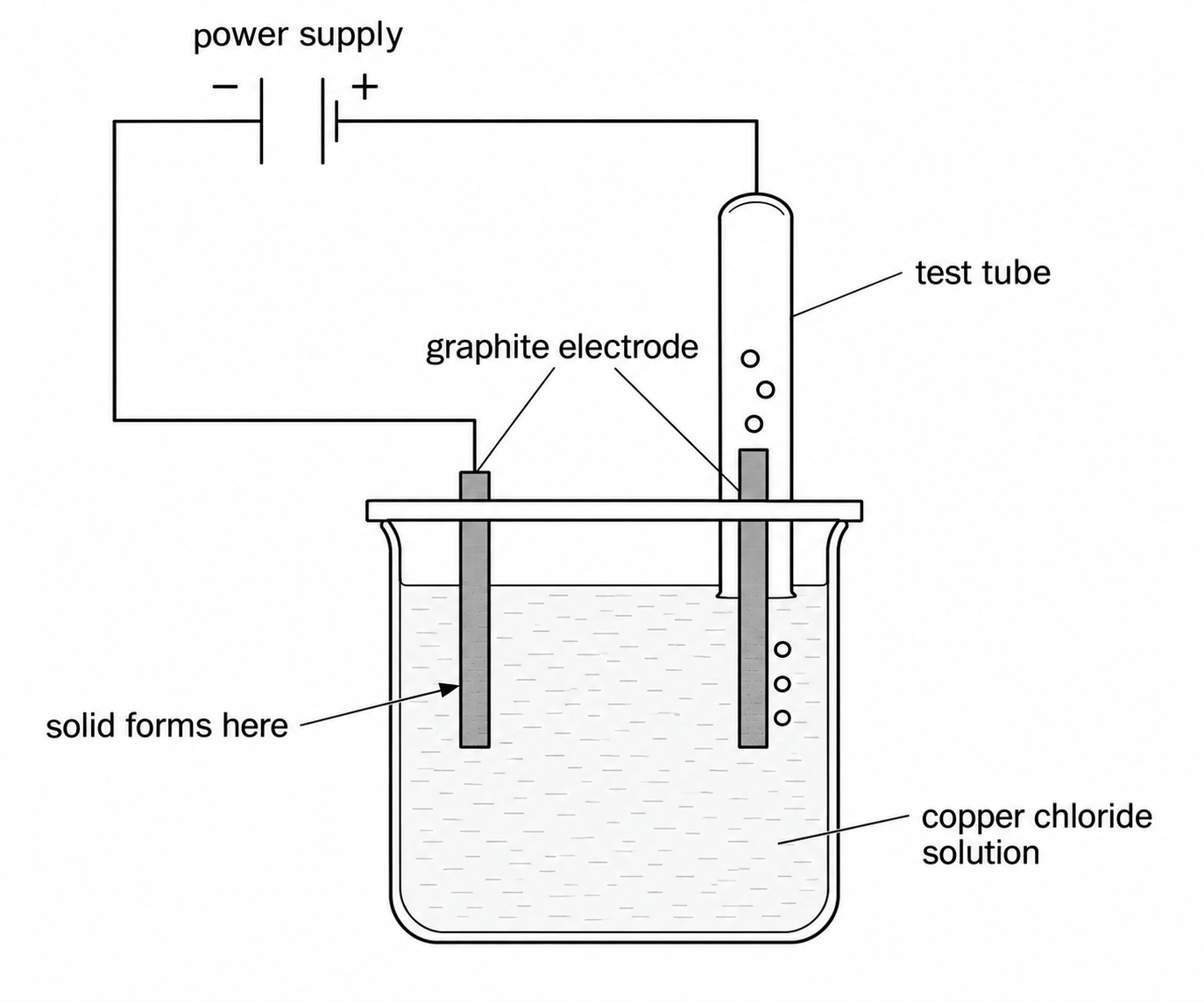
FA student investigated the electrolysis of copper chloride solution using the apparatus in Figure.
Figure: Apparatus used to electrolyse copper chloride solution and collect the gas produced
a.[2]
Describe how the student could show that the gas collected in the test tube is chlorine.
b.[1]
Give the observation the student would make at the negative electrode.
c.[2]
The student predicted that a gas would also be collected at the negative electrode. Explain why no gas was collected there.
d.[1]
Suggest one improvement to the apparatus shown in Figure.
4.3 Electrolysis Questions
40 exam-style questions on AQA GCSE Chemistry 4.3 Electrolysis, covering 4.3.1a The process of electrolysis, 4.3.1b Half equations in electrolysis, 4.3.2 Electrolysis of molten ionic compounds, 4.3.3 Using electrolysis to extract metals, 4.3.4 Electrolysis of aqueous solutions, and 4.3.5 Representation of reactions at electrodes as half equations. Each one has a worked solution and a mark scheme showing where the marks go.