Addition polymerisation joins alkene monomers into long chains
Definition
Alkene
A type of hydrocarbon that can be made by cracking, is more reactive than an alkane and turns bromine water from orange to colourless.
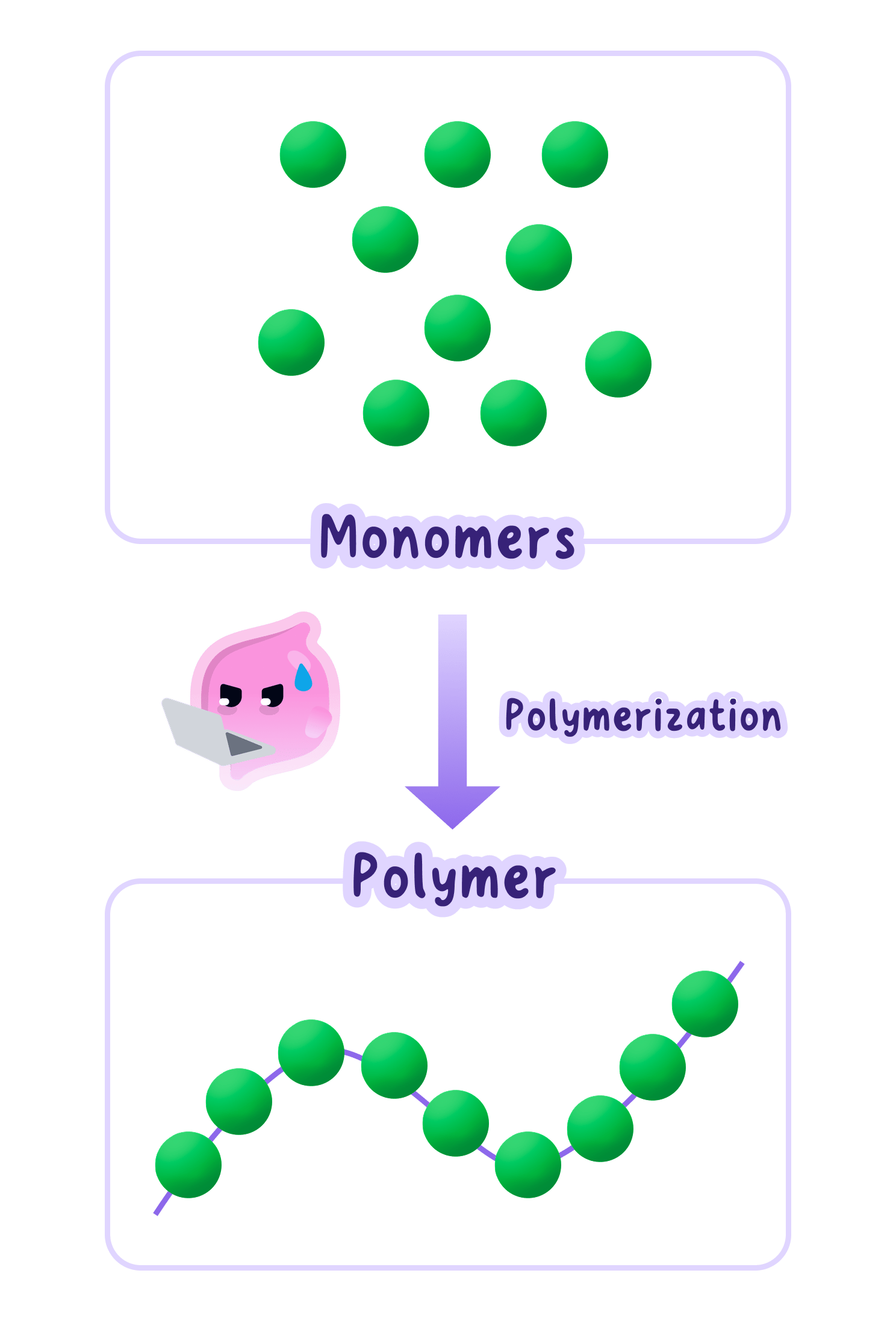
- A monomer is a small molecule that can join to many other monomer molecules.
- A polymer is a very large molecule made from many joined monomers.
- In addition polymerisation, many molecules of an alkene monomer join to make a polymer.
- Alkenes can do this because they contain the carbon–carbon double bond, C=C\text{C}=\text{C}C=C.
- Ethene forms poly(ethene) and propene forms poly(propene).
- You name an addition polymer by putting the monomer's name in brackets after poly.
Key Idea
- Many molecules of one alkene join into one long-chain polymer.
- No other molecule is made alongside the polymer.
- One repeating unit has the same atoms as one monomer, because every monomer atom ends up in the polymer.
The double bond opens so monomers link with new single bonds
- During addition polymerisation, each monomer's C=C\text{C}=\text{C}C=C bond becomes a C−C\text{C}-\text{C}C−C single bond.
- Each carbon from the old double bond forms a new single bond to a carbon in a neighbouring monomer.
- Repeating this joins many monomers into a long carbon chain.
- No atoms are removed, so no other molecule is produced.
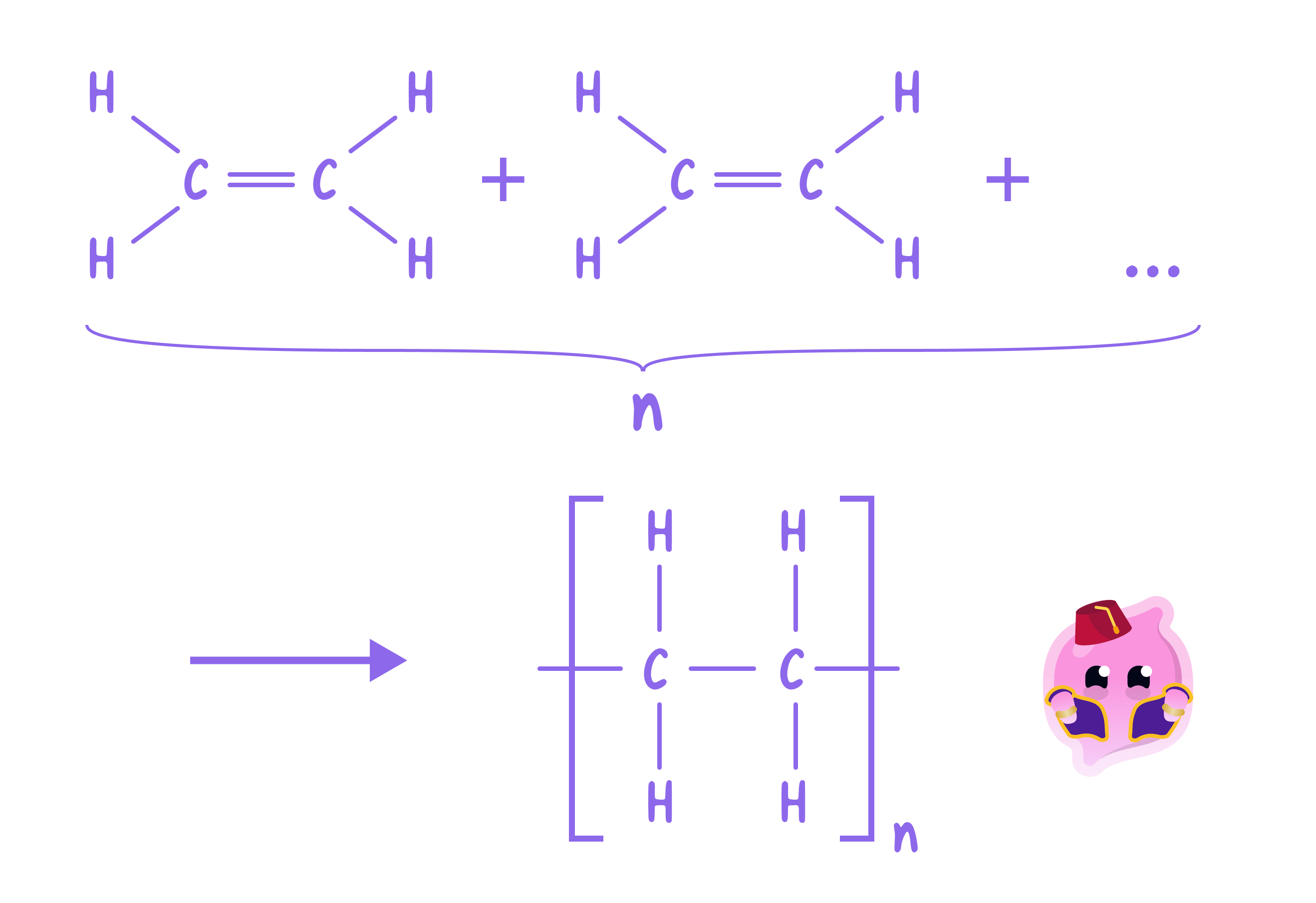
- Many ethene molecules join to form poly(ethene):n CH2=CH2→[-CH2-CH2-]nn\,\text{CH}_2{=}\text{CH}_2 \rightarrow \left[\text{-CH}_2\text{-CH}_2\text{-}\right]_nnCH2=CH2→[-CH2-CH2-]n
Example
- The equation shows many ethene molecules joining to form poly(ethene).
- Each ethene monomer gives two carbon atoms and four hydrogen atoms to the chain.
- The nnn stands for a large number of monomers and repeating units.
Drawing an addition polymer: open the double bond and keep every atom
- Identify the two carbon atoms joined by the C=C\text{C}=\text{C}C=C bond in the monomer.
- Replace the C=C\text{C}=\text{C}C=C bond with a C−C\text{C}-\text{C}C−C single bond.
- Keep every atom or group on the same carbon as in the monomer.
- Draw a bond from each backbone carbon out through the square brackets.
- Write nnn outside the brackets to show the unit repeats many times.
- For propene the repeating unit is drawn like this:n CH2=CHCH3→[-CH2-CH(CH3)-]nn\,\text{CH}_2{=}\text{CHCH}_3 \rightarrow \left[\text{-CH}_2\text{-CH}(\text{CH}_3)\text{-}\right]_nnCH2=CHCH3→[-CH2-CH(CH3)-]n
Exam technique
- Do not leave a C=C\text{C}=\text{C}C=C bond in the polymer; the backbone is all C−C\text{C}-\text{C}C−C single bonds.
- Keep the CH3\text{CH}_3CH3 group in poly(propene) and do not change the number of hydrogen atoms.
- Always include the square brackets, the bonds passing through them and the nnn.
Telling a monomer and a polymer apart in diagrams
Definition
Functional group
An atom or group of atoms that determines the characteristic chemical reactions of an organic compound.
- An alkene monomer diagram has the C=C\text{C}=\text{C}C=C functional group and no polymer brackets.
- An addition polymer diagram has a bracketed repeating unit with single bonds passing through the brackets.
- The nnn outside the brackets shows the repeating unit occurs many times.
- To get the monomer back, remove the brackets, the outward bonds and the nnn from one repeating unit.
- Then change the single bond between the two backbone carbons back into a C=C\text{C}=\text{C}C=C bond.
- Keep every attached atom or group on the same carbon.
Note
- To draw the monomer, show the C=C\text{C}=\text{C}C=C bond and every attached atom or group.
- To draw the repeating unit, show the brackets, the bonds through them and the nnn.
- The monomer and repeating unit have the same atoms; only the bonding at the two backbone carbons differs.
The repeating unit has exactly the same atoms as the monomer
Definition
Carbon-carbon double bond
Two covalent bonds that join the same two carbon atoms.
- The repeating unit is the smallest section of the polymer chain that repeats.
- In an addition polymer, one repeating unit has the same types and numbers of atoms as one monomer.
- This is because addition polymerisation makes no other molecule.
- Only the bonding around the monomer's C=C\text{C}=\text{C}C=C group changes.
- Check a diagram by counting each type of atom in the monomer and in one repeating unit.
- For ethene, CH2=CH2\text{CH}_2{=}\text{CH}_2CH2=CH2 becomes [-CH2-CH2-]n\left[\text{-CH}_2\text{-CH}_2\text{-}\right]_n[-CH2-CH2-]n.
Self review
- What is a monomer?
- Why can alkene monomers undergo addition polymerisation?
- What happens to the C=C\text{C}=\text{C}C=C bond during addition polymerisation?
- What three features must a polymer repeating unit diagram include?
- How do the atoms in one repeating unit compare with those in one monomer?
