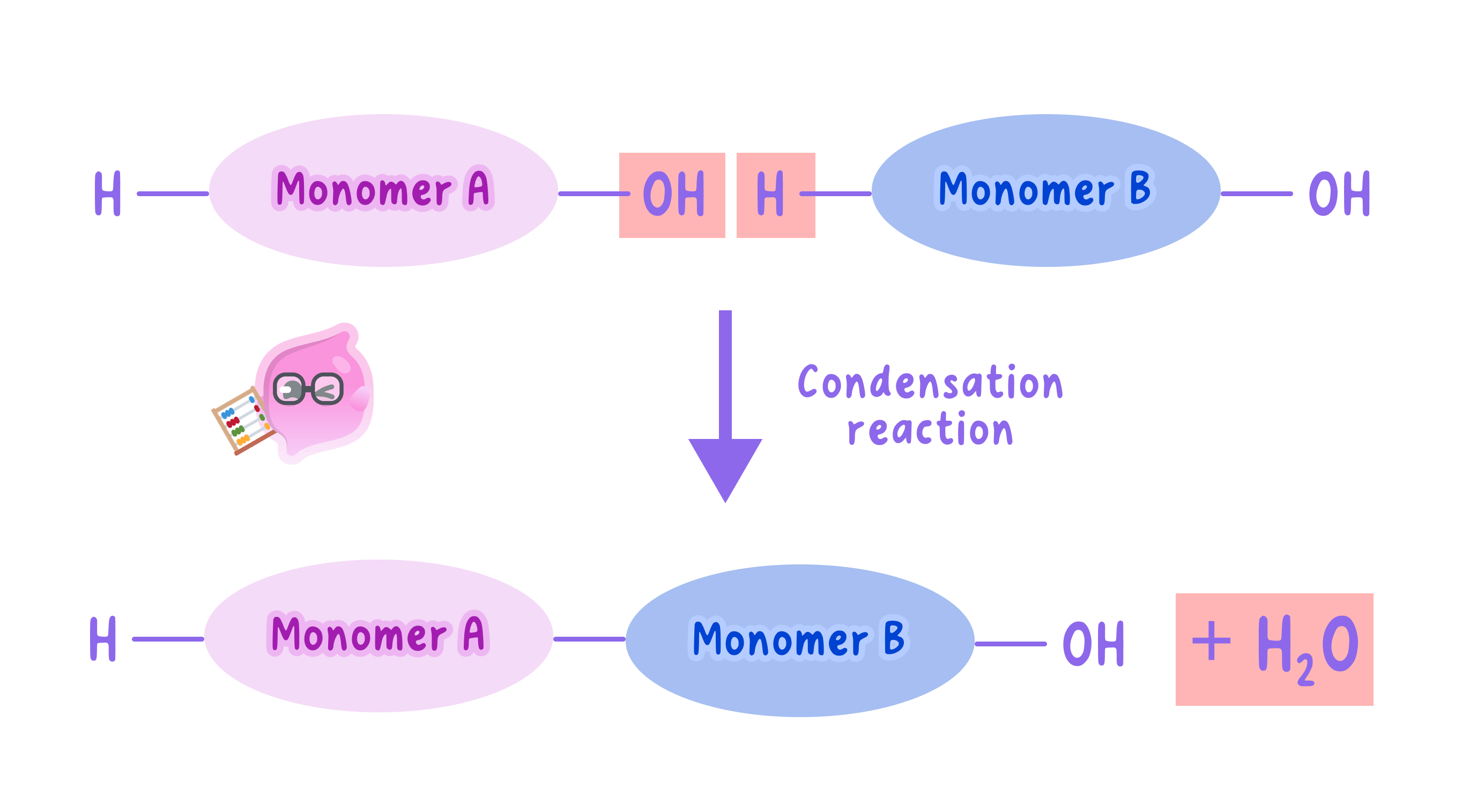
- What makes condensation polymerisation different from addition polymerisation.
- Why the monomers need two functional groups.
- How diols and dicarboxylic acids form polyesters.
- How to work out the repeating unit and the small molecule lost.
A polymer is a very large molecule made when lots of smaller molecules join together. The smaller molecules are called monomers.
You have already met addition polymerisation, where many alkene monomers join together and no other product is made. In this Higher Tier chemistry-only section, you meet a different type: condensation polymerisation.
Condensation polymerisation
Condensation polymerisation is the formation of a polymer from monomers that each have two functional groups, where the monomers join together and small molecules, usually water, are eliminated.
Main idea
In condensation polymerisation, monomers join and a small molecule is lost. For GCSE, that small molecule is usually water, H₂O.
A functional group is an atom, or group of atoms, that gives an organic molecule its typical chemical reactions.
For condensation polymerisation, each monomer must have two functional groups. This matters because each monomer needs to join to another molecule at both ends, making a long chain.
Two functional groups
A monomer with two functional groups has two reactive ends, so it can link to two other monomers and become part of a polymer chain.
For this topic, the key functional groups are:
- Alcohol group: –OH
- Carboxylic acid group: –COOH
A molecule with two alcohol groups is called a diol. A molecule with two carboxylic acid groups is called a dicarboxylic acid.
Deciding whether monomers can form a condensation polymer
A student is given these two molecules:
- HO–CH₂–CH₂–OH
- HOOC–CH₂–CH₂–COOH
Do they have the right structure to form a condensation polymer?
- Identify the functional groups in the first molecule: it has an –OH group at each end, so it is a diol.
- Identify the functional groups in the second molecule: it has a –COOH group at each end, so it is a dicarboxylic acid.
- Check whether both monomers have two reactive ends: yes, each molecule can react at both ends.
- Decide the type of polymer: a diol plus a dicarboxylic acid forms a polyester by condensation polymerisation.
A condensation reaction is a reaction where two molecules join together and a small molecule is removed.
In this topic, the small molecule is usually water, H₂O. The water forms from:
- H from one functional group
- OH from the other functional group
When an alcohol group, –OH, reacts with a carboxylic acid group, –COOH, they form an ester link.
Ester link
An ester link is the group –COO– formed when an alcohol reacts with a carboxylic acid.
The diagram shows the key idea: the monomers join, an ester link forms, and water is lost.

Forgetting the small molecule
Do not write condensation polymerisation as if the monomers simply join with no other product. A small molecule, usually water, must be produced.
A polyester is a polymer containing many ester links, –COO–, in its chain.
The simplest GCSE example uses two different monomers:
- a diol, with two –OH groups
- a dicarboxylic acid, with two –COOH groups
The spec example uses:
- ethanediol: HO–CH₂–CH₂–OH
- hexanedioic acid: HOOC–CH₂–CH₂–CH₂–CH₂–COOH
These can be shortened using boxes:
- HO–□–OH for the diol
- HOOC–□–COOH for the dicarboxylic acid
The box just means “the rest of the carbon chain”. It is not a new atom or functional group.
What the box means
In GCSE polymer diagrams, □ is a shortcut for a carbon chain. Focus on the functional groups at the ends: –OH and –COOH.
A repeating unit is the section of the polymer chain that repeats many times.
When a diol and dicarboxylic acid form a polyester, the repeating unit contains both monomers joined by ester links.
A general shorthand equation is:
nHO–R–OH+nHOOC–R’–COOH→[–O–R–O–CO–R’–CO–]n+2nH2On\text{HO--R--OH} + n\text{HOOC--R'--COOH} \to [\text{--O--R--O--CO--R'--CO--}]_n + 2n\text{H}_2\text{O}nHO–R–OH+nHOOC–R’–COOH→[–O–R–O–CO–R’–CO–]n+2nH2O
Here:
- R represents the carbon chain from the diol.
- R′ represents the carbon chain from the dicarboxylic acid.
- The brackets show the repeating unit.
- The subscript nnn means the unit repeats many times.
For the spec example, the reaction can be represented as:
nHO–CH2–CH2–OH(l)+nHOOC–(CH2)4–COOH(s)→[–O–CH2–CH2–O–CO–(CH2)4–CO–]n(s)+2nH2O(l)n\text{HO--CH}_2\text{--CH}_2\text{--OH(l)}
+
n\text{HOOC--(CH}_2\text{)}_4\text{--COOH(s)}
\to
[\text{--O--CH}_2\text{--CH}_2\text{--O--CO--(CH}_2\text{)}_4\text{--CO--}]_n\text{(s)}
+
2n\text{H}_2\text{O(l)}nHO–CH2–CH2–OH(l)+nHOOC–(CH2)4–COOH(s)→[–O–CH2–CH2–O–CO–(CH2)4–CO–]n(s)+2nH2O(l)
About the 2n water in the model
At GCSE, the polymer is represented as a very long repeating chain, so the equation is often written with 2nH₂O. Do not over-focus on the exact end groups of a short chain.
Finding the repeating unit of a polyester
Find the repeating unit formed from these monomers:
- HO–CH₂–CH₂–OH
- HOOC–CH₂–CH₂–COOH
- Split the monomers into their middle carbon chains and reactive ends: the diol has middle section –CH₂–CH₂–, and the dicarboxylic acid has middle section –CH₂–CH₂–.
- Remove the atoms that form water: H is removed from the –OH of the alcohol end, and –OH is removed from the –COOH acid end.
- Join the remaining atoms to form ester links: alcohol plus carboxylic acid gives –O–CO–.
- Put both middle sections into one repeating unit:
[–O–CH2–CH2–O–CO–CH2–CH2–CO–]n[\text{--O--CH}_2\text{--CH}_2\text{--O--CO--CH}_2\text{--CH}_2\text{--CO--}]_n[–O–CH2–CH2–O–CO–CH2–CH2–CO–]n
- Add the small molecule product: water, H₂O, is also formed.
Look for monomers with two functional groups. The wording may say:
- “a molecule with two alcohol groups”
- “a molecule with two carboxylic acid groups”
- “a diol and a dicarboxylic acid”
- “a small molecule is lost”
- “water is produced”
If you see only one functional group on a molecule, it cannot form a long chain by itself in the same way, because it only has one reactive end.
Why two reactive ends are needed
Each monomer must be able to bond at both ends. This lets the chain keep growing instead of stopping after one join.
It is easy to mix these up, so keep the comparison clear.
| Feature | Addition polymerisation | Condensation polymerisation |
|---|
| Type of monomer | Usually alkenes | Monomers with two functional groups |
| Small molecule produced? | No | Yes, usually water |
| What happens? | Double bonds open and monomers add together | Functional groups react and links form |
| GCSE example | Poly(ethene) from ethene | Polyester from a diol and dicarboxylic acid |
Writing the wrong type of polymerisation
If the question mentions water being lost, it is condensation polymerisation, not addition polymerisation.
A strong GCSE answer should link the functional groups to the polymer structure.
For example:
“Ethanediol has two alcohol groups and hexanedioic acid has two carboxylic acid groups. The alcohol groups react with the carboxylic acid groups to form ester links. Water molecules are eliminated, and the repeating units join to form a polyester.”
That answer includes:
- the names of the functional groups
- the type of link formed
- the small molecule lost
- the type of polymer made
In the exam
- Check the monomers have two functional groups each; this explains how a chain can form.
- For a diol plus a dicarboxylic acid, name the product as a polyester and look for the –COO– ester link.
- Always mention the small molecule lost, usually water, when explaining condensation polymerisation.
Check yourself
- Why must condensation polymerisation monomers usually have two functional groups?
- What small molecule is commonly produced when a polyester forms?
- How would you identify the repeating unit from a diol and a dicarboxylic acid?