Welcome to the chemistry of carboxylic acids! In this topic, you will learn about a family of organic compounds responsible for the sour taste in vinegar and the sting in ant venom.
What you'll learn:
- How to recognise and name the first four carboxylic acids.
- The chemical structure and functional group that makes them unique.
- How they react with water, carbonates, and alcohols.
- (Higher Tier only) Why they are classed as "weak" acids compared to acids like hydrochloric acid.
Carboxylic acids are a homologous series of organic molecules. Just like alkanes, alkenes, and alcohols, they have a pattern to their names and a specific part of the molecule that dictates how they react.
Functional group
A functional group is the specific group of atoms within a molecule that is responsible for its characteristic chemical reactions.
For carboxylic acids, the functional group is −COOH-\text{COOH}−COOH. You will often see it written at the end of the chemical formula.
Like all organic families, the start of the name tells you the total number of carbon atoms in the molecule:
- Meth- means 1 carbon: Methanoic acid (HCOOH\text{HCOOH}HCOOH)
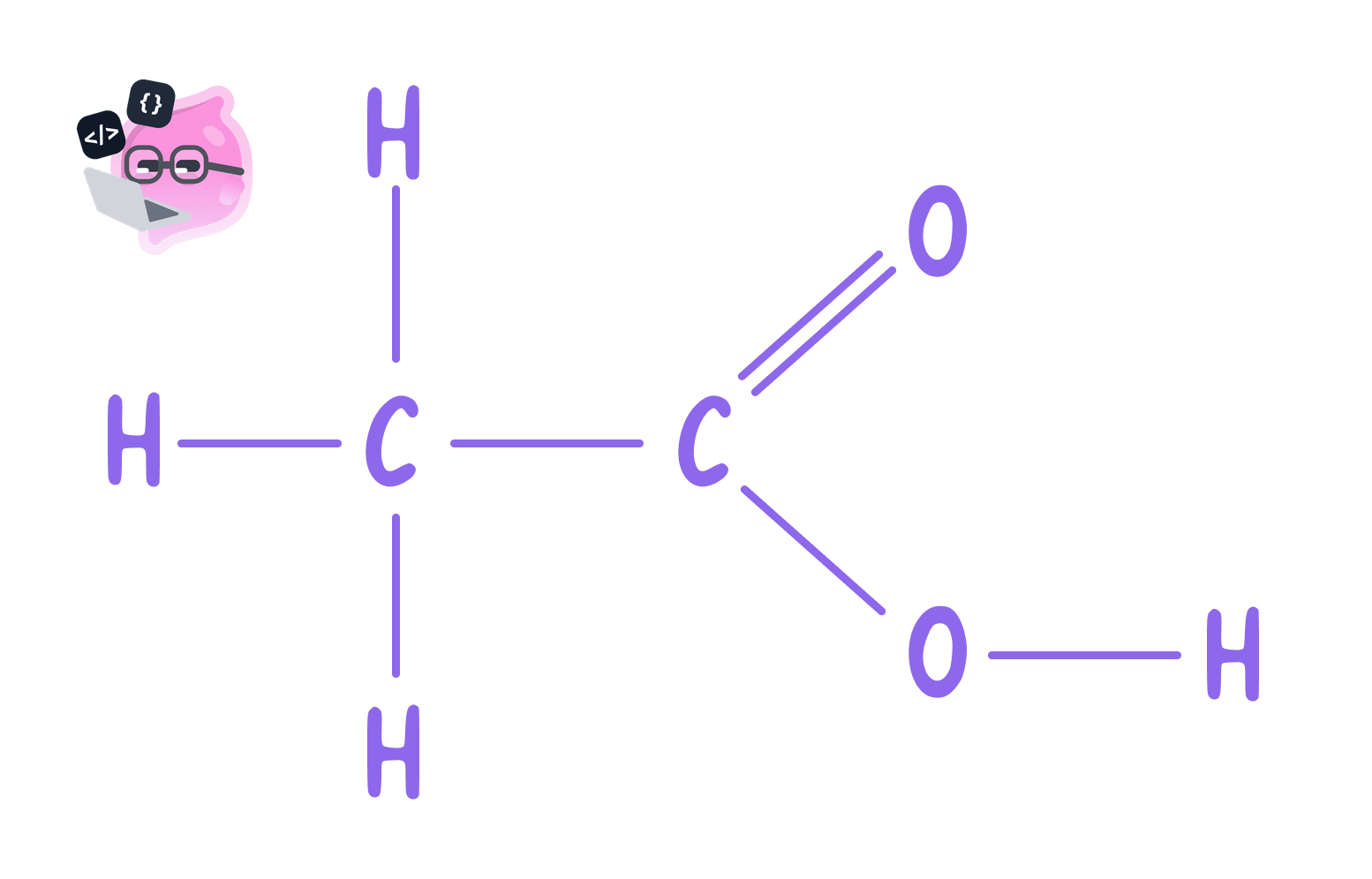
- Eth- means 2 carbons: Ethanoic acid (CH3COOH\text{CH}_3\text{COOH}CH3COOH) — this is the main acid in vinegar!
- Prop- means 3 carbons: Propanoic acid (CH3CH2COOH\text{CH}_3\text{CH}_2\text{COOH}CH3CH2COOH)
- But- means 4 carbons: Butanoic acid (CH3CH2CH2COOH\text{CH}_3\text{CH}_2\text{CH}_2\text{COOH}CH3CH2CH2COOH)
Counting carbons
Remember that the carbon atom in the −COOH-\text{COOH}−COOH group counts towards the total number of carbons. Ethanoic acid has 2 carbons in total: one in the −CH3-\text{CH}_3−CH3 group and one in the −COOH-\text{COOH}−COOH group.
You need to be able to recognise these acids from both their chemical names and their displayed formulae (where every bond is shown).
When drawing a displayed formula for a carboxylic acid:
- The carbon atom of the −COOH-\text{COOH}−COOH group is double-bonded to an oxygen atom (=O=\text{O}=O).
- That same carbon is also single-bonded to an oxygen atom, which is bonded to a hydrogen atom (−O−H-\text{O}-\text{H}−O−H).

Deducing the structural formula of propanoic acid
- Identify the total number of carbon atoms from the prefix. "Prop-" means the molecule has 3 carbon atoms in total.
- Draw the backbone of 3 carbon atoms. Make the final carbon atom part of the −COOH-\text{COOH}−COOH functional group by drawing a double bond to an oxygen atom and a single bond to an −OH-\text{OH}−OH group.
- Fill in the remaining bonds on the other carbon atoms with hydrogen atoms. Check that every carbon atom is making exactly 4 bonds.
- Write out the structural formula by grouping the atoms attached to each carbon from left to right: the first carbon is −CH3-\text{CH}_3−CH3, the second is −CH2-\text{CH}_2−CH2, and the third is −COOH-\text{COOH}−COOH. The formula is CH3CH2COOH\text{CH}_3\text{CH}_2\text{COOH}CH3CH2COOH.
Carboxylic acids undergo three key reactions that you need to be able to describe. The good news is that you are not expected to write balanced chemical equations for these reactions! You just need to know the word equations and what you would observe.
When carboxylic acids are added to water, they dissolve to form mildly acidic solutions. If you test the solution with universal indicator, it will turn yellow or orange, showing a pH of around 3 to 5.
Carboxylic acids react with metal carbonates to form a salt, water, and carbon dioxide gas.
Because carbon dioxide gas is produced, you will observe effervescence (fizzing) during the reaction.
The salts formed by carboxylic acids end in "-anoate". For example, ethanoic acid forms "ethanoate" salts.
Word equation:
Ethanoic acid + sodium carbonate →\to→ sodium ethanoate + water + carbon dioxide
When a carboxylic acid reacts with an alcohol (usually with an acid catalyst, like concentrated sulfuric acid), they produce water and a type of compound called an ester.
Esters are volatile compounds with distinct, often sweet or fruity smells. They are widely used in perfumes and artificial food flavourings.
Word equation:
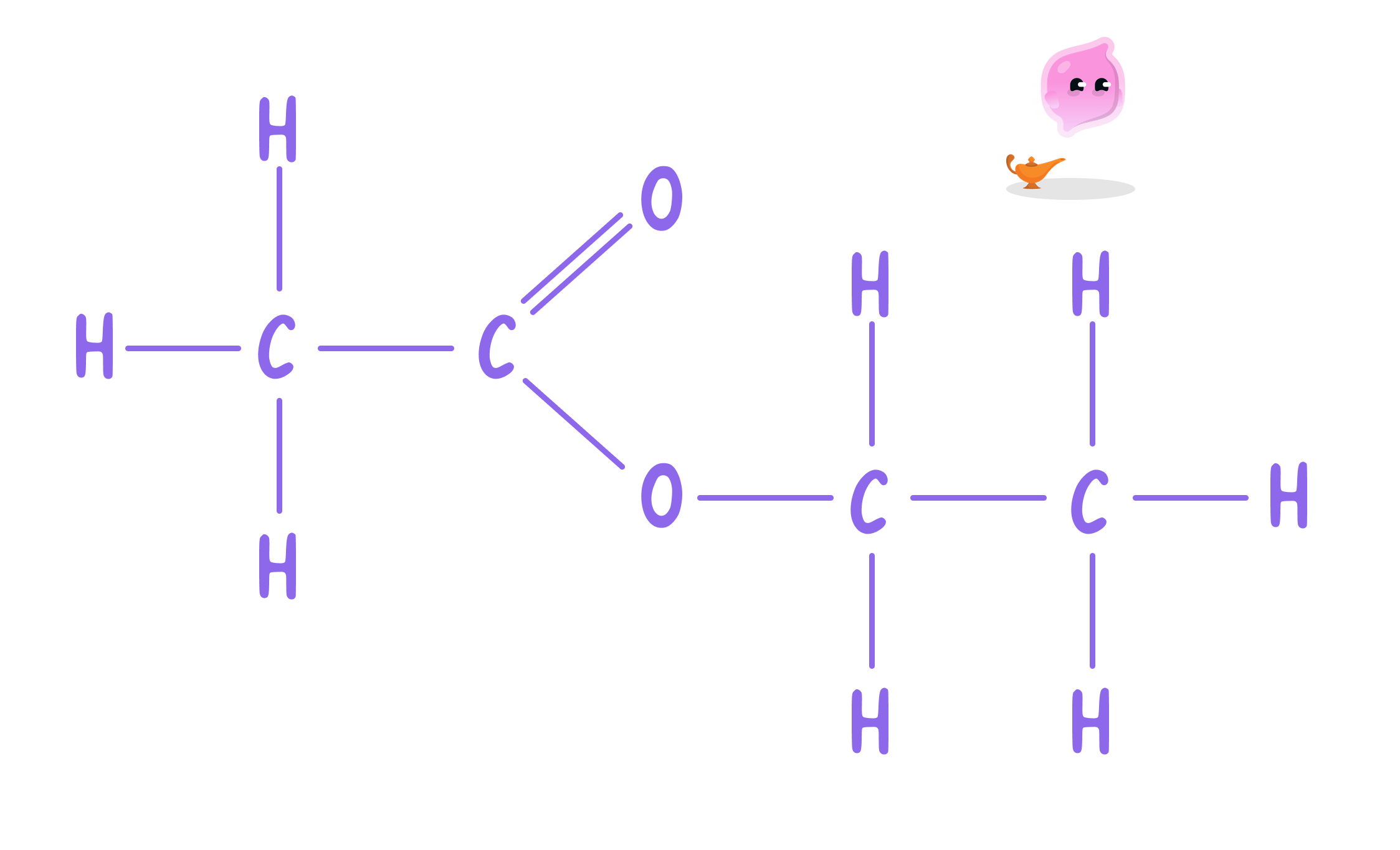
Ethanoic acid + ethanol ⇌\rightleftharpoons⇌ ethyl ethanoate + water
Esters
The only ester name you need to memorise for your GCSE is ethyl ethanoate, which is made from ethanol and ethanoic acid.
If you are studying Higher Tier chemistry, you need to be able to explain the difference between a strong acid (like hydrochloric acid, HCl\text{HCl}HCl) and a weak acid (like ethanoic acid).
This difference comes down to what happens to the acid molecules when they dissolve in water. Acids are substances that release hydrogen ions (H+\text{H}^+H+) in solution. This process is called ionisation.
- Strong acids ionise completely in water. Every single molecule splits up to release an H+\text{H}^+H+ ion.
- Weak acids (like all carboxylic acids) only ionise partially in water. Only a very small fraction of the molecules split up to release H+\text{H}^+H+ ions. Most of the molecules stay intact.

Because the ionisation of a weak acid is a reversible reaction, an equilibrium is set up:
CH3COOH(aq)⇌CH3COO−(aq)+H+(aq)\text{CH}_3\text{COOH(aq)} \rightleftharpoons \text{CH}_3\text{COO}^-\text{(aq)} + \text{H}^+\text{(aq)}CH3COOH(aq)⇌CH3COO−(aq)+H+(aq)
Concentration vs Strength
Do not confuse a weak acid with a dilute acid!
- "Weak" means it only partially ionises.
- "Dilute" means there is a small amount of the acid dissolved in a large volume of water.
You can have a very concentrated solution of a weak acid (like pure ethanoic acid)!
Because weak acids release fewer H+\text{H}^+H+ ions into the solution, their reactions are much slower (less vigorous) than those of strong acids at the same concentration. They also have a higher pH than a strong acid of the same concentration.
In the exam
- Spotting the functional group: If an exam question gives you a large, unfamiliar organic molecule and asks you to name its functional group, look closely for −COOH-\text{COOH}−COOH (or a carbon double-bonded to an oxygen and single-bonded to an −OH-\text{OH}−OH).
- Counting carbons: When asked to name a carboxylic acid from a drawn structure, always count the carbon in the −COOH-\text{COOH}−COOH group.
- Observations: If a question asks "What would you observe when ethanoic acid is added to sodium carbonate?", state that you would see fizzing or effervescence. Don't just write "carbon dioxide is made", as that is a fact, not an observation!
Check yourself
- What is the chemical formula of the carboxylic acid functional group?
- Which gas is produced when propanoic acid reacts with potassium carbonate?
- What is the name of the ester formed when ethanoic acid reacts with ethanol?

- (Higher Tier) Why does a 1 mol/dm31 \text{ mol/dm}^31 mol/dm3 solution of ethanoic acid have a higher pH than a 1 mol/dm31 \text{ mol/dm}^31 mol/dm3 solution of hydrochloric acid?