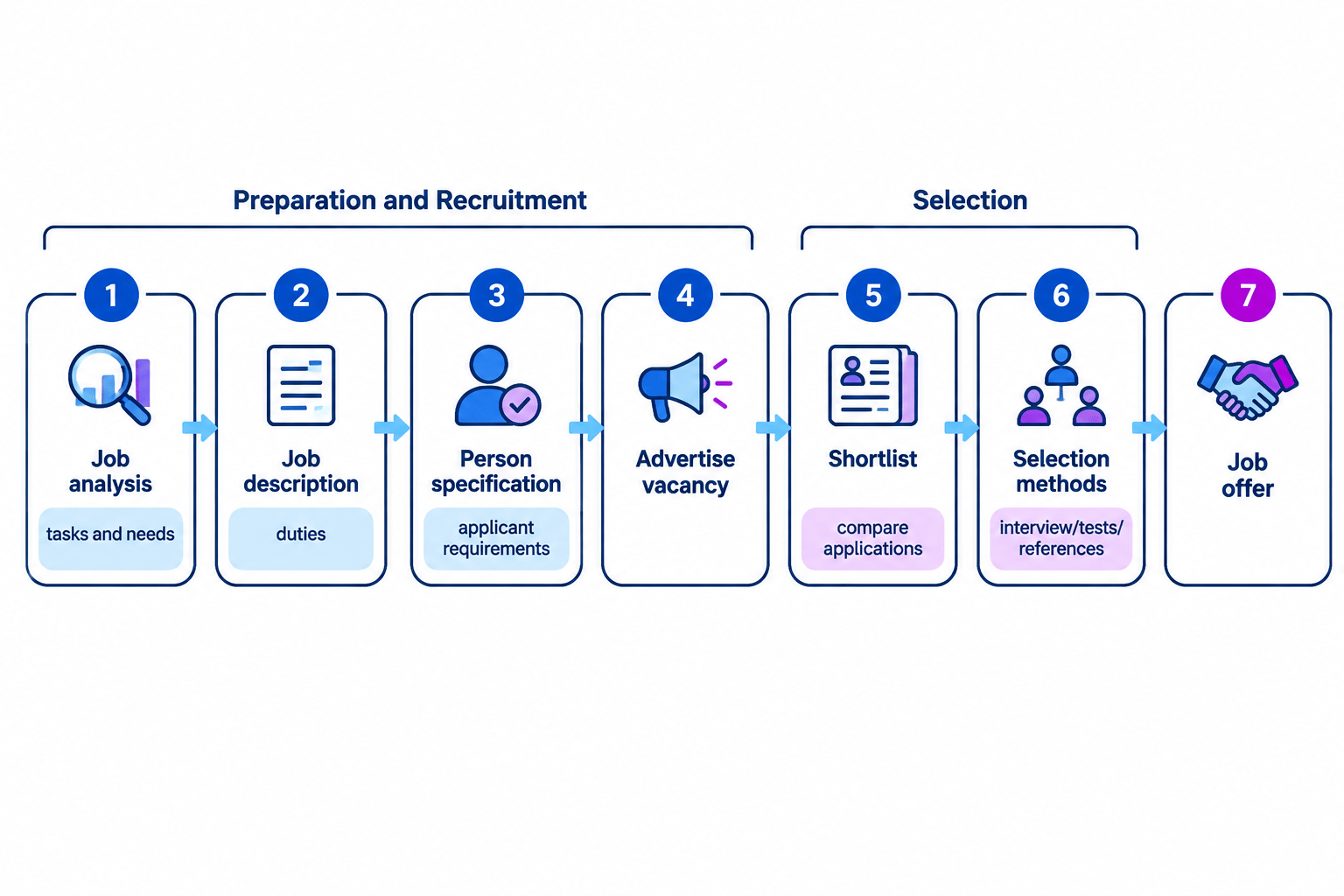
The stages in order
- The process runs in a set order: job analysis, job description, person specification, advertising the vacancy, shortlisting, selection, then the job offer.
- Recruitment is the part that attracts applicants, while selection is the part where the business chooses between the people who have applied.
- Each stage is built out of the one before it: the advert is written from the job description, and the shortlist is judged against the person specification, so an error at the first stage sends every later stage after the wrong person.
Job analysis
Job analysis: studying a role to work out exactly what tasks it involves and what skills are needed to carry them out.
- The manager works out what the job actually involves, often by watching the work being done or asking the person who is leaving, and notes the equipment, hours and training it needs.
- Job analysis also tests whether the post is needed at all, because the tasks may be shared out among existing staff or the role may work better as two part-time jobs.
Before replacing a driver who is leaving, a Warburtons depot lists the routes covered, the 4am loading and the weight of the crates, so the advert asks for the licence and the availability the job genuinely requires.
Job description and person specification
Job description: a document setting out the tasks, duties and responsibilities of a particular job.
Person specification: a document setting out the skills, qualifications and qualities somebody needs to do that job well.
- The job description is written first, because the business has to know what the work involves before it can describe the person capable of doing it.
- A job description gives the job title, the main duties and responsibilities, the hours, the pay, the place of work and who the employee reports to.
- A person specification lists the qualifications, experience, skills and personal qualities needed, usually split into essential requirements and desirable ones.
- For a delivery driver, deliver parcels on local routes belongs in the job description, while a full clean UK driving licence and a polite manner with customers belong in the person specification.
- Having both documents in writing keeps the process fair and consistent, because every applicant is judged against the same stated requirements rather than one manager's impression.
- The commonest confusion in this topic is between the two documents: the job description describes the job, the person specification describes the person.
- Use this test: serve customers at the till is a duty, so it belongs in the job description, while friendly and reliable is a quality, so it belongs in the person specification.
Advertising the vacancy
- The advert is written from the two documents, so it states the duties, the hours, the pay and the requirements that applicants must meet.
- Inside the business a vacancy is posted on the intranet, on a staff noticeboard or in an email to all employees.
- Outside the business it can go on a job website, in the local paper, in a shop window, through a recruitment agency, at a jobcentre or on social media, and the choice depends on where suitable people will look: a shop window suits a Saturday assistant, a specialist website suits an engineer.
Because a Nando's advert states that weekend availability is essential, people who cannot work weekends rule themselves out before applying, which saves the manager reading their applications.
Selection methods
- Shortlisting: every application is compared with the person specification and only the closest matches go forward, which keeps the number of interviews manageable.
- Application form: the business designs the form, so everybody answers the same questions and the answers can be compared side by side.
- CV: the applicant writes their own summary of education, experience and interests, which costs the business nothing to produce but is harder to compare because everyone sets it out differently.
- Interview: questions asked face to face, by telephone or online show how a candidate communicates and whether they would fit the team, although a confident talker can interview well and then work badly.
- Tests: a skills test shows whether somebody can already do the task, such as a trial shift in a kitchen, while an aptitude test measures potential such as numeracy or problem solving.
- References: a statement from a former employer or a teacher checks that what the application claims is true and that the person was reliable and punctual.
- Most businesses use two or three methods together, because no single one shows everything: an interview judges manner while a test proves ability.
Aldi asks candidates for store roles to complete an online test and then attend an interview, so it checks what they can do as well as how they deal with people.
- For explain the difference between a job description and a person specification, give one sentence on the document about the job and one on the document about the person, with an example of what each contains.
- For outline the stages the business would follow to appoint a new manager, keep the stages in order and name each one, rather than writing generally about hiring people.
- If you are asked to recommend a selection method, name it, say what it reveals about the candidate, and match it to the job in the case, such as a trial shift for a kitchen role.
- List the stages of recruitment and selection in order.
- What is job analysis, and what does a business learn from it?
- State the difference between a job description and a person specification.
- Name three selection methods and say what each one shows about a candidate.
- Why do most businesses use more than one selection method?