What makes recruitment effective
Effective recruitment and selection: a process that attracts enough suitable applicants and then reliably appoints the one who best matches the person specification.
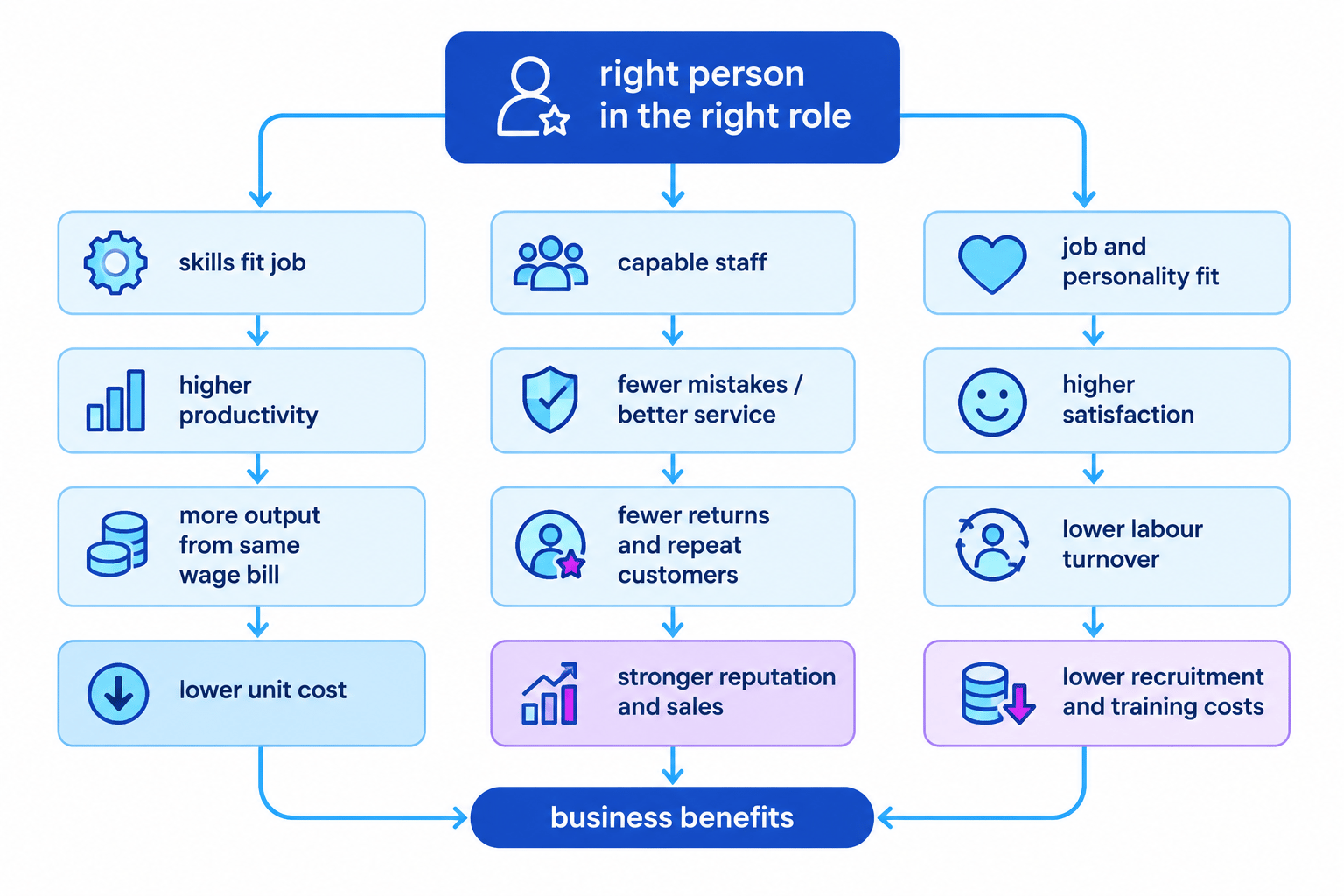
- Every benefit in this topic starts from the same cause: the person appointed can actually do the job, so the business ends up with the right person in the right role.
- An effective process is not the cheapest one. Aldi paying for an online test and an interview spends more up front than a manager skimming a pile of CVs, but is far more likely to appoint somebody who can do the work and who stays.
- The gains show up in three places: how much staff produce, the quality of the product or the service customers receive, and how long employees stay.
Trace each benefit through to the business instead of jumping to profit, so write that output per worker rises, therefore the cost of making each unit falls, therefore the business can undercut a rival.
Higher productivity
- Somebody selected because they have the skills the job needs works at full speed sooner and needs less supervision than somebody appointed only because nobody better applied.
- More output from the same wage bill lowers the cost of producing each unit, so the business can charge a competitive price or keep a wider profit margin on the price it already charges.
- Managers also spend less time correcting work and chasing progress, so they can get on with their own responsibilities rather than covering for a weak appointment.
At Nissan Sunderland an assembly worker chosen with a practical test reaches full line speed within days, so the plant builds more cars per shift without paying any more in wages.
Higher quality output and better customer service
- Capable staff make fewer mistakes, so less material is scrapped and less work has to be done twice, which cuts waste and the cost that goes with it.
- Fewer faults reaching customers means fewer returns, refunds and complaints to handle, and a reputation for quality that lets the business hold its price.
- In a job that involves dealing with people, the right appointment shows straight away, because a patient and cheerful assistant on a Currys shop floor explains the product properly and sells more.
- Good service brings repeat custom and positive reviews or word of mouth, so sales rise without the business spending more on advertising.
Greggs selects counter staff partly on how they handle a queue, because a fast and friendly counter is what brings customers back at lunchtime.
Staff retention and lower training costs
Labour turnover: the rate at which employees leave a business and have to be replaced over a period of time.
- Somebody whose skills and personality suit the job is more satisfied in it, so fewer new starters walk out in the first few weeks and labour turnover falls.
- Recruiting less often saves the money spent on adverts and agency fees and the paid management hours that shortlisting and interviewing take up.
- There is less retraining to pay for, because the business is not putting a new starter through induction every few months, and it keeps the experience staff have built up.
- Existing employees gain as well, since they are not constantly covering empty posts or training replacements, so their own work and motivation do not suffer.
The same argument works in reverse: a poor appointment leaves the business advertising, selecting and training for one post twice over, and losing output in between.
- For analyse the benefits to the business of an effective recruitment and selection process, start from the right person being appointed and take each step through to an outcome such as lower unit costs.
- Pick the benefit that fits the business given to you: productivity for a manufacturer such as JCB, customer service for a restaurant or a shop.
- Use the terms productivity, labour turnover and retention precisely, because they are what the question is testing.
- What makes a recruitment and selection process effective?
- Explain the chain from a good appointment to lower unit costs.
- How does appointing the right person improve customer service?
- Define labour turnover and say why effective selection lowers it.
- Name two costs a business avoids when its staff stay longer.