The business idea and the objectives
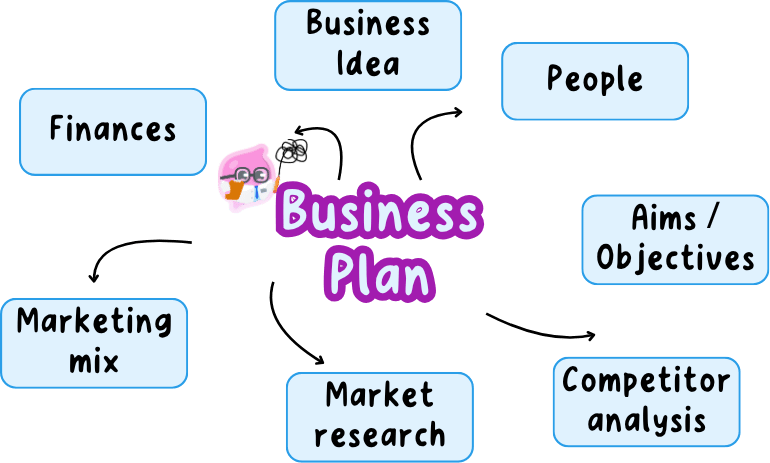
- A business plan is set out in sections, and each section answers a different question about the business.
- The business idea: this describes what the business will sell, whether it is a product or a service, and what makes it different from what customers can already buy.
- It also names the type of ownership, for example sole trader or private limited company, so a reader knows who is liable for the debts.
- Aims and objectives: the aim is the long-term goal, such as becoming the best known sandwich shop in the town, and the objectives are the measurable steps towards it.
- A start-up objective is often survival or breaking even, while an established business may set an objective for sales growth or market share.
- Objectives are written with a number and a date, for example £150,000 of sales by the end of year one, so progress can be checked.
The target market and market research
- The target market: this section describes the customers the business is aiming at by age, income, lifestyle or location, so the reader can see who is expected to buy.
- Market research: this gives the evidence that those customers exist, using primary research such as a survey of local shoppers and secondary research such as published data on the size of the market.
- It also names the main competitors and what they charge, which shows the owner understands what the business is up against.
Example
- A plan for a bubble tea shop in Nottingham describes its target market as students and shoppers aged 16 to 25 within walking distance of the city centre.
- The research section reports that 180 of 250 students surveyed buy a hot or cold drink out at least twice a week.
- It names Costa and two independent cafés nearby and records that their drinks sell for £3.20 to £4.50.
The marketing mix
- Product: the plan lists what will be sold, the range on offer and any features that set it apart, such as gluten-free options.
- Price: the plan states what will be charged and how that compares with competitors, because the price drives the forecast of revenue later in the plan.
- Promotion: the plan says how customers will be told about the business, for example social media, leaflets or an opening offer, and what that will cost.
- Place: the plan explains where customers will buy, such as a high street unit, a market stall, a website or through a retailer like Currys.
Note
- Here you only need to know that the four elements of the mix appear as a section of the plan.
- How the four elements are chosen and how they work together is covered in the articles on the marketing mix.
The people and the premises
- The people: the plan says how many staff are needed, what skills they must have, whether they are full time or part time, and what they will be paid.
- It also sets out the experience of the owner, because a lender is lending to a person as much as to an idea.
- The premises: the plan states where the business will operate, how big the site is and what the rent or purchase price will be.
- It lists the equipment and machinery the site needs, such as ovens, refrigeration or delivery vans, since these have to be paid for before trading starts.
The financial forecasts
Definition
Cash flow forecast: an estimate of the money expected to flow into and out of the business each month, showing the cash left at the end of every month.
- Forecast costs: the plan estimates what the business will have to pay out, separating costs that stay the same each month from costs that rise with output.
- Forecast revenue: the plan estimates the money coming in from sales, worked out from the planned price and the number of sales expected.
- Forecast profit: the plan shows the profit expected once the forecast costs are taken away from the forecast revenue, usually for the first year and often for three years.
- The cash flow forecast: this shows month by month whether the business will have enough cash to pay its bills, which is what a bank checks before agreeing a loan.
- Finance needed: the plan states how much money the owner is putting in, how much is being asked for, and where the rest will come from.
Common Mistake
- Every figure in this section is a forecast, an estimate of the future, not a record of what the business has already earned.
- Saying that the plan shows the profit the business made is wrong, because a plan written before trading has no actual results in it.
- How costs, revenue and profit are calculated is covered in the article on basic financial terms and calculations.
Exam technique
- If you are asked to explain why one section is important to a bank, pick the cash flow forecast or the financial forecasts and say what the bank learns from them.
- Match the section to the business in the case study, for example premises and equipment matter more to a bakery than to an online reseller.
- The mistake to avoid is naming a section and stopping there when the question asked what the section contains.
Self review
- Name six sections of a business plan.
- What does the target market section describe?
- Which four elements appear in the marketing mix section?
- What does a cash flow forecast show?
- Why is every figure in the financial section an estimate?
