Fixed costs and variable costs
Definition
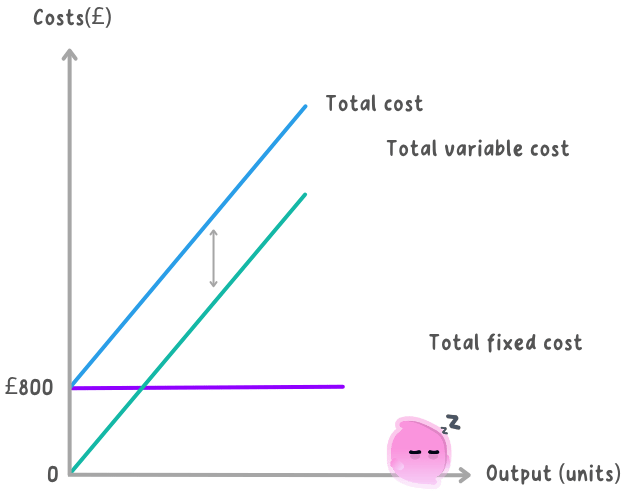
Fixed costs: costs that stay the same whatever the level of output, so they are paid even if the business sells nothing.
Variable costs: costs that rise as output rises and fall as output falls, because they are paid for each unit produced or sold.
Total costs: the fixed costs and the variable costs added together for a given level of output.
- Fixed costs include rent, business rates, insurance, salaries of permanent staff, loan interest and advertising booked for the year.
- Greggs pays the rent on a shop whether that shop sells 200 sausage rolls in a day or 800, so the rent is a fixed cost.
- Variable costs include raw materials, packaging, bought-in stock, delivery charges and wages paid by the hour or per item made.
- Flour, butter and boxes are variable costs for a bakery, because making twice as many cakes needs twice as much of each.
- The same type of cost can be fixed for one business and variable for another, so read the case study rather than guessing.
- A manager on an annual salary is a fixed cost, while a shop assistant paid £12 an hour only when the shop is busy is a variable cost.
Example
- Maya runs a brownie stall on Leeds Kirkgate Market and sells boxes of brownies at £4 each.
- Her fixed costs are a £450 monthly pitch fee plus £50 insurance, giving £500 of fixed costs every month.
- Her ingredients and packaging cost £1.20 for every box, so that £1.20 is her variable cost per unit.
- These figures are used for every calculation in the rest of this article.
Calculating total costs
- The formula is total costs=fixed costs+variable costs\text{total costs} = \text{fixed costs} + \text{variable costs}total costs=fixed costs+variable costs, and this formula is not given to you in the exam, so learn it.
- Variable costs must be worked out for the output first, using variable costs=variable cost per unit×output\text{variable costs} = \text{variable cost per unit} \times \text{output}variable costs=variable cost per unit×output.
Example
- In a busy month Maya sells 500 boxes, so her variable costs are scaled to that output first.
- Adding the £500 of fixed costs gives the total costs for that month.
- In a quiet month she sells only 150 boxes.
- The £1,100 is the amount Maya has to pay out in the busy month, so she must take at least £1,100 from customers before she keeps anything herself.
- In the quiet month total costs fell by £420 but not to zero, because the £500 pitch fee and insurance are still due even in a bad month.
Common Mistake
- Check whether the figure you are given is the variable cost per unit or the total variable cost, because adding £1.20 to £500 instead of £600 makes the whole answer wrong.
- Multiply before you add, since the variable cost has to be scaled to output first.
Calculating revenue
Definition
Revenue: the total value of sales in a period, before any costs have been taken away, sometimes called sales revenue or turnover.
- The formula is revenue=price×quantity sold\text{revenue} = \text{price} \times \text{quantity sold}revenue=price×quantity sold, so revenue depends on both what you charge and how much you sell.
Example
- In the busy month Maya sells 500 boxes at £4 each.
- In the quiet month she sells 150 boxes at the same price.
- The £2,000 is the money customers handed over, not money Maya has earned, because her ingredients and pitch fee still have to come out of it.
- Revenue fell by £1,400 between the two months, caused entirely by the drop in quantity sold rather than by any change in price.
- The £600 does not cover the £680 of total costs Maya faces that month, so the stall is losing money at that level of sales.
Common Mistake
- Revenue is not profit, and this is the most common confusion in this topic.
- A business with £2,000 of revenue and £2,300 of total costs has plenty of sales and is still losing money.
- Never describe revenue as money the owner can keep or spend on herself.
Calculating profit and loss
Definition
Profit: the amount left over when total costs are taken away from revenue.
Loss: the shortfall when total costs are greater than revenue, so the business has not covered what it spent.
- The formula is profit=revenue−total costs\text{profit} = \text{revenue} - \text{total costs}profit=revenue−total costs, and the same subtraction gives the loss when the answer comes out negative.
Example
- In the busy month Maya's revenue was £2,000 and her total costs were £1,100.
- In the quiet month her revenue was £600 and her total costs were £680.
- A negative answer is a loss, so the quiet month produced a loss of £80.
- The £900 is what the business has actually earned that month, so Maya can take it as income, keep it as a cash cushion for the winter, or reinvest it in a second stall.
- The loss means selling 150 boxes does not cover the stall's costs, so Maya must fund the £80 gap from savings, sell more boxes, raise the £4 price or find cheaper ingredients.
Exam technique
- Calculate the profit made by the business almost always needs two steps, so work out total costs first and then subtract them from revenue.
- If the answer is negative, label it as a loss in words rather than leaving a minus sign to speak for itself.
- When a question follows the calculation with explain what this figure shows, say what the owner can now do with the money or must now do about the shortfall.
Self review
- Give two examples of a fixed cost and two examples of a variable cost.
- State the formula for total costs and the formula for revenue.
- A café has fixed costs of £2,000 a month and variable costs of £1.50 per meal, and serves 1,000 meals: what are its total costs?
- If that café charges £9 a meal, does it make a profit or a loss, and how much?
- Why is a business with high revenue not necessarily profitable?
