How a business chooses its price
- Price is the only part of the marketing mix that brings money into the business, because product, promotion and place all add to its costs.
- The five pricing methods on the specification are price skimming, price penetration, competitive pricing, loss leader and cost-plus, and a business can use different methods for different products at the same time.
- The method a business picks changes the profit it makes on each sale, the number of units it sells and the image customers hold of the product.
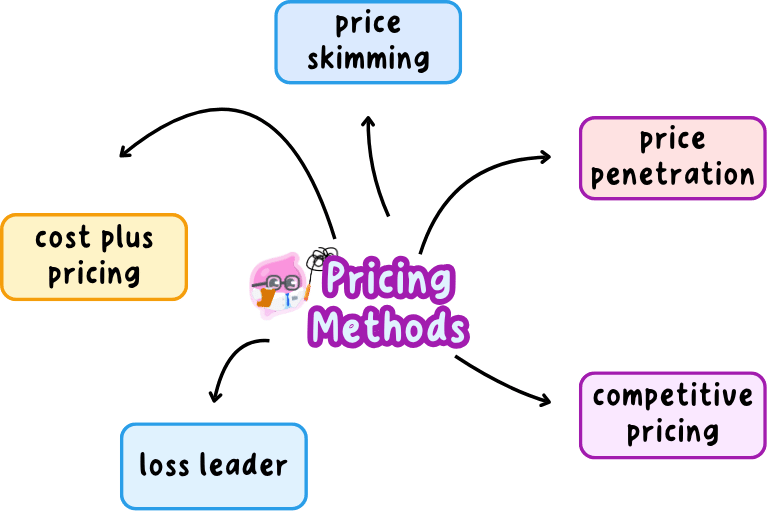
The influences that push a business towards one method rather than another, its costs, its market, its rivals and the stage of the product life cycle, are taught in the article on factors influencing pricing decisions.
Price skimming
Price skimming: setting a high price for a new or unusual product at launch, then lowering it over time as rivals appear and the keenest customers have already bought.
- Skimming suits a product that is genuinely new, hard to copy quickly and facing few rivals, because the customers who want it first will pay a premium to have it first.
- Impact on the business: profit on every unit is high, so heavy development costs are recovered fast, but sales volume stays low and the wide margin advertises to competitors that the market is worth entering, which forces the price down later.
- Dyson prices each new cordless vacuum at the top of the market on release and keeps the previous model on sale for less once the newer one is out.
- A games console follows the same shape, priced high while keen gamers are queuing for it at launch and then discounted in bundles a year or two later.
Price penetration
Price penetration: setting a deliberately low price when a product enters a market, to win customers and market share quickly, then raising it once the product is established.
- Penetration suits a competitive market full of similar products, where customers switch easily and need a reason to try a name they do not know.
- Impact on the business: sales volume and market share grow quickly, but profit per unit is thin and the product may make a loss in its first months. Raising the price later is the hard part, because customers who came only for the cheap price may leave the moment it goes up.
Disney+ launched in the UK at £5.99 a month, well under the established streaming services, and lifted the price to £7.99 once it had built a large base of subscribers.
- Skimming starts high and comes down, while penetration starts low and goes up.
- Reversing that direction is the commonest error on this topic, so decide first whether the launch price sits above or below the rest of the market.
- Never recommend skimming for an ordinary product in a busy market, because customers will simply buy the cheaper rival.
Competitive pricing
Competitive pricing: setting a price at, or very close to, the price rival businesses charge for a similar product.
- It suits markets where the products are nearly identical and shoppers compare prices before buying, such as petrol, everyday groceries and car insurance.
- Impact on the business: sales volume is protected, because no customer walks away on price alone, but the profit margin on every sale is squeezed and a rival's price cut has to be matched. With price fixed by the market, the business has to win customers on quality, service, convenience or brand instead.
Sainsbury's runs an Aldi Price Match on hundreds of everyday items, holding those prices level with a cheaper rival so shoppers have no price reason to shop elsewhere.
Loss leader
Loss leader: a product priced deliberately at or below what it costs the business, to pull customers in so that they buy other, profitable products while they are there.
- Supermarkets choose staples such as milk and bread, because almost nobody drives to Tesco for one loaf and leaves with nothing else in the trolley.
- Impact on the business: more customers come through the door, and the loss taken on one line is covered many times over by the profit on the rest of their shopping.
- The risk is that some customers buy only the cheap item, and that a permanently low price teaches customers to think the product is worth very little.
IKEA's very cheap hot dogs and breakfasts earn the store almost nothing, but they bring families in and keep them there long enough to fill a trolley with furniture.
Cost-plus pricing
Cost-plus pricing: working out what one unit costs to make, then adding a set percentage of that cost on top to give the selling price.
- The formula is not supplied in the exam, so learn it and write it out before you substitute a figure.
- A bakery works out that one sausage roll costs £1.20 in ingredients, energy and labour and adds 40% on top, and when flour and energy later push the unit cost to £1.35 the same method raises the price automatically.
- At £1.68 each roll covers the £1.20 it cost and leaves 48p towards rent, wages and profit, so the owner knows no sale is made at a loss.
- At £1.89 the price has risen because the cost rose, not because customers were asked what they would pay, and it may now be more than they are willing to hand over for a sausage roll.
- Impact on the business: it is quick, needs no research and guarantees every unit's cost is covered, which is why small independent shops and tradespeople quoting for a job rely on it.
- Its weakness is that it looks only inwards, ignoring what rivals charge and what customers would accept, so the price can end up too high to sell or lower than it needed to be.
- Recommend a pricing method means choose one and stand behind it, so name it, define it in a sentence, then justify it using the business in front of you.
- Pull the deciding facts out of the scenario: how new or unusual the product is, how many rivals sell something similar, and whether the owner wants profit now or share first.
- Strengthen the choice by saying why the obvious alternative is worse, for example why penetration beats skimming when twenty firms already sell the same thing.
- Which method starts with a high launch price and lowers it over time?
- In what kind of market does price penetration make sense, and why?
- How can selling milk below cost still be profitable for a supermarket?
- Use cost-plus on a unit cost of £8 with 25% added, and state the selling price.
- Give one drawback of competitive pricing for a small business.
