Internal and external influences on price
- Every price sits between a floor and a ceiling: the business's costs set the lowest price it can survive on, and what customers are willing to pay sets the highest it can ask.
- Internal factors come from inside the business, mainly its costs of production and the stage its product has reached in the product life cycle.
- External factors come from outside it, mainly the nature of the market, the degree of competition and the level of demand.
- As a business grows and expands the pressures change, because it sells in more places and meets more rivals, while buying in bulk cuts its cost per unit and gives it room to price below a smaller competitor.
Note
A factor is a pressure the business responds to; the five methods it can choose in response, including competitive pricing and cost-plus, are taught in the article on pricing methods.
Costs
- Over time the price has to cover the cost of making each unit, because a business selling below that cost loses money on every sale and eventually runs out of cash.
- The floor is found with average unit cost, and the formula is not supplied in the exam, so learn it.
Example
average unit cost=total costoutput
\text{average unit cost} = \frac{\text{total cost}}{\text{output}}
average unit cost=outputtotal cost
- A furniture maker spends £180,000 to produce 15,000 stools.
Example
average unit cost=£180,00015,000=£12
\text{average unit cost} = \frac{\pounds180{,}000}{15{,}000} = \pounds12
average unit cost=15,000£180,000=£12
- Any price under £12 loses money on every stool, so £12 is the floor and a price of £18 leaves £6 a stool towards profit, which tells the owner how much room there is before a discount becomes damaging.
- When a supplier raises its prices or wages rise, the unit cost rises with them, and the business must either put its price up or accept a thinner profit margin on each sale.
Example
When ingredient and energy costs climbed sharply, Greggs raised the price of its sausage roll, because holding the old price would have left almost nothing on each sale.
The nature of the market
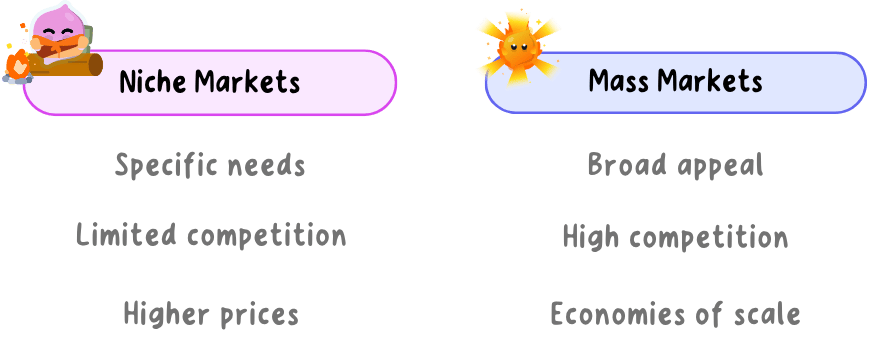
- In a mass market of millions of similar customers, price is the main weapon, so prices are low, margins are thin and the business relies on selling huge volumes.
- In a niche market a smaller group of customers wants something specific and will pay well above the average price to get it.
- Whether the product is an everyday essential or a luxury also shapes what feels acceptable, because customers judge a new price against the going rate they already expect.
Example
- Aldi sells to a mass market and builds its whole business around prices its customers can check against any rival.
- Brompton sells folding bikes built in London for well over £1,000, because commuters in its niche value a bike that folds small enough for a train.
The degree of competition
- The more rivals selling something similar, the less freedom a business has, because customers can compare prices in seconds and switch without losing anything.
- With few rivals, or with a product customers see as different from the rest, the business can hold a higher price and still keep its sales.
- This is why prices in a crowded market move together: when Tesco cuts the price of a staple and Asda does not follow, shoppers notice and move their weekly shop.
Common Mistake
- The degree of competition is a factor, while competitive pricing is a method the business might choose because of it, so do not use the two words as if they were the same idea.
- Treating cost as the only influence is the other common slip, because a price that covers costs can still be far above what rivals charge or what customers will pay.
The stage of the product life cycle
- At introduction the launch price signals what the product is, so a genuinely new product can be priced high while a product entering a busy market is often priced low to win a first group of buyers.
- During growth rivals arrive, so the price is usually brought closer to theirs to protect the market share the product has won.
- At maturity price competition is at its hardest, with offers and multipacks used to defend sales against products that are much the same.
- In decline the price is usually cut to clear remaining stock and hold on to the customers who are left, which is why an out-of-date phone model is discounted rather than withdrawn immediately.
Price and demand
- The basic relationship is simple: as the price rises, demand is likely to fall, and as the price falls, demand is likely to rise.
- A higher price earns more on each sale but sells fewer units, so the business is always weighing the money per sale against the number of sales.
- How far demand falls depends on the product, so sales of essentials such as bread, and of strongly branded goods customers feel loyal to, drop less when the price goes up than sales of an unbranded treat.
- Demand itself moves over time, which is why easyJet charges far more for the same seat in the August school holidays than on a wet Tuesday in November.
Exam technique
- Analyse the factors that influence the price rewards a chain, so run each factor through to a consequence: the factor, the effect on the price, then the effect on sales or profit.
- Label each one internal or external if the question asks, since costs and the life cycle stage are internal while the market, rivals and demand are external.
- If a figure for total cost and output is given, work out the cost per unit and use it to show what the business cannot go below.
Self review
- Why do costs set a minimum price in the long run?
- Name two internal and two external factors that influence a pricing decision.
- State the basic relationship between price and demand.
- Why is price competition hardest when a product reaches maturity?
- Why can a niche business charge more than a mass market rival?
